Despacho Ceremony Ingredients: Every Element and What It Means
 By PumAdventures

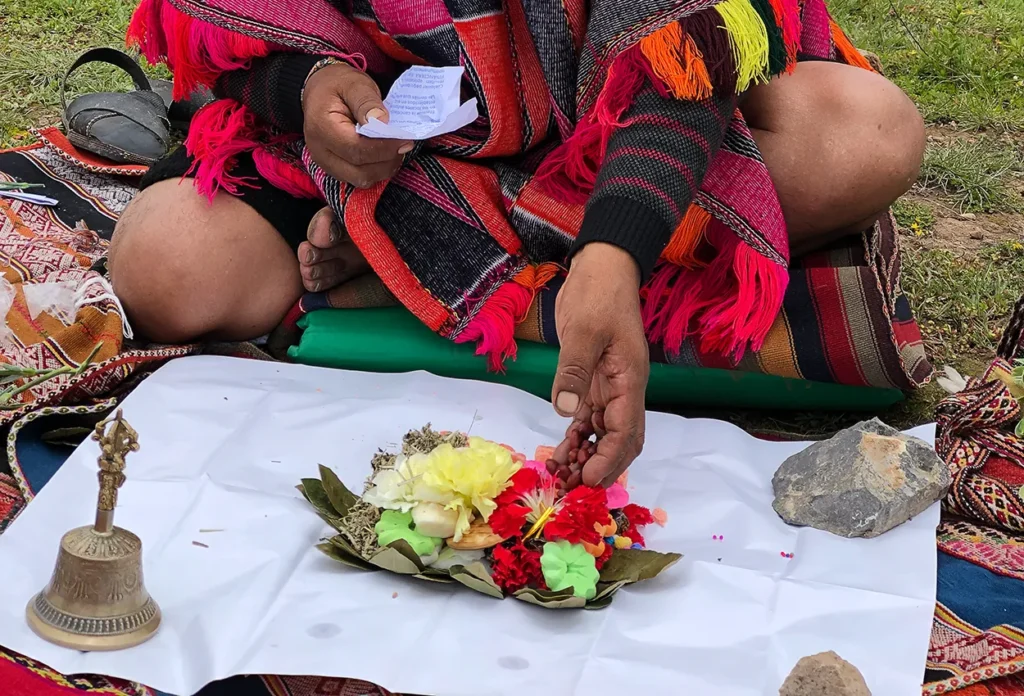
The first time you see a despacho being built, it looks like someone is arranging a plate of sweets.
There’s sugar. Coloured candies. Bits of foil, wool, tiny stamped tablets, flower petals, what appears to be confetti. If you arrived expecting solemnity, the sheer prettiness of it is disorienting.
Then someone explains that the white sugar underneath everything is snow, that the foil squares are the sun and the moon, that the small grey lump nobody wants to touch is llama fat and it’s the most important thing on the paper after the coca. And the plate of sweets turns out to be a sentence — one that has been written in more or less the same grammar for centuries.
This is a complete guide to despacho ceremony ingredients: every element you’re likely to see, what it carries, how the bundle is assembled, the main types of despacho and what each is for, and why it ends in fire, earth or water. It’s also honest about the thing most guides skip — that there is no single fixed recipe, and anyone who tells you there is has never watched two paqos work.
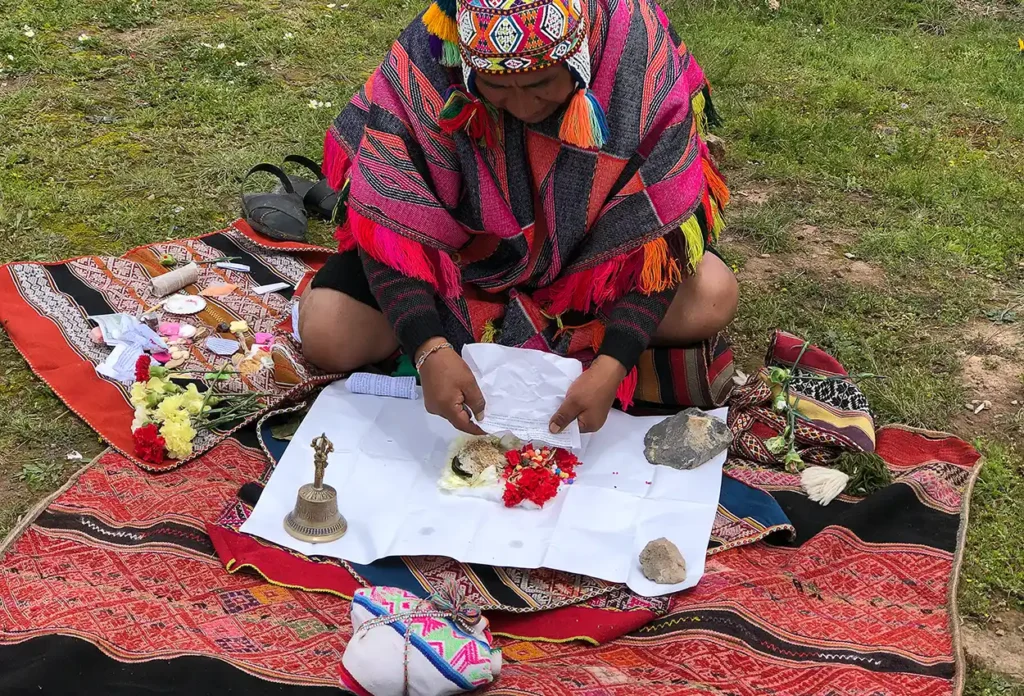
Table of Contents
What a Despacho Actually Is
A despacho is an offering bundle: a sheet of paper on which dozens of small elements are arranged with intention, then wrapped, then given — to fire, to the ground, or to water.
The Quechua is hayway, to offer or hand over, from which comes haywarisqa and haywakuy, the act of making the offering. In the Cusco region you’ll also hear pago a la tierra — payment to the earth — which captures something the English word “offering” misses. This is a transaction, not a gift.
That distinction is everything. Andean practice runs on ayni, reciprocity: the understanding that everything exists in an exchange of giving and receiving. You have eaten from this ground. You have drunk this water and sheltered under these mountains. Something is owed, and the despacho is how it’s paid. Our overview of Andean rituals sets out how completely this principle governs the rest.
So a despacho is not a spell. It does not compel anything. It is not a wish sent upward in the hope that someone is listening. It’s closer to settling a bill with a neighbour you will be living beside for the rest of your life.
The First Honest Thing: There Is No Single Recipe
Before the element-by-element list, the caveat that makes the list usable.
Despacho practice is not standardised. Serious practitioners are explicit about this: there are hundreds of types of despacho, because there are hundreds of reasons to make one, and no central authority ever fixed the grammar. Two paqos from villages an hour apart will build differently.
Some meanings are genuinely personal. Experienced practitioners will tell you that the same object can carry opposite meanings for different people — and that what matters is the intention it’s infused with, not a dictionary entry. Paqos develop signature styles the way cooks do; people who have watched a particular master work can often recognise their despachos on sight.
But a stable core exists. Coca, llama fat, shell, sugar, wool, seeds, flowers and metallic foil turn up in the overwhelming majority of despachos across the Cusco region, and their broad associations are consistent enough to describe honestly.
Read what follows as a working vocabulary rather than a codebook. If the master in front of you does something different, they aren’t wrong — you’re watching a living tradition rather than a reconstruction.
The Base and the Frame
White paper
Nearly every despacho begins on a sheet of white paper, often plain, sometimes with a printed border. It is the ground the world will be built on and, at the end, the wrapping that contains it.
Sugar, and the snow underneath
A layer of white sugar usually goes down first, covering the paper. It reads as snow on the peaks — the high, pure ground the Apus occupy — and as sweetness offered to the earth. Everything else is arranged on top of it.
Building outward from the centre
The arrangement is broadly mandala-like: a centre, and elements radiating from it. Where things sit matters. A loose, open spread carries a different quality from a tight cluster at the middle, and paqos read their own layouts as they build.
The bundle is also oriented. It faces the Apus of the local horizon — which mountains depends entirely on where you’re standing, and is one of the reasons a despacho made in Chinchero is not interchangeable with one made in Puno.
The Despacho Ceremony Ingredients, Element by Element
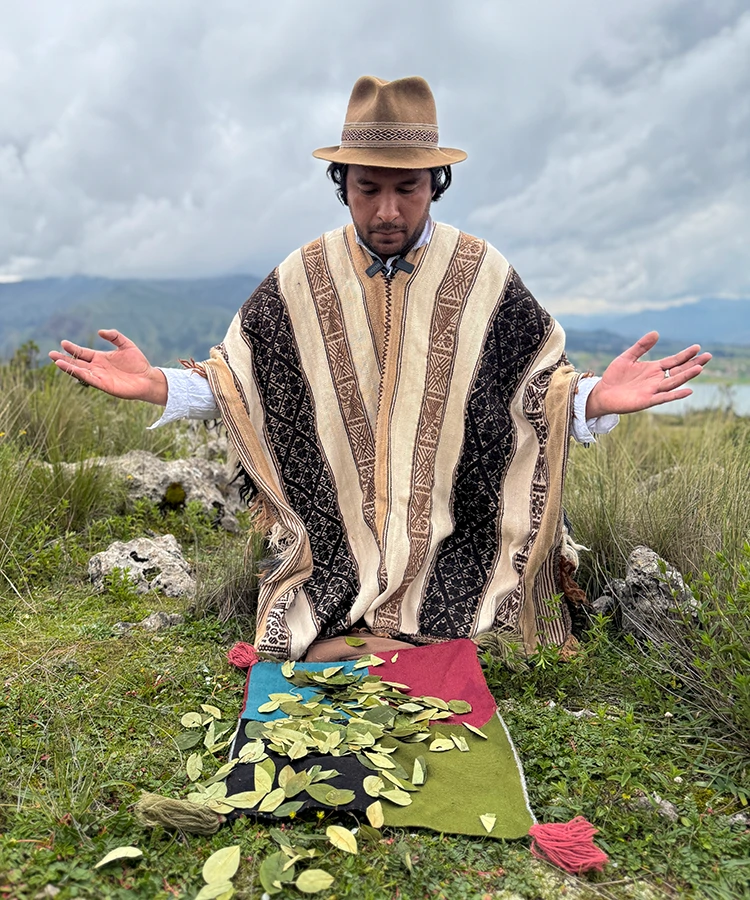
K’intu — three coca leaves
The heart of the entire practice, and the element everything else is arranged around.
A k’intu is three whole, unbroken coca leaves held together with their glossy faces up and stems aligned. Three, because of the three worlds: Hanan Pacha above, Kay Pacha here, Ukhu Pacha within.
Each person present takes a k’intu, holds it to their mouth, and blows their prayer into it — phukuy, the ritual breath. The leaves are then handed to the paqo, who places them into the despacho. Coca is understood to accept prayers unconditionally, without judging what’s in them.
Everything after this point is arrangement around the prayers already placed. If you take part in a despacho, this is the moment you actually participate. Our article on coca leaf reading covers the same leaf in its divinatory role.
Untu — llama fat
A pale, waxy lump of llama fat, sometimes specifically heart fat.
This is the element visitors most often flinch at and the one many paqos consider indispensable. It represents pure, dense life energy — the concentrated vitality of an animal that sustains Andean life at altitude. Nothing else in the bundle carries that particular weight.
It’s often placed centrally, and in some traditions the paqo shapes it or presses elements into it.
Mullu — the Spondylus shell
If one ingredient deserves its own paragraph, it’s this one.
Mullu is Spondylus, the spiny oyster, and it does not come from Peru. It grows in the warm coastal waters of Ecuador and Colombia, and for at least three thousand years it was carried down into the Andes along trade routes that ran for thousands of kilometres. Pre-Hispanic societies valued it comparably to gold — a merchant class grew up around moving it — and it travelled as far north as Mexico and deep into the central Andes.
Think about what that means for a moment. Communities living at 4,000 metres, in a landscape with no ocean anywhere near it, considered a warm-water shell among the most valuable substances they could obtain, and gave it to the ground.
Mullu carries water, the ocean, fertility and the divine feminine. Its deep red-orange colour matters. Today most despachos use small pieces or fragments; whole shells are expensive and, given Spondylus populations, increasingly a conservation question.
Other shells and starfish
Alongside or instead of mullu: small seashells, sometimes a dried starfish. These address Mama Cocha, mother of the waters, and the general principle of water in a landscape where its arrival or failure decides everything. The starfish also carries navigation and orientation — finding your way.
Q’aytu — coloured wool threads
Short lengths of spun wool in bright colours, often laid in pairs or bundles.
Wool is the material of Andean life: alpaca and llama fibre clothe people, and the weaving of Chinchero carries cosmology in pattern. In the despacho the threads bind and connect — relationships, commitments, the tie between the person and the spirit being addressed. The colours together evoke the rainbow, which in Andean understanding is a bridge between worlds rather than a weather phenomenon. Chinchero is known as the birthplace of the rainbow, which is not incidental to why the weaving there matters.
Qori and qolqe — gold and silver foil
Two small squares of metallic paper, gold and silver.
Qori is gold: the sun, Inti, the masculine principle. Qolqe is silver: the moon, Mama Killa, the feminine. Placed together they establish the pair that everything else sits inside — the Andean world is organised by complementary pairs far more than by hierarchies.
They also, straightforwardly, represent material abundance. Both readings are held at once and nobody finds this contradictory.
Flowers — red and white carnations
Petals, usually pulled from carnations, scattered or arranged in patterns.
Red and white together carry the feminine and masculine principles again. Beyond that, flowers are beauty offered for its own sake — the recognition that an offering should be lovely, not merely correct. Some paqos build elaborate petal patterns; others scatter.
Seeds and grains
Quinoa, maize kernels in several colours, beans, sometimes rice or wheat.
These are intention as planting. You are putting seed into an offering that will go into the ground, in a culture whose entire year turns on whether seed becomes food. Maize in particular is the sacred crop of the Andes.
Beans commonly carry prosperity; different-coloured maize carries the diversity of what’s hoped for.
Sugar, sweets and chocolate
Coloured candies, sugar figures, and often a piece or square of chocolate.
The sweetness of life, offered so that life stays sweet. Chocolate is frequently designated for Pachamama specifically. This is the layer that makes a despacho look like a children’s party from a distance, and there is no irony in it — the tradition is not solemn about pleasure.
The misterios — stamped sugar tablets
Small pressed tablets, usually white sugar, stamped or painted with images: a house, a car, a cow, a couple, tools, a heart, a book.
Bought by the sheet in the ritual sections of Andean markets — the San Pedro market in Cusco has whole stalls of them — these are the most literal elements in the bundle. A house tablet is a house. Someone hoping for a child, a recovery, a safe journey or a business will have the corresponding tablet placed in. Purists sometimes look down on them as modern and commercial. They’ve been in use for generations, they’re used by the same masters who use everything else here, and they’re where the specific human requests actually live.
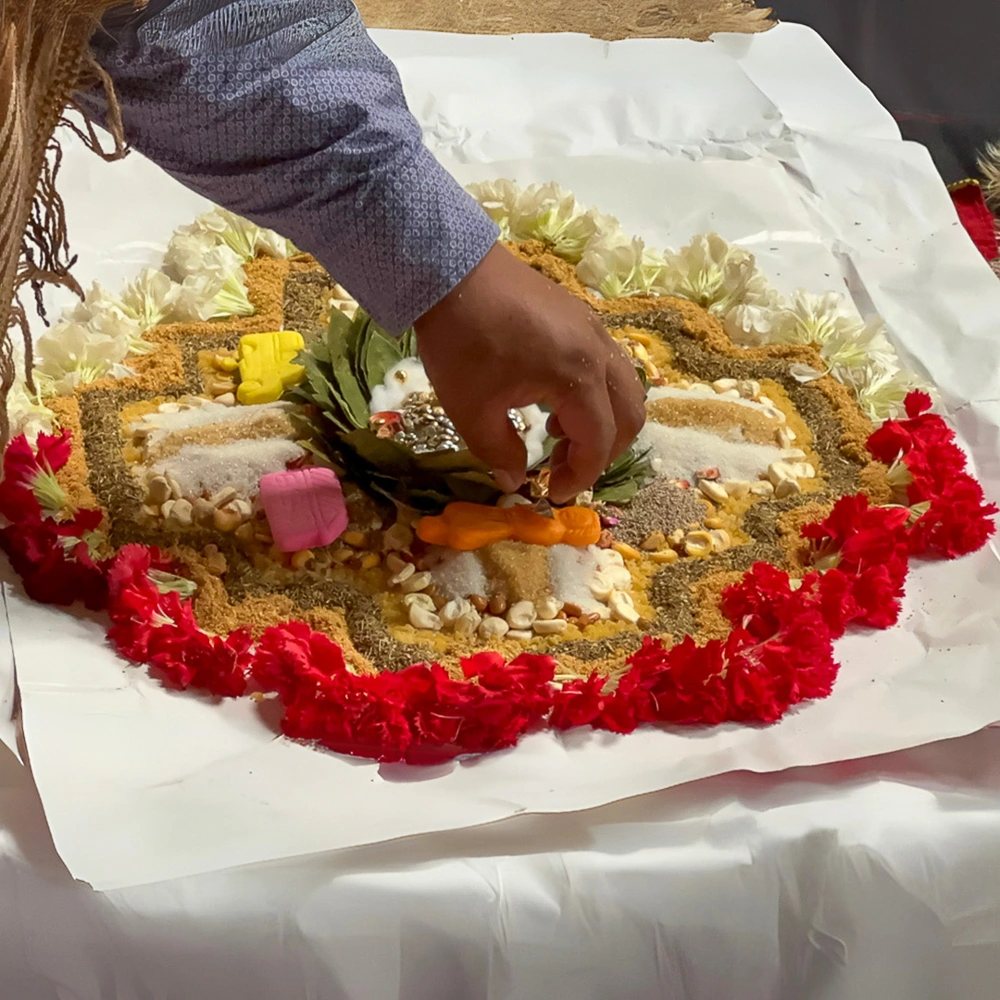
Huayruro seeds
Small hard seeds, brilliant red with a black patch, from a jungle tree.
Widely used across Peru for protection and good fortune, and worn as beads as well as offered. In a despacho they carry protection, luck, and — because the seed pairs red and black — another instance of the complementary duality that runs through everything.
Cotton
A tuft of raw cotton, sometimes shaped.
Clouds. Sometimes snow. The rain that has to come in September, in a landscape that lives or dies on it.
Star anise
The dried star-shaped pod, placed whole.
Stars, the night sky, and the celestial order the Andean calendar is read from. Small silver or gold star-shaped candies sometimes stand in.
Wine and chicha
Poured rather than placed — over the bundle, onto the ground, or both, and often shared with everyone present before or after.
Chicha de jora, fermented maize beer, is the traditional drink and the traditional libation. Wine appears through colonial contact and is entirely naturalised. Pachamama is thirsty as well as hungry, and a dry offering is an incomplete one.
Salt
A small amount, for cleansing and preservation.
The cross
Many despachos in the Cusco region include a small cross, or elements arranged in a cross.
This is genuine syncretism rather than decoration. Andean practice has coexisted with Catholicism for five centuries and the two are woven together in ways that are not experienced as contradictory by the people practising them. Ask a family in Chinchero whether they’re Catholic and the answer is usually yes, without hesitation, while the despacho is being built.
Play money and small paper notes
Miniature banknotes, sometimes real small-denomination coins.
Abundance and material sufficiency, requested plainly. Like the misterios, occasionally sniffed at by outsiders and entirely normal in practice.
And whatever you bring
Many paqos will incorporate something personal: a photograph, a strand of hair, a small object, a written note. If there’s something you want in the bundle, ask beforehand rather than during.
Types of Despacho
There are, genuinely, hundreds. These are the ones you’re most likely to encounter named.
Ayni despacho
The reciprocity offering — gratitude and the balancing of exchange. This is the everyday despacho, the one made in August for Pachamama Raymi, the one built at weddings and departures and beginnings. Built in a spirit of celebration rather than gravity.
Kuti despacho
Kuti means to turn back or return. This despacho reverses and removes — heaviness, obstruction, misfortune, the energy the tradition calls hucha. It sends back what doesn’t belong to you.
Kuti despachos are typically burned, and burned in a fire built for the purpose. They are also usually built differently: fewer sweet elements, different colours, a different intent in the arrangement.
Chuya despacho
From ch’uya, clear or pure. A cleansing offering, made to clarify a person, a household, a herd or a piece of land. Often the one requested when something feels stagnant rather than actively wrong.
The line between kuti and chuya is drawn differently by different lineages — some treat them as one family, some as distinct. Don’t be surprised by variation.
Aya despacho
Aya concerns the dead. Built to accompany a soul, layered with rainbow colours over black, understood as a bridge from this world upward. Not made casually.
And the rest
Despachos for a new house, a journey, a marriage, a business, a herd of alpacas, an illness, a reconciliation, the opening of a road. The category is as wide as the reasons people have for needing to set something right. Our Pachamama offering in Chinchero is an ayni despacho by default, and can be shaped to a different intention if you tell us in advance.
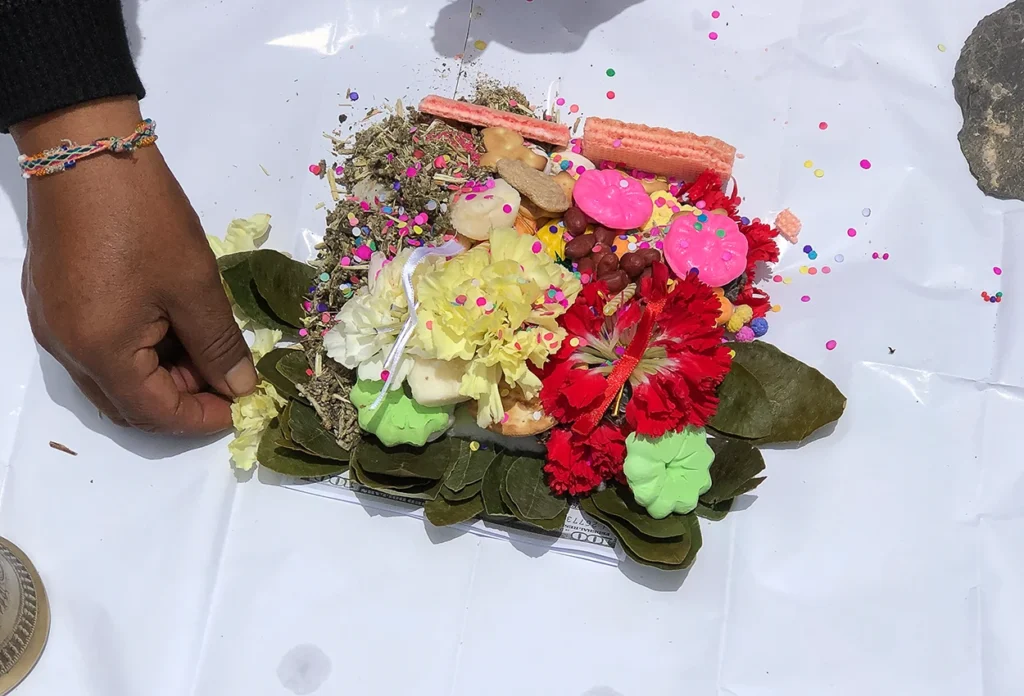
How the Bundle Is Built
The sequence, as it usually runs.
Opening. The paqo establishes the space, praying in Quechua and calling the Apus of the local horizon and Pachamama by name. This is not preamble.
The base. Paper down, sugar spread.
The k’intus. Everyone present receives three leaves, forms a k’intu, and blows their prayer into it. The paqo takes them, adds their own, and places them.
Building. Elements go on in order, each named and often prayed over as it’s placed. This takes time — an hour is not unusual — and the pace is part of the thing. Watching it hurried is a bad sign.
The blessing. Everyone present holds their hands over the finished bundle and gives it whatever they’ve got.
Wrapping. The paper is folded closed in a particular sequence and tied. It is now a single object rather than a collection.
Cleansing. In many traditions the wrapped bundle is passed over the bodies of everyone present, head to foot, gathering up whatever it’s meant to take away.
Delivery. And then it’s given.
Fire, Earth or Water
Three destinations, and the paqo chooses based on the offering and what’s needed. The most useful way to understand the difference is speed of transformation.
Fire — immediate. The bundle is burned, usually in a fire built for it, and the transformation is instant and total. Kuti despachos almost always go to fire. Around Cusco, burning is the most common finish generally. Some traditions read the smoke and the way the bundle takes; some hold that everyone present should watch it burn all the way down rather than turning away.
Water — flowing, gentler. Given to a river, a spring or a lake, and carried away. A softer release, appropriate when something needs to move on rather than be destroyed.
Earth — slowest. Buried, sometimes in a clay pot, in a hole opened in the ground. This is the classic August delivery, where the offering is food placed into a mouth. The transformation takes as long as decomposition takes, which is exactly the point. What never happens: the bundle is not kept, not displayed, not taken home, not photographed as a souvenir once complete. An undelivered despacho is an unfinished one.
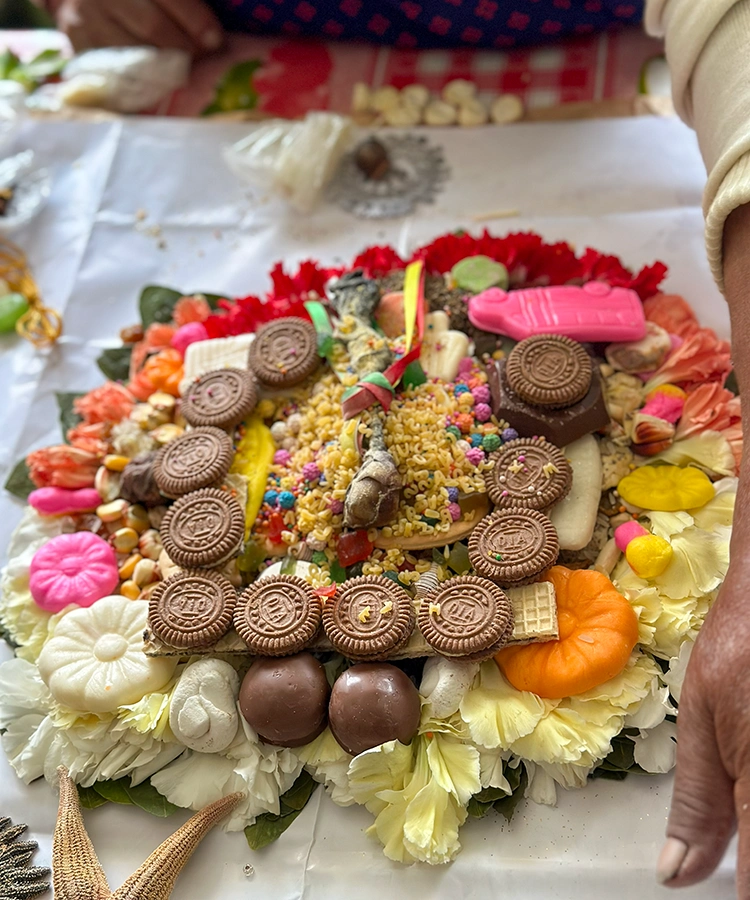
Where the Elements Come From
Worth knowing, because it changes how you see the bundle.
Almost nothing in a despacho is gathered by the paqo personally. The elements are bought, and they’re bought in a specific place: the ritual sections of Andean markets. In Cusco that’s the San Pedro market, where a run of stalls sells nothing else — sheets of stamped sugar tablets, bags of huayruro, coils of dyed wool, foil squares, dried starfish, blocks of untu, packets of mixed seeds, and pre-assembled kits for people who want the standard set.
The women who run these stalls are not incidental to the tradition. They know what each practitioner buys, they know what a kuti despacho needs versus an ayni one, and in practice they’re a repository of the knowledge as much as anyone. It’s one of the more quietly interesting corners of Cusco to walk through, and considerably more informative than most guided tours of the city.
Costs are modest for most elements and less so for two: mullu, because Spondylus has to come from the Ecuadorian coast and good pieces aren’t cheap, and untu, which fluctuates. A full set for a substantial despacho runs to something between a modest and a moderate amount of money — not trivial for a rural family, which is part of why the offering counts.
And prices climb in August. Every household in the region is buying at once. If you’re arranging a ceremony in the first week of the month, that’s one more reason the paqos are busy and the lead times are long.
What a Paqo Does — and Doesn’t
Does: establish sacred space; know which Apus to name from that specific spot; select and arrange elements according to intent; hold the ceremony’s pace; decide the manner of delivery; carry a mesa, the bundle of khuyas and sacred objects accumulated across a working life.
Doesn’t: guarantee outcomes; sell protection from curses; charge escalating fees for increasingly powerful versions; work faster because you have a flight.
That third one deserves emphasis. If anyone tells you that you’re cursed and that a more expensive despacho will lift it, you are being worked. It isn’t the tradition. Leave.
The deeper relationship between a practitioner and their mesa — how it’s built, what lives in it, why it takes decades — is the subject of our mesa retreat, which is where people go when watching a despacho stops being enough.
Taking Part Without Appropriating It
Direct, because the line is real and easy to cross with good intentions.
Don’t build one yourself after watching one. The elements are for sale at the San Pedro market and nobody will stop you. But assembling a despacho because you saw it done is exactly the superficial appropriation the tradition’s carriers object to. The knowledge is the paqo’s, held through a lineage, and it isn’t transferred by observation.
Do participate fully in the parts that are yours. The k’intu and the prayer blown into it are genuinely yours. Take that seriously.
Ask before photographing. Every time, and particularly at the burning.
Don’t step over the bundle. Walk around.
Don’t take anything from it. Not a petal, not a shell.
Contribute. Payment to the paqo is normal and correct; ayni applies to your relationship with them too.
Be quiet while it’s being built. Questions afterwards. The silence is part of the construction.
And don’t ask what each item “means” mid-ceremony. That’s what this article is for. Read it beforehand and watch properly on the day.
Frequently Asked Questions
What is a despacho?
An Andean offering bundle: elements arranged with intention on paper, wrapped, and given to fire, earth or water as payment within the reciprocal relationship of ayni.
What are the main despacho ceremony ingredients?
Coca k’intus, llama fat, mullu shell, white sugar, coloured wool, gold and silver foil, flower petals, seeds and grains, sweets, stamped sugar tablets, huayruro seeds, cotton, star anise, wine or chicha, and often a cross.
What does haywarisqa mean?
It comes from hayway, to offer or hand over — the act of making the offering. Pago a la tierra, payment to the earth, is the common Spanish equivalent.
Why llama fat?
It carries concentrated life energy, and in the high Andes the llama is the animal that makes life possible. Many paqos consider it essential.
What is mullu?
Spondylus, a spiny oyster from the warm waters of Ecuador and Colombia, traded into the Andes for millennia and valued comparably to gold. It represents water, fertility and the feminine.
Is a despacho burned or buried?
Both are traditional, and water is a third option. Fire transforms immediately, water releases gently, earth transforms slowly. The paqo decides.
How long does a despacho ceremony take?
Two to three hours, with the building alone often taking an hour. Our Pachamama offering in Chinchero runs to that length.
Can I make my own despacho at home?
Not meaningfully, and it isn’t recommended. The knowledge belongs to the practitioners who carry it. Sit with a paqo instead.
Can I put something personal in it?
Usually yes — ask beforehand rather than during.
Do the ingredients mean the same everywhere?
No. There’s a stable core, but practice varies by lineage, region and individual, and some meanings are personal to the practitioner.
Do I have to believe in it?
No. Attend respectfully and let it be what it is. Nobody will ask you what you believe.
Why the Plate of Sweets Is Not a Plate of Sweets
The thing that stays with most people isn’t any single element. It’s the scale of what’s being represented on one sheet of paper.
The sun and the moon. Snow on the peaks. A shell carried a thousand miles from an ocean nobody in the room has seen. Seeds from the fields below. Wool from animals grazing on the hill. The rainbow. The dead. The specific mountains on the horizon, named aloud. And in the middle of all of it, three leaves someone breathed a private hope into.
Then it’s wrapped, and burned, and gone in about four minutes.
That’s the part visitors find hardest and the part that matters most. Nothing is kept. The whole thing exists to be given away — which is, when you get down to it, the entire argument the Andes have been making for a very long time.
If you want to see one built properly, our despacho offering in Chinchero runs two to three hours with masters of the Rainbow Lineage, and can be arranged as part of a longer Pachamama immersion. Ask us about dates — and if you’re coming in the first week of August, ask early.Practices vary by region, community and lineage; the account here reflects the Cusco region and the tradition of our masters in Chinchero. Peru’s cultural heritage is administered by the Ministerio de Cultura, which maintains the register of national cultural heritage declarations. A despacho is a cultural and spiritual practice and is not a substitute for medical, psychological or financial advice.