Coca Leaf Reading Meaning: How a Paqo Actually Reads the Leaves
 By PumAdventures
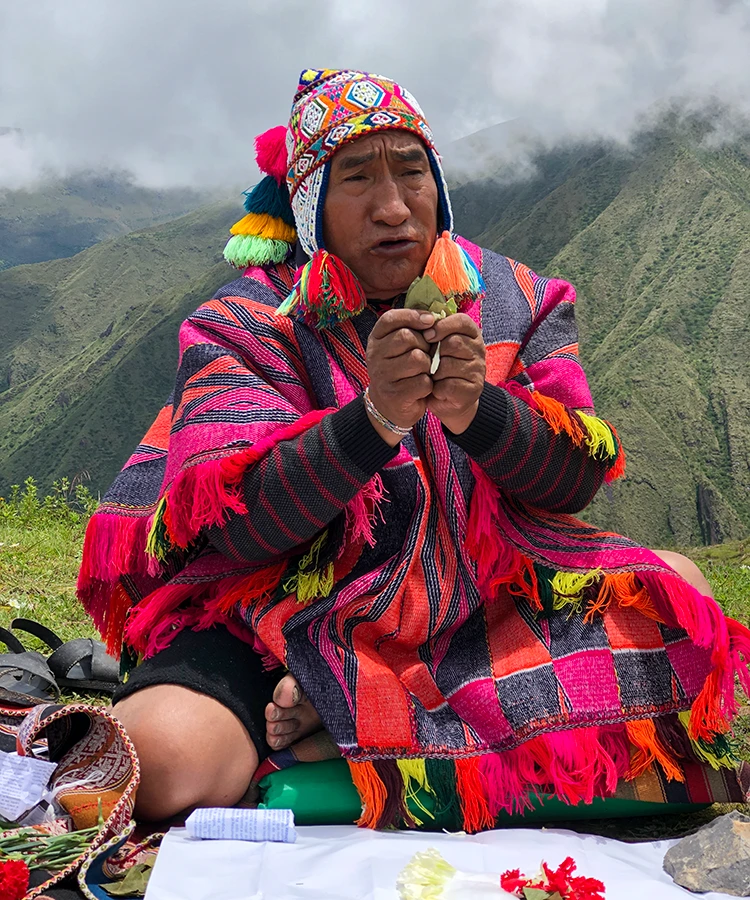
Almost everything published in English about coca leaf reading falls into one of two failures.
The first is vagueness. A well-known Peruvian hotel group describes the practice by saying the shaman observes “the leaves’ shapes and colours” and from this discerns your future, work, family and finances. That’s a description of a result, not an explanation of a method. It tells you nothing.
The second failure is worse: the symbol table. Sites that publish tidy lists — leaf pointing north means travel, torn leaf means betrayal, three leaves together mean a wedding — as though there were a codebook. There isn’t one. Those tables are invented, and they’re copied from each other so often that they’ve started to look like tradition.
This article takes the harder path. It explains what a paqo is actually attending to when the leaves land on the cloth — the elements that genuinely carry coca leaf reading meaning — and it’s equally clear about where interpretation stops being transferable and becomes the work of a specific person in a specific lineage. If you want the history of the coca leaf and its place in Andean cosmology, we cover that separately in our piece on coca leaves as Andean heritage. This one is about the mechanics.
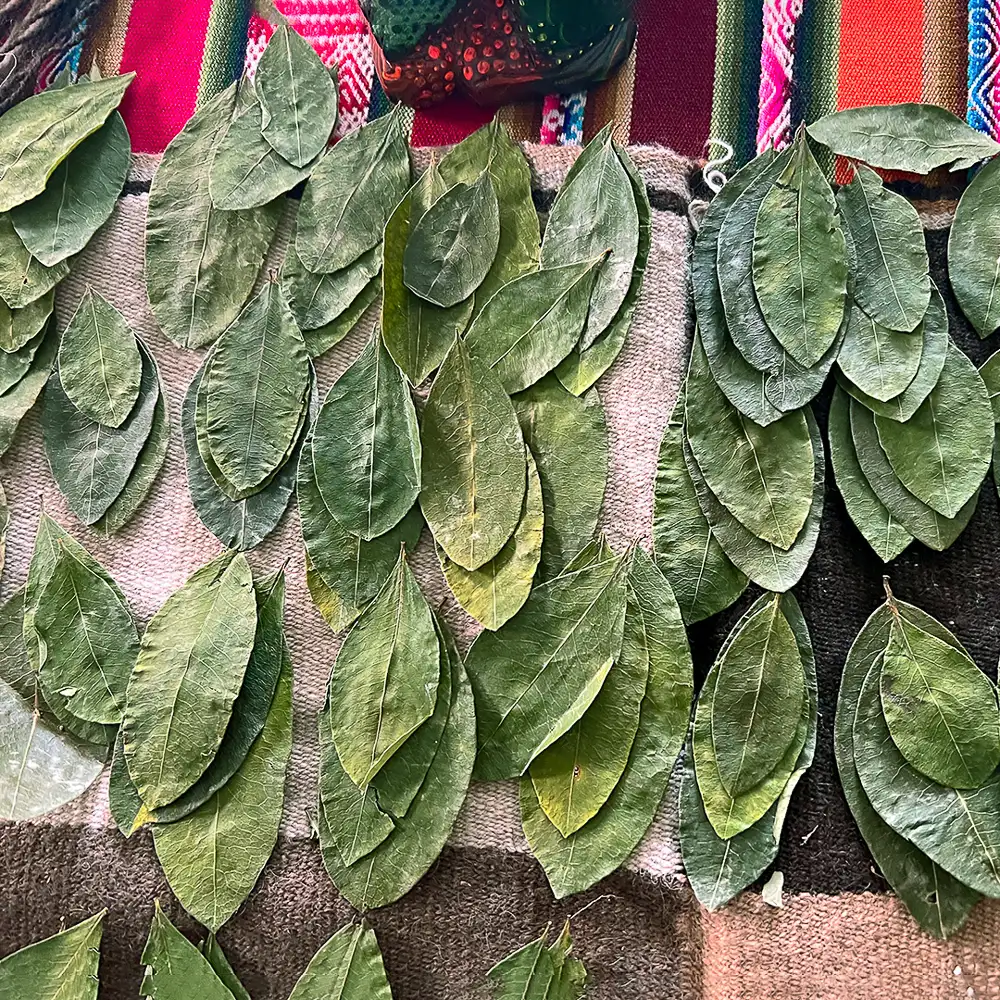
Table of Contents
First, What a Coca Leaf Reading Is Not
It is not tarot with leaves. Tarot has a fixed deck. Every card exists before the reading and carries an established range of meanings that a competent reader can name in advance. Coca has none of that. The leaves are ordinary leaves until they’re in relationship with each other, the cloth, the question and the person asking.
It is not fortune-telling. The Quechua framing is closer to consultation than prediction. You are not being told what will happen; you are being shown the condition of something — a relationship, a decision, a path — as it currently stands, and where the weight sits in it.
It is not a performance with a fixed script. Two paqos reading the same cast will not say identical things, any more than two doctors reading the same scan will write identical notes. They’re looking at the same field and bringing different depth to it.
That variability makes some travellers uneasy, and it shouldn’t. It’s the same variability you accept from any interpretive discipline. What should make you uneasy is the opposite — a reader whose interpretations sound like they were memorised from a website.
Who Is Reading, and Why It Changes Everything
Before the leaves, the reader. This is the part almost no English-language article explains, and it’s the single most useful thing to understand.
Paqo, and the bundle that makes one
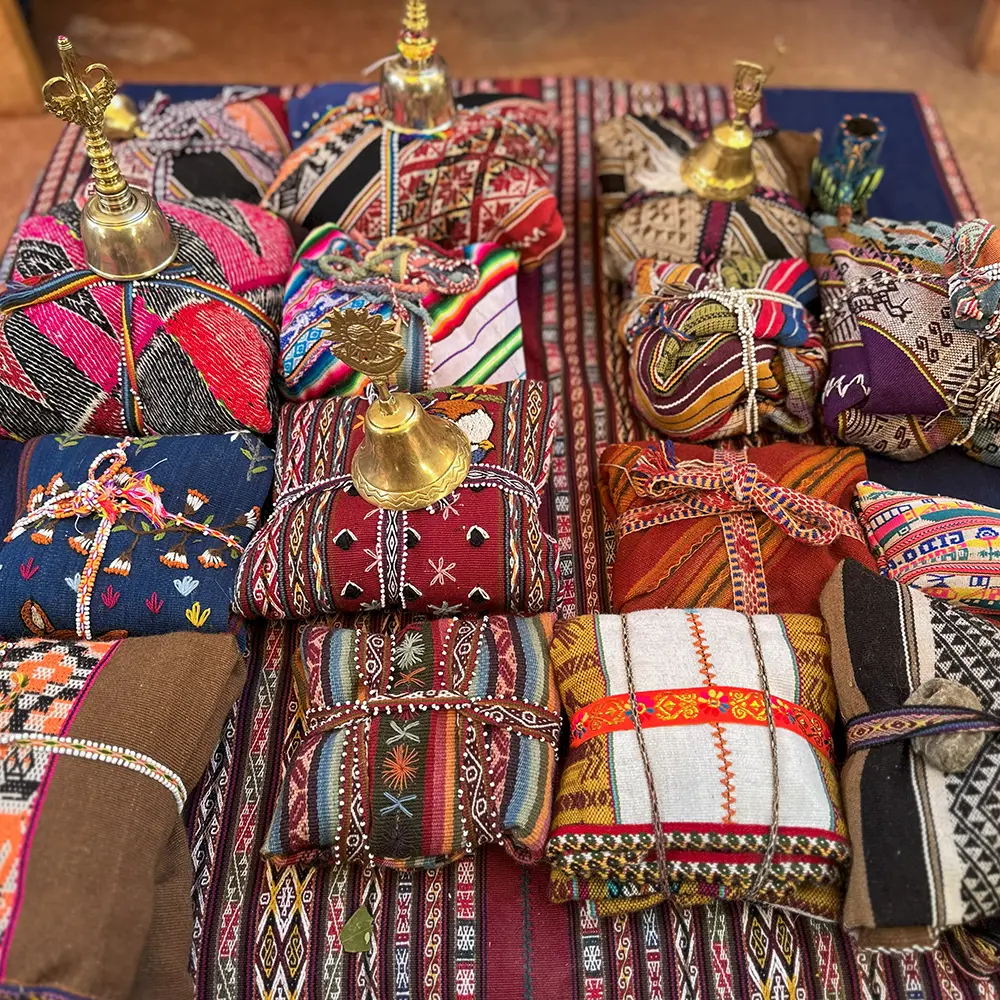
Paqo is the umbrella term for an Andean spiritual practitioner. The word is tied to the mesa — the sacred bundle a practitioner carries, holding khuyas (stones charged with prayer and intention) and other objects gathered over a lifetime of practice. Carrying one makes you mesayoq: one who has a mesa. Our page on what a mesa is goes into what lives inside it. The mesa isn’t decoration. In coca reading it is frequently the working surface, and in some lineages the leaves are cast onto the bundle’s cloth itself.
Pampamisayoq — the earth-level reader
Pampa mesayoq means, roughly, earth-vision practitioner. These are the ritual specialists of everyday Andean life: they conduct despachos, they work with Pachamama, and they perform the great majority of coca readings.
The traditional distinction is that a pampamisayoq communicates indirectly — through the mesa, through the leaves, through dreams. That is not a lesser thing. It is a different mode, and it is the mode coca divination belongs to. Most excellent readings you will ever receive come from a pampamisayoq.
Altomisayoq — the one who speaks with the Apus
Alto mesayoq, high-vision practitioner, also called Hatun Qhawaq — Great Seer. The defining claim is direct communication with spirit beings, particularly the Apus, the mountain intelligences.
Within this level, tradition recognises degrees by the geographic reach of the practitioner’s relationships: ayllu altomisayoq, connected to a local area; llaqta, to a wider region; suyu, to a vast territory and vanishingly rare.
Kuraq akulleq — the elder coca chewer
The highest designation, literally elder coca chewer, reserved for practitioners understood to work with universal rather than territorial forces. There are very few. If a tour operator tells you their reader is one, be sceptical.
What this means when you’re booking
Here is the practical consequence, and it’s worth more than any symbol list.
The title is routinely inflated in the tourist market. “Altomisayoq” appears on booking pages the way “chef’s special” appears on menus. A genuine one is not doing $30 readings for walk-ins on the Plaza de Armas.
Ask three things: who is reading, where they are from, and who they learned from. A real practitioner has a lineage and a village, and answers the question without difficulty. Our masters are from Chinchero, from families that have practised without interruption for generations — you can see the format and pricing openly stated for the same reason we publish everything else openly.
An honest pampamisayoq beats an inflated altomisayoq every time.
What the Paqo Is Actually Looking At
Here is the substance. These are the elements that readers across Andean lineages genuinely attend to. What they mean in any given reading is contextual — that’s the next section — but what is being observed is consistent and describable.
The cloth
The leaves are cast onto a small woven textile — an unkuña (also istalla), the quadrangular hand-woven cloth traditionally used to carry coca. It is not a tablecloth. It is the frame that turns a scatter of leaves into a field with a centre, edges and quadrants.
Everything else on this list is read relative to the cloth. A leaf near the centre and the same leaf at the edge are not the same leaf.
Face or underside
Coca leaves are strongly two-sided: a glossy, deep green upper face and a paler, matte underside with a pronounced central vein.
Whether a leaf lands face up or face down is the most immediately legible signal on the cloth, and readers across lineages attend to it closely. Broadly, the visible face is associated with what is open, conscious, or already in motion; the underside with what is hidden, unresolved, or not yet acknowledged. Broadly is doing real work in that sentence — the specific reading depends on where the leaf sits and what it sits with.
Whole leaves and torn leaves
Before anything is cast, leaves are selected for integrity. In our sessions you choose three whole, unbroken leaves representing mind, body and spirit — the same triad that governs a k’intu.
Damage matters. A leaf that arrives torn, split at the vein, insect-bitten or brittle is not discarded as a flaw; it is information. Rupture in the leaf is generally read as rupture in the matter — something broken, interrupted, or under strain. Where the tear falls on the leaf, and whether it happened before or during the handling, both count.
This is also why readers handle leaves with care that can look excessive. A leaf broken by carelessness contaminates the reading with the reader’s own clumsiness.
Position relative to the centre
Distance from the centre of the cloth is read as proximity — in time, in relevance, or in intimacy. Leaves clustered at the middle tend to concern what is immediate and central to the question. Leaves that land at the margins are read as peripheral, distant, or belonging to someone else’s story.
A leaf that lands off the cloth entirely is significant in most lineages, and rarely in a comfortable way.
The three worlds on the cloth
Andean cosmology divides existence into three pachas: Hanan Pacha, the upper world of spirit and higher perspective; Kay Pacha, the middle world of lived daily reality; and Uku Pacha, the inner or lower world of the unconscious, ancestral pattern and deep transformation.
Many readers map this vertically onto the cloth, treating the far edge, the middle and the near edge as the three registers. Where your leaves fall says which world your question is really living in. People often arrive with what they believe is a practical Kay Pacha problem — a job, a move — and watch the leaves gather in Uku Pacha instead.
We treat the three worlds in more depth in our introduction to Andean oracles.
Groupings and clusters
Individual leaves matter less than the shapes they make together. Readers attend to leaves that land touching, overlapping, or in visible arcs, lines and gaps.
Two leaves touching face to face reads differently from two leaves overlapping with one covering the other. A tight cluster with an isolated leaf at a distance is one of the most commonly noted configurations, and its interpretation depends entirely on what was asked.
Empty space is read too. An area of cloth where nothing landed is not nothing.
Which leaf lies on top
Where leaves overlap, the layering is read as precedence or pressure — what is sitting on top of what, what is being covered, what is holding something else down. This is one of the details most casual descriptions omit entirely, and it’s among the first things an experienced reader looks for.
The direction the tips point
Coca leaves are elongated and pointed, so every leaf has an axis. Readers note where the tips point — toward the person asking, away from them, toward each other, toward a particular Apu on the horizon.
Note what this is not: a compass table. The direction is meaningful relative to the people and mountains present, not to abstract cardinal points. This is exactly the kind of detail the invented symbol tables get wrong, by turning a relational observation into a fixed rule.
The k’intu and the phukuy
Before casting, three perfect leaves are stacked into a k’intu, held with the faces up and the stems together. The person asking breathes into them — phukuy, the ritual blowing of breath — transferring intention into the leaves. This is the moment the reading actually begins. Everything afterwards is interpretation of something you yourself placed there. The k’intu is also the fundamental unit of offering in Andean practice, which is why it appears in the despacho, at the Pachamama offering, and at Andean weddings.

And afterwards — what happens to the leaves
We mentioned above that the leaves aren’t discarded, and that deserves finishing.
Leaves that have carried your breath and your question are no longer generic plant matter. Depending on the reading and the practitioner, they are burned, buried, returned to a spring or river, or folded back into a despacho and offered to Pachamama. What they are not is swept into a bin at the end of the session.
This follows directly from ayni. Something was given to you; something is returned. A practitioner who tips the leaves away in front of you at the end has told you a great deal about how they understand what just happened — and it’s worth noticing, because it’s the easiest tell there is.
Why There Is No Universal Symbol Dictionary
Now the honest part, and the reason this article can’t give you a lookup table.
Interpretation is lineage-specific. A pampamisayoq from Chinchero, a Q’ero paqo from the high communities of Paucartambo and a reader from the Lake Titicaca region are all working within Andean tradition and will not read the same cast identically. Their teachers differed. Their mountains differ. This is normal in oral traditions and it is not a defect.
The reader reads a field, not a token. No competent paqo looks at a single leaf and produces a meaning. What produces meaning is the whole configuration — orientation, position, grouping, layering, damage, emptiness — held against the question and against the person in front of them. Isolating one element and assigning it a fixed meaning is like reading one word of a sentence.
The framing is energetic, not predictive. Andean practice describes a living energy, kawsay, running through everything, and distinguishes between sami — light, refined, well-flowing energy — and hucha, heavy or incoherent energy. Note that hucha is not evil; it’s dense, stuck, unmetabolised. A reading is largely an assessment of where sami is moving freely in your situation and where hucha has collected. Our overview of the Andean healing world sets out this framework.
And the relationship is reciprocal. Ayni — sacred reciprocity — governs the whole practice. You are not extracting data from a plant. You are entering an exchange, which is why offerings, gratitude and payment to the earth are inseparable from the reading rather than decoration around it.
Any website offering you a definitive coca symbol dictionary is selling certainty that the tradition itself does not claim.
Coca Leaf Reading Meaning in Practice: How a Session Actually Runs
The structure below is ours, in Chinchero. The sequence varies between practitioners; the shape rarely does.
Opening and cleansing. The master prays in Quechua, calling the Apus and Pachamama into the space. This is not a preamble to get through. It establishes who is present.
Intention. You hold your question — clearly, in your own language, silently. This is where most readings are won or lost. A muddy question produces a muddy cast.
Selection. You choose three whole, unbroken leaves yourself. Not the master. The choosing is part of it.
Breath. The k’intu is formed and you breathe your intention into it.
Casting. The leaves are released onto the unkuña. Nobody arranges them.
Reading. The master works through the field — orientation, distance, grouping, layering, what’s face up, what’s torn, where nothing landed. Interpretation is spoken in Quechua and translated by a guide working across Quechua, Spanish and English. A session runs about an hour.
Questions. You can and should ask follow-ups. A reading is a conversation, not a verdict delivered from a height.
Closing. Gratitude to Mama Coca, the Apus and Pachamama. The leaves are not thrown away.
A note on the translation: if you can’t follow what’s being said over you, you haven’t had a reading, you’ve watched one. Insist on a translator whose only job is that.
What the Leaves Cannot Tell You
We’d rather say this before you book than have you feel short-changed afterwards.
Dates. The leaves do not produce calendars. A reader who tells you in March is improvising.
Numbers. No lottery numbers, no salary figures, no how-many-children. Any tradition that starts producing numbers has left divination and entered entertainment.
Death. A reputable paqo will not predict anyone’s death, yours or another person’s. If a reader raises this, particularly alongside an offer to remove a curse for a fee, leave.
Medical diagnosis. The reading is not a health assessment and carries no clinical standing. If something in it concerns you about your health, see a doctor. Andean practitioners of good faith say this themselves.
Other people’s private business. Readings about a third party — what your partner is secretly doing, what a rival intends — are generally discouraged. The tradition treats the question as belonging to the person who asks it.
Certainty. A reading shows condition and tendency, not fixed outcome. If it worked the other way, ayni would be meaningless: nothing you did afterwards would matter.
A last honest note. Anyone who follows a reading by telling you that you’re cursed and that they can lift it for an additional payment is running a well-worn confidence trick. It is not part of the tradition. Walk away and say so publicly.
How to Ask a Question the Leaves Can Answer
The single biggest variable in the quality of a reading is the quality of the question, and almost nobody prepares.
Closed questions produce thin readings. Will I get the job? has two possible answers and the leaves aren’t a coin.
Open questions produce rich ones. What am I not seeing about this work I’m considering? gives the field something to be about.
Some that consistently work well:
- What is asking for my attention right now that I’ve been avoiding?
- What is the condition of this relationship, honestly?
- What would I need to release to move toward this decision?
- What am I carrying that isn’t mine?
- Where is my energy going that I’m not aware of?
Bring two or three, written down. In a session at 3,760 metres, with a translator working between three languages, people forget what they came to ask. It happens constantly.
And come with a real question. Testing the reader with something you already know the answer to wastes an hour that could have been useful.
Frequently Asked Questions
What does a coca leaf reading actually mean?
It’s an assessment of the condition of your situation — where energy is flowing and where it’s stuck — read from how leaves land on a woven cloth. It is consultation rather than prediction.
How does coca leaf reading work?
You choose three whole leaves, breathe your intention into them as a k’intu, and they’re cast onto an unkuña. The paqo reads orientation, position relative to the centre, groupings, overlapping, damage and empty space as a single field.
Do specific coca leaf symbols have fixed meanings?
No. Readers attend to consistent elements, but interpretation is lineage-specific and contextual. Published symbol dictionaries are inventions.
What’s the difference between a pampamisayoq and an altomisayoq?
A pampamisayoq works with earth-level forces and communicates indirectly through the mesa, leaves and dreams — the mode coca reading belongs to. An altomisayoq is understood to communicate directly with the Apus. The title is often inflated for tourists.
Does the leaf landing face down mean bad news?
Not in itself. It generally points to what’s hidden or unacknowledged rather than what’s negative, and it only means anything in combination with everything else on the cloth.
Can the leaves predict when something will happen?
No. Dates and numbers are outside what the tradition claims.
Is coca leaf reading psychoactive?
No. Chewing coca is mildly stimulating, like strong tea, and helps with altitude. The reading itself involves no altered state for you at all.
Can I have a reading in English?
Yes. Our masters work in Quechua with a guide translating into English or Spanish throughout.
Can it be done remotely?
Yes — we offer readings over video for people who can’t travel. The leaves are cast in Chinchero while you’re present on the call.
How long does a reading take and what does it cost?
About an hour, from $70 per person. Full details on our coca leaf reading page.
Why We Wrote This the Hard Way
It would have been easier to publish a symbol table. They perform well, people share them, and nobody writes in to complain that leaf-tip-north doesn’t really mean travel.
But the tradition our masters carry is more interesting than a lookup table and considerably more useful. It reads relationship rather than tokens, it produces condition rather than prophecy, and it is honest about the limits of what a plant can tell you about next March.
If you sit down in Chinchero having understood the elements described here, you’ll follow what the master is doing while they do it — which is a completely different experience from being handed conclusions.
Book a reading, or ask us anything first. Both are fine. Come with a real question either way.Coca leaf reading is a traditional Andean practice of cultural and spiritual significance. Traditional uses of the coca leaf are recognised within Peru’s national cultural heritage framework, and Andean ritual traditions appear among Peru’s UNESCO intangible cultural heritage elements. A reading is not medical, psychological, legal or financial advice, and should not be used in place of professional consultation. Terminology and interpretation vary between lineages; the practice described here follows the tradition of our masters in Chinchero.