What to Ask in a Coca Leaf Reading: 20 Questions That Work
 By PumAdventures
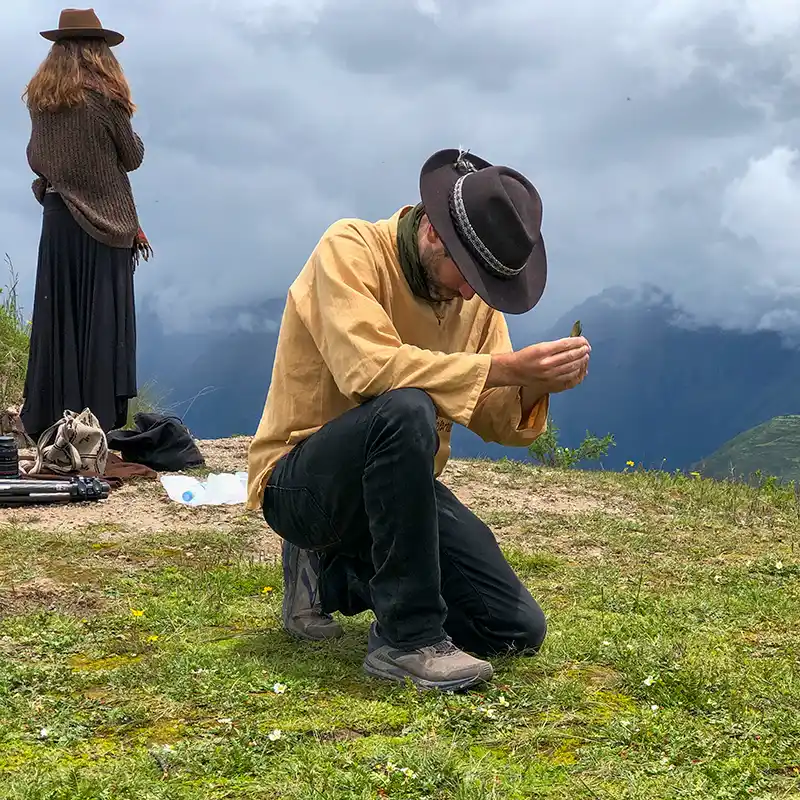
The hour goes faster than anyone expects.
You’re at 3,760 metres, slightly short of breath. The master is speaking Quechua and a guide is translating into English, which halves the words that reach you. You’ve been thinking about this session for weeks, and about four minutes in you realise you have no idea what you actually came to ask.
We’ve watched it happen many times. It is the single most common way a coca leaf reading goes thin — not a weak reader, not an off day, just a question that was never really formed.
So this is the preparation article. Twenty questions to ask in a coca leaf reading, sorted by what they’re for, with a note on why each one works. Then the questions that reliably waste your hour, and how to rewrite them. If you want to understand the mechanics of the reading itself — what the paqo is looking at when the leaves land — that’s a separate piece on coca leaf reading meaning. This one is purely about what comes out of your mouth.
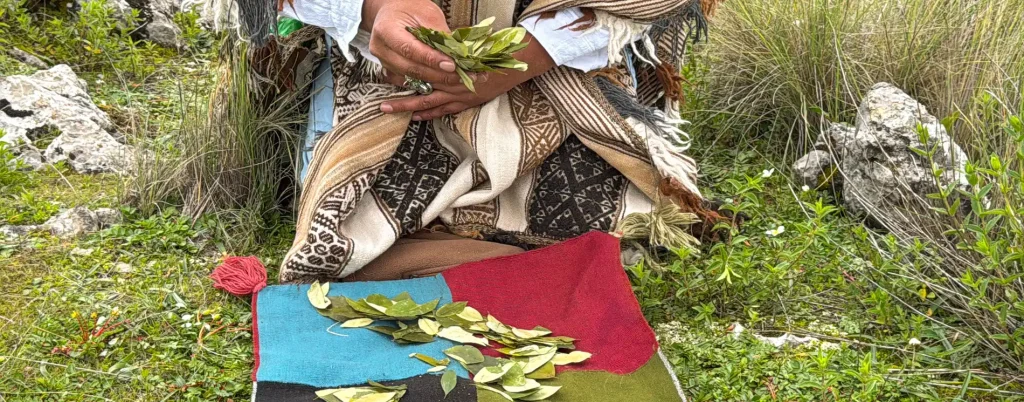
Table of Contents
Why the Question Matters More Than the Reader
A coca reading works by giving a field something to be about. The leaves land, the paqo reads position, orientation, grouping and damage — but all of that is read against what was asked. Change the question and the same cast means something different.
Which leads to an uncomfortable truth: a mediocre question given to an excellent paqo produces a mediocre reading. The reverse isn’t true nearly as often. A sharp, honest question tends to produce something useful even from a modest reader, because the question itself has already done half the work of locating what matters.
There’s a second reason to prepare. Andean practice runs on ayni, reciprocity. You’re not extracting information; you’re entering an exchange. Arriving with nothing to offer — no clarity, no real question, just “tell me about my future” — is a thin contribution to a two-sided thing.
The One Rule: Ask About Condition and Path, Not Outcome
Nearly every good question in this article follows the same shape. It asks what is and what is needed, not what will happen.
That isn’t a limitation invented for convenience. It’s what the tradition actually claims to see. The leaves show the condition of a situation — where energy moves freely and where it has collected and gone heavy — and the paths available from there. They do not produce fixed outcomes, because in a worldview built on reciprocity, what you do next has to matter.
Here’s the same instinct, rewritten:
| Instead of asking | Ask |
| Will I get the job? | What am I not seeing about this role? |
| Is he the one? | What is the honest condition of this relationship? |
| Should I move to Peru? | What would I be moving toward, and what away from? |
| When will I meet someone? | What in me is not yet available for a relationship? |
| Will the business succeed? | Where is the weakness in what I’m building? |
| Am I making the right choice? | What am I afraid of in each direction? |
| Will I be happy? | What is standing between me and contentment right now? |
| Does she still love me? | What is mine to carry in this, and what isn’t? |
Read the right-hand column aloud. Every one of them is answerable in a way the left-hand column isn’t — and every one of them would still be useful even if you never sat down with a paqo at all.
The Twenty Questions to Ask in a Coca Leaf Reading
Bring two or three of these, not twenty. The list is a menu.

Direction and life path
1. What is asking for my attention right now that I’ve been avoiding? The strongest opening question there is. It doesn’t presume you know what the session is about, which is often the honest position.
2. What am I carrying that isn’t mine? Family expectation, inherited fear, someone else’s ambition. This question opens doors in Andean practice more reliably than almost any other, because the tradition takes ancestral inheritance seriously rather than metaphorically.
3. I’m at a crossroads between two paths. What does each one cost me? Notice it doesn’t ask which to choose. It asks for the price of both — which is the information you’re actually missing.
4. What have I outgrown that I’m still holding on to? Good for people who arrive saying they feel stuck without being able to say why.
Work, money and vocation
5. What is the real weakness in what I’m building? Blunt, and it consistently produces the most practically useful answers of any work question.
6. Where is my energy going that I’m not aware of? For exhaustion that doesn’t match the workload. Often surfaces something that isn’t the job at all.
7. What would I need to release to move toward this work? Assumes the direction and asks about the obstacle. Much richer than will it work out.
8. Am I building this for myself or for someone’s approval? Uncomfortable, which is the point. People frequently know the answer before the leaves land and needed someone to ask.
Love and relationships
9. What is the honest condition of this relationship? The core relationship question. Condition, not verdict.
10. What am I not saying to this person? Almost always produces something. It’s rarely nothing.
11. What pattern do I keep repeating in love, and where did it start? Connects present relationship to ancestral and childhood pattern — territory Andean reading is genuinely comfortable in.
12. What in me is not yet available for a relationship? The right version of when will I meet someone. It puts the question where you have some influence.
Family and ancestry
13. What is unresolved between me and my family that is still shaping me? Uku Pacha territory — the inner world of ancestral pattern and shadow. Expect this one to go deeper than you planned.
14. What did I inherit from my parents that serves me, and what doesn’t? Asks for both sides, which prevents the reading collapsing into grievance.
15. How do I honour where I come from without being bound by it? Particularly resonant for travellers estranged from family or culture of origin.
Health and energy — asked carefully
16. Where in my body am I holding what I haven’t processed? Note the framing: emotional and energetic, not diagnostic. This is the right way to bring the body into a reading.
17. What would restore my energy, and what keeps draining it? Practical, answerable, and outside any medical claim.
A necessary caution. A coca reading is not a health assessment and has no clinical standing. If you have a symptom, see a doctor. Ask the leaves about what you’re carrying, not about what you might have.
Grief, transition and endings
18. What is this loss asking of me? For the bereaved. Gentler and more useful than asking whether someone is at peace.
19. What am I ready to let go of, and what am I not ready for yet? The second half is the valuable half. Permission to not be ready is often what people most need to hear.
20. What is beginning that I haven’t noticed yet? A good closing question, and a good one to end a session on.
Questions That Waste Your Hour
Every one of these gets asked. Here’s why it doesn’t work, and what to ask instead.
“Will I…?” anything. Closed questions have two possible answers and the leaves aren’t a coin. → Ask what would need to be true for this to happen?
“When?” The leaves do not produce calendars. Any reader who names a month is improvising. → Ask what has to happen before this becomes possible?
“How much?” / “How many?” No salaries, no lottery numbers, no how-many-children. A tradition that starts producing figures has stopped being a tradition. → Ask what is my relationship with money actually like?
“What is my partner doing behind my back?” Readings about a third party’s private business are discouraged in Andean practice. The question belongs to whoever asks it. → Ask what do I already suspect that I haven’t let myself look at?
“Am I cursed?” Please don’t. And if a reader raises it unprompted and offers to lift it for a fee, that’s a well-worn confidence trick, not the tradition. Leave, and say so publicly. → Ask what heaviness am I carrying and where did it come from?
“When will I die?” / “Will my mother be all right?” A reputable paqo will not predict anyone’s death. → Ask how do I want to be with this person in the time we have?
A test question you already know the answer to. People do this to check whether the reader is genuine. It burns an hour proving nothing — a real paqo isn’t a lie detector and won’t perform as one. If you don’t trust the practitioner, don’t book; check their lineage first.
“Just tell me about my future.” No question at all. The field has nothing to organise itself around, and you’ll get generalities you could have got from anyone. → Bring one real thing.
What a Good Answer Sounds Like
Nobody tells you how to judge a reading while you’re inside it, so here is our attempt.
A good answer is specific to you. It refers to something in your actual life — a relationship, a decision, a pattern — rather than describing a personality type. If everything being said would apply equally to the person sitting outside, that’s not a reading.
A good answer sometimes says no. I don’t see that here. The leaves aren’t answering that. Ask me something else. Practitioners willing to admit the limits of what’s in front of them are demonstrating exactly the honesty that makes the rest credible. Readers who have an answer for everything have an answer for nothing.
A good answer is uncomfortable at least once. Not cruel — uncomfortable. If an entire hour is reassuring, you’ve had a pleasant conversation rather than a reading. The tradition is not built around making visitors feel good about themselves.
A good answer gives you something to do. Andean practice is reciprocal, so readings tend to end in an obligation of some kind: something to release, to repair, to offer, to stop avoiding. A reading with no ask in it is incomplete.
A good answer survives the week. The real test isn’t how it feels in the room. It’s whether, seven days later, the thing you were told still fits.
And the warning signs, plainly: an answer that could apply to anyone; escalating claims of danger; a curse mentioned unprompted; pressure toward an expensive follow-up ritual; or a reading that flatters you continuously. Any of those and you’re in the wrong room.
How Many Questions to Bring
Two or three. Not one, not ten.
One is risky. If it resolves in fifteen minutes you’ll sit there with forty-five left and nothing prepared.
Ten is worse. A session runs about an hour, and with everything spoken in Quechua and translated, your effective speaking time is far less than sixty minutes. Ten questions produces ten shallow answers.
Two or three, ordered by what matters most, is the shape that works. Ask the hardest one first — energy and attention are highest at the start, and if you leave the difficult one until the end you may not ask it at all. That happens constantly.
Write them down. On paper, in your own words. At altitude, in a language you may not share with the person answering, memory is not reliable. Nobody has ever regretted arriving with a written question.
Your First Reading: What to Expect
If this is your first, a few things commonly surprise people.
It’s quieter than you imagine. No theatre, no costume drama. An older person, a woven cloth, some leaves, and a long silence while they look.
The silence is not a problem. Foreign visitors tend to fill pauses. Resist it. The looking takes time, and interrupting to clarify your question mid-reading disrupts the thing you paid for.
Translation doubles everything. Every exchange happens twice. Speak in short, complete sentences and let the guide work. It feels slow for the first ten minutes and then stops mattering.
You may be asked questions back. A reading is a conversation. The master may ask about your family, your work, your journey. This isn’t cold reading — context genuinely changes interpretation, in the same way a doctor asks about your history before reading a scan.
Something may land harder than expected. People cry. Not because anything dramatic was said, but because a question they’d been avoiding got named out loud by a stranger. Bring tissues and don’t be embarrassed.
Take notes afterwards, not during. Writing while listening pulls you out of it. Sit for ten minutes afterwards and write everything down then — details fade faster than you’d think.
One hour, from $70. The full format and pricing are on our service page: at your hotel in Cusco, at the master’s home in Chinchero, or online.
Asking Well in an Online Reading
We offer readings over video, and the question people ask first is whether it’s a lesser version. It isn’t — but the preparation changes slightly.

How it works. The master casts the leaves in Chinchero while you’re present on the call over Zoom or WhatsApp. You set your intention and breathe it into the k’intu from wherever you are; distance isn’t treated as an obstacle in a tradition where the Apus are addressed across whole mountain ranges.
What it’s good for. Anyone who can’t travel. People deciding whether to travel. And, usefully, people who want a reading before a journey — several travellers take a reading weeks ahead and arrive in Cusco with an intention already shaped by it.
What actually changes. You lose the place: the altitude, the cold, the sound of Chinchero outside. That’s a real loss and we won’t pretend otherwise.
Prepare harder for online. Two adjustments matter. Send your questions in writing beforehand so the translation is prepared rather than improvised on a video call. And sit somewhere you won’t be interrupted, with the door closed and your phone face down — a reading taken between meetings is a reading wasted.
Time zones. Cusco is UTC−5 year-round, with no daylight saving. Readings run in Peruvian morning hours, which is workable from Europe in the afternoon and awkward from Asia. We’ll find a slot; just ask early.
When the Reading Is Preparation for Something Else
A significant number of our guests take a coca reading not for its own sake but to sharpen an intention before plant medicine work.
It’s a sound instinct. An ayahuasca ceremony or a wachuma ceremony asks you to arrive with a clear intention, and most people don’t have one — they have a vague sense that something needs to change. A reading two or three days beforehand turns that fog into something specific enough to actually carry into the ceremony.
If that’s your plan, the questions shift slightly:
- What should I bring to this ceremony?
- What am I hoping the medicine will do that I need to do myself?
- Am I ready for this, or am I rushing it?
That third question deserves real weight, and a good paqo will answer it honestly — including when the answer is not yet.
Before, During and After
A week before. Write your questions. Rewrite them once you notice the closed ones.
The day before. Reread them and cut to three. Rank them.
An hour before. Eat lightly. Don’t arrive full, and don’t arrive having drunk the night before.
During. Ask the hardest one first. Let silences sit. Ask follow-ups — that’s what the time is for.
Immediately after. Ten minutes, alone, writing. This is the step everyone skips and later regrets.
A week later. Read what you wrote. Readings frequently make more sense at a distance than they did in the room, and the line you dismissed at the time is often the one that turns out to matter.
And if it contradicts what you hoped for? Sit with it rather than booking a second reading to get a better answer. Shopping between paqos until one tells you what you want is the fastest way to make the whole practice meaningless — and experienced readers can usually tell when someone is doing it. If the answer genuinely doesn’t fit, that’s useful information too. Note it and move on.
Frequently Asked Questions
What can you ask in a coca leaf reading?
Anything about your own life: direction, work, relationships, family, energy, grief, decisions. The framing matters more than the topic — ask about condition and path rather than outcome.
How many questions should I bring?
Two or three, ranked. A session runs about an hour and translation takes half of it.
Can I ask a yes or no question?
You can, but you’ll get a thin reading. Rewrite it as an open question — the table above shows how.
Can I ask about another person?
About your relationship with them, yes. About their private business without their knowledge, no — that’s discouraged in the tradition.
Can the leaves tell me when something will happen?
No. Dates and numbers are outside what the practice claims.
What if I don’t know what to ask?
Then ask what is asking for my attention that I’ve been avoiding? — it’s the best opening question precisely for people in that position.
Does an online coca leaf reading work as well?
Yes, with sharper preparation. Send questions in advance and protect the hour. What you lose is the place, not the reading.
What should I expect from my first coca reading?
Quiet, slow, conversational, and often more emotional than anticipated. No theatre.
Can I record the session?
Ask first. Many masters agree; some don’t. Never record without permission.
How do I book?
Through our coca leaf reading page or the enquiry form — tell us your dates and whether you’d prefer Cusco, Chinchero or online.
One Last Thing
The best question we’ve heard asked in Chinchero came from a woman who’d flown in from Rotterdam with a page of neatly typed questions about her career. She got through none of them.
She sat down, the leaves went out, and she said: I think I already know what I have to do and I want to know why I can’t do it.
That’s the whole thing. Bring the question underneath the question, and the hour will be worth it.
Book a reading, or send us your dates and we’ll arrange it in Cusco, in Chinchero, or online.Coca leaf reading is a traditional Andean practice of cultural and spiritual significance; its traditional uses are recognised within Peru’s national cultural heritage framework and Andean ritual traditions appear among Peru’s UNESCO intangible cultural heritage elements. A reading is not medical, psychological, legal or financial advice and should not replace professional consultation.