Inca Trail: 2 Days or 4 Days?
 By PumAdventures
Almost everyone writing about this treats the short trail as the consolation prize — the route you take when you couldn’t get a classic permit, couldn’t get the time off, or couldn’t face four days of camping.
That framing is wrong, and it costs people a good trip.
Here’s the fact that reorders the whole decision: both routes enter Machu Picchu on foot through the Intipunku, the Sun Gate. The two-day walker climbs the same final stairs, crests the same threshold, and gets the same first sight of the citadel from above as the person who has been walking since Km 82. That arrival is the thing the Inca Trail is actually for, and the short route does not skip it.
So the real question in Inca Trail 2 days vs 4 days is not “how much of it can I afford to miss.” It’s a genuine trade between two different experiences — one a mountain expedition, the other a long day’s walk with a bed at the end — and for a substantial number of travellers the shorter one is the better choice rather than the lesser one.
Table of Contents
The Short Answer
| Classic (4 days) | Short (2 days) | |
| Start | Km 82 | Km 104 |
| Walking distance | ~42 km / 26 miles | ~12 km |
| Maximum altitude | 4,215 m at Warmiwañusca | ~2,750 m at the Sun Gate |
| Nights | 3 in tents on the trail | 1 in a hotel in Aguas Calientes |
| Daily hiking | 6–8 hours, three days running | 6–7 hours, one day |
| Daily permits | ~200 trekkers (of 500 total) | 250 including staff |
| Difficulty | Challenging | Moderate |
| Enters via Sun Gate | Yes | Yes |
| Our price from | $1,500 pp | $900 pp |
Two numbers in that table decide most people’s answer: 4,215 metres, and three nights in a tent.
What the Classic Gives You
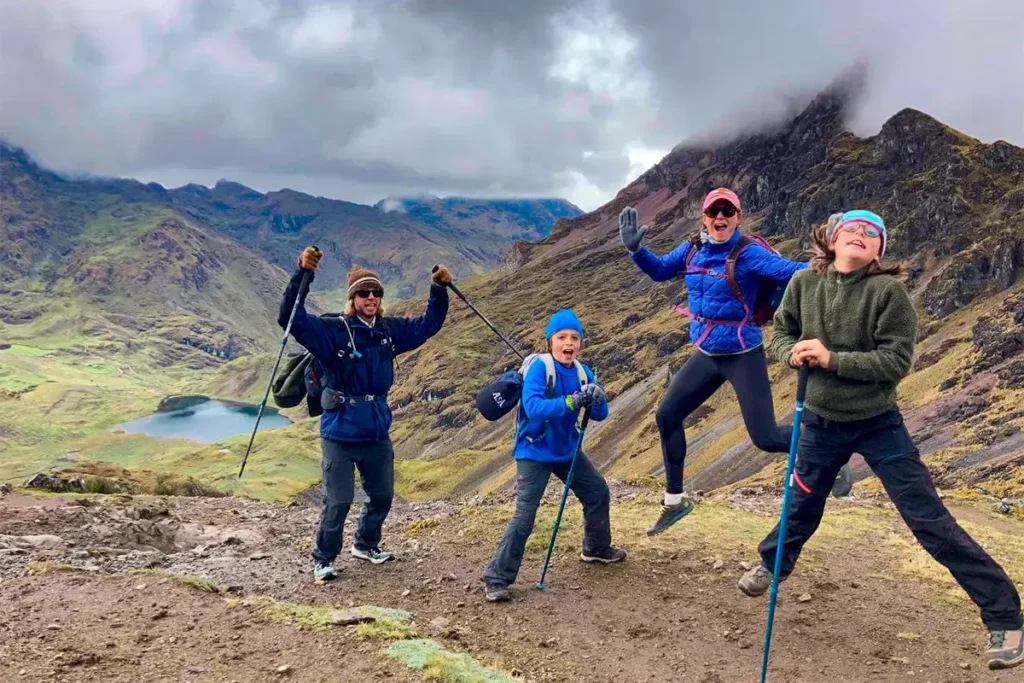
Dead Woman’s Pass
Warmiwañusca, at 4,215 m, on the morning of day two. It is the high point of the route and the reason the classic trail is rated challenging rather than moderate.
The ascent is a long, relentless climb of stone steps at an altitude where your body is working on roughly half the oxygen it’s used to at sea level. Most people find it the hardest physical thing they have done. Most also describe cresting it as the moment the trek became something they’ll talk about for years.
There is no equivalent on the short route. That is the single biggest difference between them, in both directions.
The ruins only trekkers see
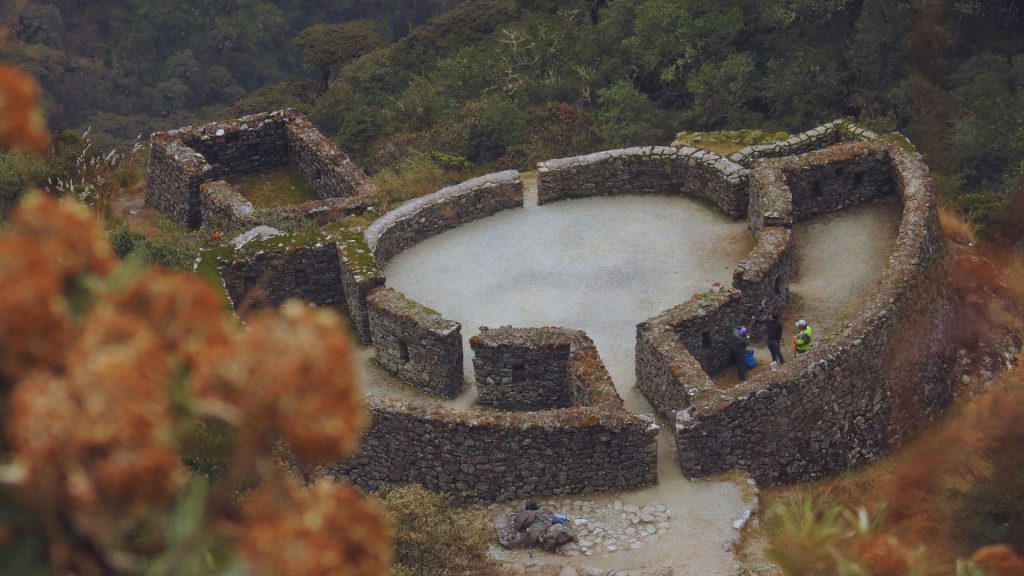
The classic route passes a sequence of sites that no other visitor to Peru reaches: Llactapata, Runkurakay, Sayacmarca and the terraces at Phuyupatamarca, strung along the ridge over days two and three.
These are not consolation stops. Sayacmarca sits on a spur above a cloud-forest valley and is reached by a stair cut into rock. Phuyupatamarca — “the town above the clouds” — sits high enough that on a good morning you look down onto weather. They are quiet, largely empty, and you will have walked to every one of them.
Nobody arriving by train sees any of this. It is the strongest single argument for the four days.
Three nights on the trail
Our classic Inca Trail camps at Wayllabamba, Pacaymayo and Wiñaywayna, with a cook, porters carrying 7 kg of your kit, all meals, and tents with air mattresses.
Whether this is an attraction or a deterrent is entirely personal, and worth being honest with yourself about. Nights are cold — around 5 °C at the higher camps and colder at altitude. There are basic toilets. You sleep on the ground. And there is something about a fourth day beginning at 4 AM in a tent, having walked there, that a hotel morning does not replicate.
What the Short Trail Gives You
The same arrival
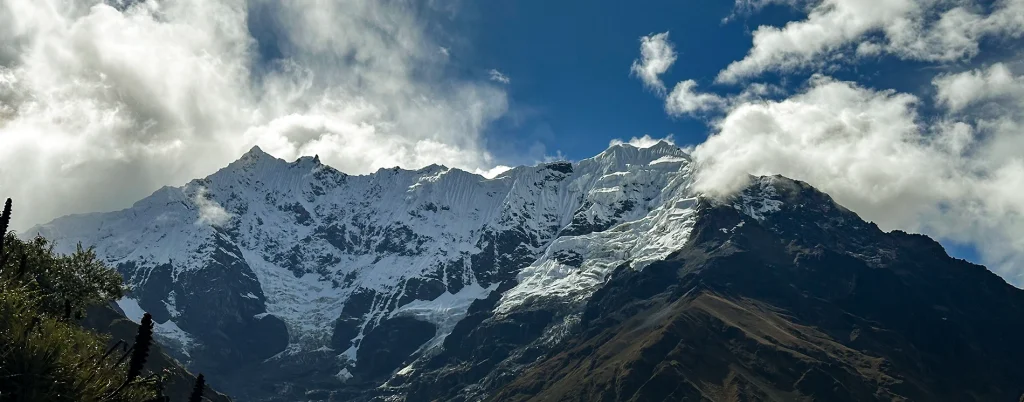
Worth repeating because it is the thing people don’t believe. From Km 104 you climb through the cloud forest, reach Wiñay Wayna, then take the steep stairs — about an hour and a half of them — up to the Intipunku, and descend into Machu Picchu.
Same gate. Same threshold. Same view. Our piece on the Inca Trail as pilgrimage sets out why that entrance was built where it was, and the answer applies equally to whoever walks through it.
Wiñay Wayna
Both routes visit it, and it deserves its own mention because it is arguably the finest site on the trail — a cascade of terraces and ceremonial baths built into a steep flank, with a waterfall beside it.
The short trail also starts at Chachabamba at 2,178 m, a compact riverside complex with ritual baths that the classic route doesn’t pass at all. So the exchange isn’t purely one-way.
A bed, and what that’s actually worth
One night in a hotel in Aguas Calientes. A shower, a mattress, a door.
This matters more than trekking literature admits. You arrive at Machu Picchu on day two having slept properly, and our short Inca Trail is built to get you into the citadel at 6 AM on Circuit 2 — early light, before the trains arrive. Classic trekkers reach the site having camped three nights and walked since dawn, which is magnificent and also means a fair few of them are running on empty by the time the guide starts talking.
Half the altitude exposure
The short route tops out around 2,750 m at the Sun Gate. The classic route sleeps above 3,000 m and crosses 4,215 m.
For anyone who has struggled in Cusco, has a cardiac or respiratory condition, or simply doesn’t know how they’ll react at altitude, that difference is not a detail. It’s the whole decision.
Inca Trail 2 Days vs 4 Days: Who Each One Suits
| If you… | Book | Why |
| Want the full trekking experience and have the time | Classic | The passes and the high ruins are unique to it |
| Have under a week in Cusco | Short | Four days plus acclimatisation eats a whole trip |
| Have had altitude trouble in Cusco | Short | It stays below 2,800 m |
| Have a cardiac or respiratory condition | Short, after medical advice | 4,215 m is a serious ask |
| Have never camped and don’t want to start now | Short | Three cold nights in a tent is the deal-breaker for most |
| Are travelling with older parents | Short | Moderate, one day, hotel at the end |
| Are travelling with teenagers | Classic | They’ll manage it and remember it |
| Are on a tight budget | Short | Roughly $600 less with us |
| Couldn’t get a classic permit | Short | Not a downgrade — read this article again |
| Want to combine the trek with ceremony | Short | Leaves room in the week; see below |
Our honest recommendation. If you are fit, have nine or ten days in the region, and the mountain itself is part of what you came for — do the classic. It is one of the great treks and we would not talk you out of it.
For everyone else, and that’s most people, the short trail delivers the arrival, Wiñay Wayna and a properly rested morning at Machu Picchu, for less money and a fraction of the physical risk. We book plenty of both and we do not think of the two-day walkers as having settled.
Altitude Is the Real Deciding Factor
The classic trail is not hard because of distance. Forty-two kilometres over four days is a comfortable pace at sea level. It’s hard because of where those kilometres are.
Cusco sits at 3,399 m. The trail climbs above that and stays there for two days. And altitude illness does not correlate with fitness — marathon runners get it and sedentary people sometimes don’t. What predicts it is acclimatisation time and rate of ascent.
Which means the classic trail requires more than four days of your trip. Arriving in Cusco and starting the trek within 48 hours is how people end up being evacuated from Pacaymayo. Two to three nights at altitude beforehand is the minimum, and the Sacred Valley floor — Urubamba at 2,871 m — is a smarter place to spend them than the city.
Our 7-day Cusco itinerary sets out the acclimatisation logic in detail. Budget realistically: the classic Inca Trail is a seven-day commitment, not a four-day one.
If you have any cardiac, respiratory or blood-pressure condition, talk to your doctor before booking the classic route specifically. Our trek includes a first aid kit and oxygen, and evacuation from the middle of the route still means hours, not minutes.
Permits, and Why They Disappear
The bottleneck that decides many trips.
Classic trail: 500 people per day, total. That figure includes everyone — and roughly 300 of those places go to guides, porters and cooks. Which leaves about 200 trekker permits per day for the entire world.
Short trail: 250 per day, counting hikers and staff together. More forgiving, and still tight on popular dates.
Permits for the following year are typically released in the first week of October, and thousands of operators worldwide compete for them the moment they open.
Book three to five months ahead as a working rule. For June, July or August on the classic route, four to eight months is realistic, and some people reserve a year out to secure specific dates and campsites.
Three things to know about how permits work:
They are named and non-transferable. Your passport number goes on the permit. Bring the same passport you booked with — a renewed passport with a new number causes real problems at the checkpoint.
There is no waiting list and no last-minute release. Once a date is gone, it’s gone. Cancellations are not resold.
No operator can guarantee a date before permits open. Anyone promising otherwise is selling you something they don’t have. If your dates are fixed and the classic trail is sold out, the short trail and the other treks — Salkantay, Lares, Huchuy Qosqo — are the real alternatives.
February
The Inca Trail closes for the whole of February. Both routes. Every year, for maintenance on the path, bridges and campsites.
It’s also the wettest month in the region, so the closure makes sense on two counts. The trail operates from 1 March to 31 January.
Machu Picchu itself stays open. If February is your only window, you reach the citadel by train — see our guide to the Machu Picchu circuits — or walk Salkantay or Lares instead, neither of which is subject to the closure.
What It Costs
Our classic Inca Trail starts at $1,500 per person and the short Inca Trail at $900, both based on two travellers.
What the classic price covers that a cheaper quote may not: a bilingual guide working in English, Spanish and Quechua; trail and Machu Picchu entrance fees; transport including the train; a cook and porters carrying 7 kg of your personal gear; all meals across the four days; tents and air mattresses; and a first aid kit with oxygen.
Add-ons. Huayna Picchu or Machu Picchu Mountain run $65 each on the classic route, and need booking well in advance — Huayna Picchu is capped and sells out months out.
Not included on either: tips for the crew, which are customary and should be budgeted; extra water and snacks; and flights.
On very cheap quotes. Porter welfare is the thing that gets cut. Peru regulates porter loads and pay for good reason, and an operator undercutting the market is usually doing it on someone’s back. Ask what porters are paid and what they carry.

What Both Routes Miss
A detail that catches trekkers out on arrival.
Walking in through the Sun Gate puts you on a designated route for Inca Trail arrivals — the terraces, the water fountains, the Temple of the Sun, the Inca House and the Pisonay Plaza — without the upper panoramic section that produces the classic photograph.
So the image you’ve had in your head for months is not necessarily the one your ticket gives you.
The fix: book a second entry for the following day on Circuit 2, and see the citadel properly with rested legs. Arrange it when you book the trek rather than trying to sort it from Aguas Calientes the night before. Our circuits guide explains which route reaches what.
Training, Honestly
For the short trail: if you can walk for six hours on undulating ground, you can do it. The stair section to the Sun Gate is steep but short.
For the classic: build up to consecutive days of walking, not single long ones. Two back-to-back six-hour days with a pack tells you far more than one ten-hour day. Stairs are the specific thing — the Inca Trail is mostly stone steps, up and down, and calves and knees take the brunt.
What can’t be trained at home: the altitude. Nothing in a gym prepares you for 4,215 m. Acclimatisation is the only preparation that works, which is the point above about the trek being a seven-day commitment.
Poles — with rubber tips, as metal tips are prohibited — save your knees on the descents, which are harder on the body than the climbs.
Before the Trail — Sitting With the Tradition That Built It
Most people build a Cusco trip around the trek and add nothing else, and it’s the most common thing our guests say they wish they’d done differently.
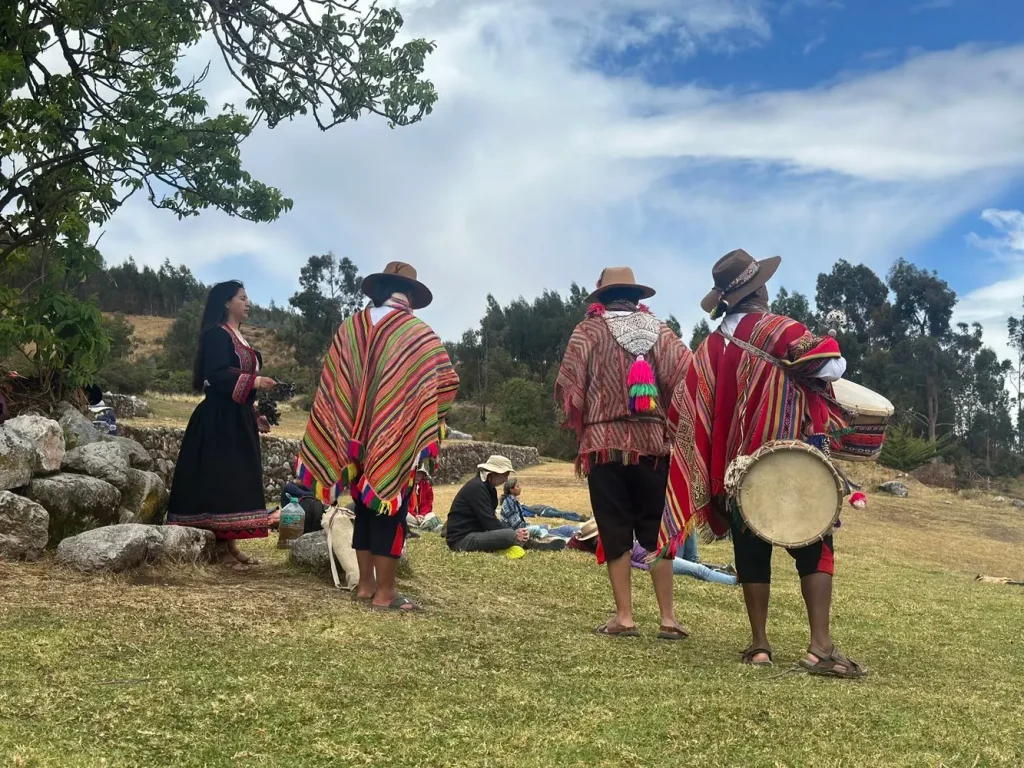
The route you’ll walk was not built for recreation. It was a ceremonial approach, and the apachetas on the passes — stone cairns still being added to — are part of a living practice, not archaeology. The tradition that laid out those thresholds is still carried an hour from Cusco, in Chinchero and the villages around it.
Do the ceremony before the trek, not after. You’ll be acclimatising anyway, and those are days that otherwise get spent wandering the Plaza de Armas.
A coca leaf reading — an hour, from $70 — is the natural place to start, and coca is the plant you’ll be chewing on the passes. A Pachamama offering at $350 means that when your guide places a k’intu at the top of Warmiwañusca, you’ll know exactly what that gesture is. Our guide to despacho ingredients explains what goes into one.
On the plant medicines, the timing is a safety matter. Our wachuma ceremony runs eight to twelve hours in daylight; our ayahuasca ceremony runs overnight with an integration circle the next morning.
Never start a trek the day after either one. Wachuma leaves you dehydrated and tired for a day or two even when it goes beautifully, and a 4 AM start up a 4,215 m pass in that state is genuinely dangerous rather than merely unpleasant. Leave a clear day — two before the classic route. And the medicines should not be done on consecutive days with each other either; the spacing logic is in our 7-day itinerary.
The reverse order works well. Trek first, ceremony after. You arrive at the ceremony fully acclimatised, physically emptied out and with a week of walking already in you, which several guests have described as the ideal preparation.
Plant medicine ceremonies require individual health screening and are excluded for cardiac conditions, pregnancy and a range of medications among others. The coca reading and the Pachamama offering carry no such restrictions. The full range is on our ceremonies page.
Mistakes We See
Booking the classic trail for the week you land. No acclimatisation, and the most likely way to not finish.
Treating the short trail as a failure. It isn’t, and this whole article is about why.
Leaving permits until spring. By March, peak dates for that year are frequently gone.
Renewing your passport after booking. The permit carries the old number.
Assuming the trek includes the classic photograph. It doesn’t — book a second-day entry.
Flying out of Cusco the morning after finishing. Give yourself a day.
Packing for the distance rather than the cold. The nights are the problem on the classic route, not the walking.
Frequently Asked Questions
Is the 2-day Inca Trail worth it?
Yes. It enters Machu Picchu through the Sun Gate, visits Wiñay Wayna and Chachabamba, and leaves you rested for the citadel. It is a genuinely different trip from the classic, not a reduced one.
What’s the difference between the classic and short Inca Trail?
The classic covers about 42 km over four days from Km 82, crosses Warmiwañusca at 4,215 m, camps three nights and passes ruins nobody else reaches. The short covers about 12 km in one day from Km 104, tops out near 2,750 m and includes a hotel night.
How hard is Dead Woman’s Pass?
It is the hardest part of the route — a sustained stone-step climb to 4,215 m. Most fit people manage it; nobody finds it easy.
How many Inca Trail permits are there per day?
Around 500 total for the classic, of which roughly 300 go to staff, leaving about 200 for trekkers. The short trail has 250 including staff.
When do Inca Trail permits go on sale?
Usually the first week of October for the following year.
How far ahead should I book?
Three to five months as a rule; four to eight for June to August on the classic route.
Is the Inca Trail closed in February?
Yes, the whole month, both routes. Machu Picchu itself stays open.
Can I do the Inca Trail without camping?
Yes — the short trail sleeps in a hotel in Aguas Calientes.
Do I need to acclimatise first?
Yes, especially for the classic route. Two to three nights at altitude minimum, ideally in the Sacred Valley.
What happens if the classic trail is sold out for my dates?
Take the short trail, or walk Salkantay or Lares, which have no permit quota.
Can I climb Huayna Picchu after the trek?
Yes, as a paid add-on, booked months ahead.
What We’d Tell You Over Coffee
If the mountain is why you’re coming — if you want the pass, the cold camps and the ruins on the ridge — take the four days, and give yourself three nights at altitude first.
If Machu Picchu is why you’re coming and walking in is the part that matters, take the two days. You’ll get the Sun Gate, Wiñay Wayna and a 6 AM entry with a night’s sleep behind you, and you’ll have four days of your trip left over. Spend one of them in Chinchero with a paqo, and the trek will mean more than it otherwise would.
Tell us your dates and we’ll tell you honestly which one fits — including when the answer is neither.
Permit quotas, release dates, prices and regulations change between seasons; figures here were current at the time of writing and should be confirmed before booking. The Inca Trail network and Machu Picchu are administered by Peru’s Ministerio de Cultura through the Dirección Desconcentrada de Cultura de Cusco, with protected-area oversight from SERNANP. Trekking at high altitude carries real risk; consult your physician before booking, particularly with any cardiac, respiratory or blood-pressure condition. Plant medicine ceremonies referred to here require individual health screening and are not suitable for everyone.