A Spiritual Retreat for Couples in the Andes
 By PumAdventures
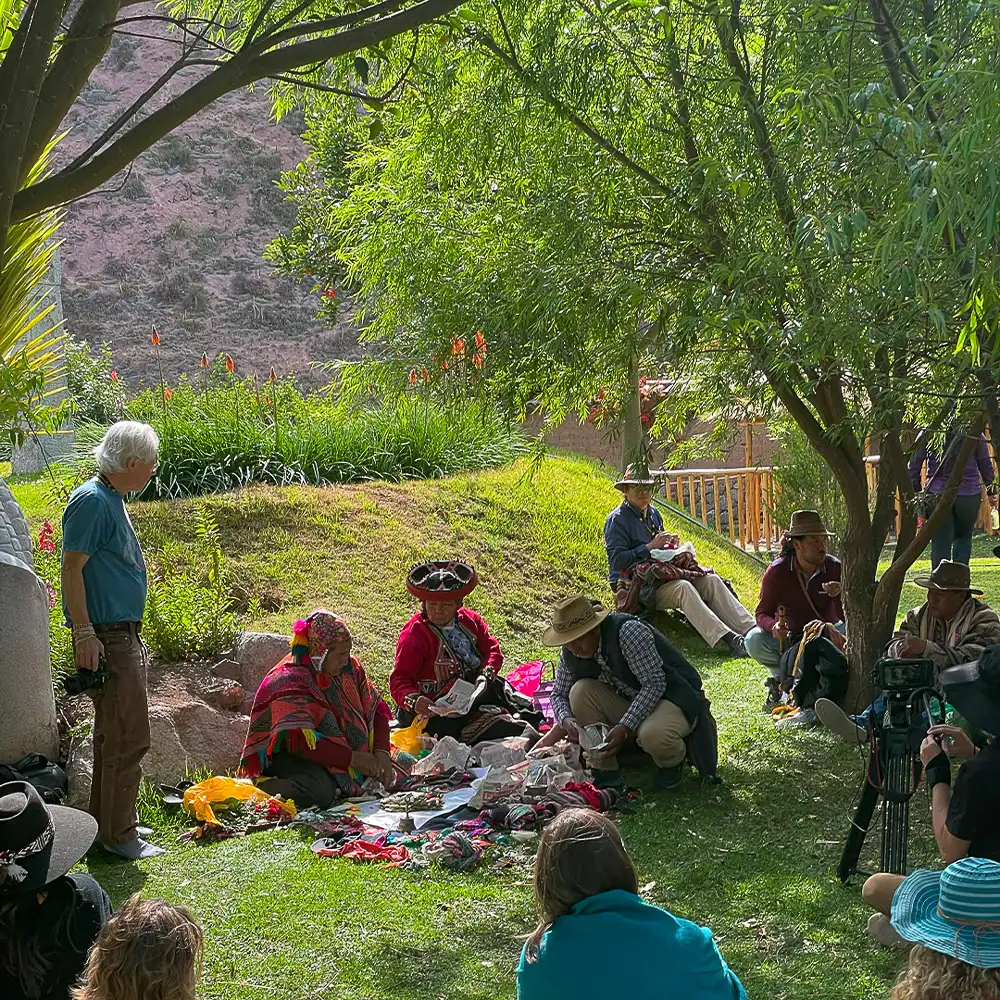
Couples arrive in Chinchero with a picture in their heads. They will drink together, journey together, meet somewhere in the dark, and come home holding something neither could have found alone.
Some of that happens. A good deal of it doesn’t, and the gap between the picture and the night is where most of the difficulty lives.
A spiritual retreat for couples in Peru is not a shared experience in the way people imagine. You will sit in the same room, breathe the same smoke, and hear the same icaros — and you will have entirely separate nights. Understanding that in advance is most of what separates couples who come home closer from couples who come home careful with each other.
This article covers which ceremonies genuinely work well for two people, which one asks for different expectations, what happens when one of you has a hard night and the other doesn’t, and where an Andean wedding fits as a closing rather than an opening.
Table of Contents
What the Research Actually Suggests
Worth starting here, because it cuts against what we used to tell people.
A 2025 dyadic study of 798 participants, including 81 couples, examined couples’ psychedelic use, shared reality and relational well-being. Couples who took a psychedelic together reported greater “shared reality” and more positive relational changes — emotional closeness, physical intimacy, satisfaction. Solo use, by contrast, was indirectly associated with relationship dissolution.
Read that carefully before drawing conclusions from it. The design was cross-sectional and self-reported, dyadic participation was low, and the authors are explicit that causation cannot be inferred. Couples with strong relationships may simply be more likely to do this together in the first place.
Still, it points somewhere useful, and it changed how we advise people. We used to suggest partners take ayahuasca on separate nights. We no longer do by default. Sitting in the same ceremony appears to matter — not because you share the experience, but because you share the night, the room, the fear beforehand and the morning after.
What the research does not say, and what nobody should promise you, is that ceremony improves relationships. It says something narrower and more interesting: doing it alongside your partner tends to go better than doing it without them.
“Together” Does Not Mean “The Same”
Here is the thing to settle before you book.
In an ayahuasca ceremony you may be non-verbal for three hours. You will very likely not touch. You may not be aware of your partner at all for long stretches, and if you are, you will not be able to help them. That is not a failure of the ceremony; it is what the medicine does.
Couples who expect to journey hand in hand tend to spend the night trying to find each other rather than doing their own work. And the person being sought usually experiences that as pressure.
The useful reframe: you are not going through it together. You are going through it in the same room, on the same night, and you will meet again in the morning. That is a genuinely intimate thing, and it’s enough.
Wachuma is different — it runs in daylight, outdoors, over eight to twelve hours, and there are long stretches where you can walk beside each other and talk. Of the two plant medicines, it is the one that actually delivers something like a shared day.
Ceremony by Ceremony on a Spiritual Retreat for Couples
Coca leaf reading — the best possible starting point
Do this on day two, before anything else. An hour, seated, from $70. Our coca leaf reading can be taken individually or as a couple, and the choice matters more than people realise.
Separately gives each of you a private conversation with a master from Chinchero, and lets you ask the question you would not ask in front of your partner. That question is usually the important one.
Together turns the reading into a conversation about the relationship itself, with a third presence in the room who is not taking sides.
Our honest recommendation: separately first, then compare notes over lunch if you want to. Couples who do it that way often discover they came to Peru for different reasons, which is worth knowing on day two rather than day six.
The Pachamama offering — the one made for two
If there is a single ceremony built for couples, this is it.
A despacho is two to three hours in Chinchero, from $350, building an offering by hand from coca k’intus, seeds, flowers, wool and shell. You each breathe your intention into your own k’intu. Both go into the same bundle. The bundle is burned or buried as one thing.
The symbolism does not need explaining to anybody. Two intentions, one offering, given away.
It is also entirely non-psychoactive, carries no contraindications, and can be done by any couple regardless of health, medication or nerves. For partners where one is enthusiastic about plant medicine and the other is not, this is frequently the ceremony that makes the trip worthwhile for both.
Wachuma — the shared day
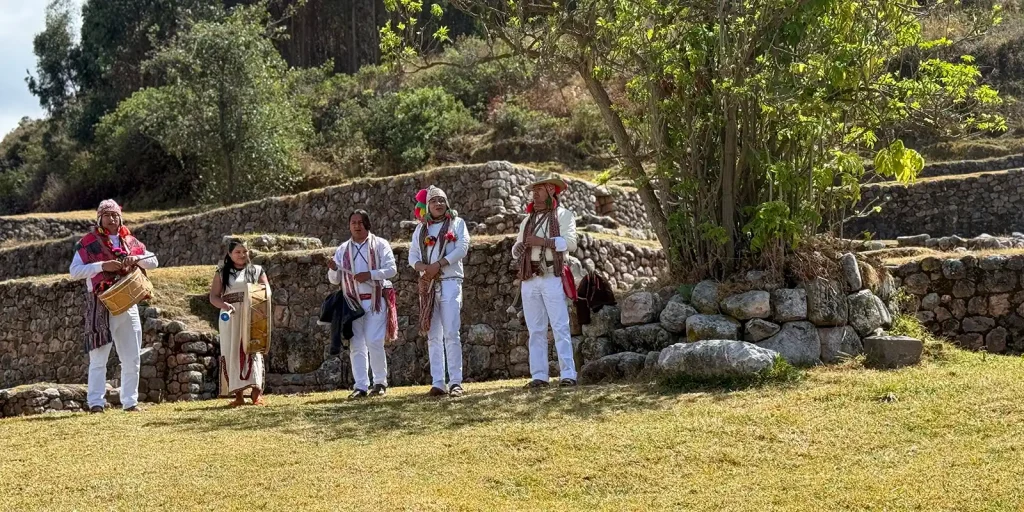
Our San Pedro ceremony runs from an 8 AM pickup through eight to twelve hours at Quillarumiyoq, from $250. Daylight, outdoors, walking, with a family lunch.
This is the plant medicine that suits couples best. You are conscious, mobile, able to speak. There are hours where you walk beside each other in comfortable silence, and hours where you separate and find each other again. Several couples have described it afterwards as the closest thing to a long conversation without words.
Two cautions. Wachuma is not offered to women who are menstruating, which for couples means the dates matter and you should tell us early. And the medicine is not offered to anyone with a cardiac condition — see is wachuma safe for the full list.
Ayahuasca — same night, separate journeys
The ayahuasca ceremony runs from a 4 PM pickup, through the night, from $350, with an integration circle the following morning.
Sit in the same ceremony. Set separate intentions. Expect nothing of each other during the night.
The most common mistake couples make is bringing a joint intention — we want to work on our relationship. Bring your own question instead. What the relationship needs will surface on its own if it needs to, and it surfaces more usefully when neither of you has arrived determined to fix the other.
Screening is individual. One of you may be accepted and the other declined — for medication, a cardiac condition, or psychiatric history. That happens, and it is not negotiable. Our guide on who should not drink ayahuasca sets out why.
If that’s your situation, the person who can’t drink is not sidelined. They can do the coca reading, the despacho and the wachuma. Which brings us to the harder part of this article.
The Asymmetry Problem
This is the real risk of ceremony as a couple, and almost nobody writes about it.
When one of you has a hard night
One person weeps for two hours and comes out radiant. The other is nauseous, frightened, and gets nothing they can name.
What follows is predictable and quietly corrosive. The one who had the beautiful night feels guilty and starts editing what they say. The one who struggled feels defective, or worse, decides the whole thing is nonsense to protect themselves.
Say it out loud on the walk back. Naming the imbalance takes most of the poison out of it. Difficult ceremonies are common, they are not failures, and a hard night frequently turns out to be the more useful one at three months’ distance.
When one of you receives a decision the other didn’t
I saw that we should leave the city. I saw that we should have a child. I saw that I need to stop working with my brother.
This is the most consequential asymmetry, and it deserves a rule: a decision that surfaces in ceremony is not a decision your partner has agreed to. It is information about you.
Anything that changes both your lives should be revisited in ordinary daylight, weeks later, after the intensity has drained out of it. We say this to couples before every retreat and we still watch people book flights from the Sacred Valley.
When one of you wants to interpret for the other
Resist it completely. You do not know what your partner’s vision means, and offering a reading of it — however loving — takes their experience away and replaces it with yours.
Ask questions. Do not supply answers. This is harder than it sounds at 7 AM after no sleep.
When you integrate at different speeds
One of you wants to talk it through immediately. The other needs four days of silence before they can say anything at all. Neither is wrong, and the mismatch causes more friction in the week after a retreat than the ceremonies themselves.
Agree in advance: the person who needs silence gets it, and the person who needs to talk finds someone else to talk to first. Our facilitators are available for exactly that.
What a Retreat Cannot Do for a Relationship
Said plainly, because the alternative is letting people spend a lot of money on the wrong thing.
Ceremony is not couples therapy. There is no therapist, no framework, no structured conversation about your relationship. What there is, is a night that may surface things you have both been avoiding — with no professional in the room to help you handle what comes up.
If your relationship is in crisis, this is the wrong intervention. A retreat will not repair infidelity, an unresolved betrayal, or a decision one of you has already made privately. It may well bring those things to the surface at 2 AM in a village an hour from Cusco, which is not where you want them.
It cannot substitute for a conversation you have been avoiding sober. If there is something you have not said, say it before you fly. Plant medicine is an unkind place to say it for the first time.
And it cannot make someone want what you want. Bringing a reluctant partner to Peru hoping the medicine will convert them is a bad plan for the relationship and a poor foundation for a ceremony. If one of you isn’t drawn to this, build a week around what you both want — the despacho, the Sacred Valley, a coca reading, and no plant medicine at all. That is a real trip, not a consolation prize.
The Month Before
Preparation is where couples either become allies or start irritating each other, and it’s worth planning deliberately.
The diet is a shared project. The ayahuasca preparation asks for a week without alcohol, red meat, pork, fermented foods, caffeine and sugar; the wachuma diet is shorter but similar. Doing that alone in a household where the other person is drinking wine is miserable. Doing it together is straightforward and, several couples have told us, the first thing they’d done jointly in months.
Have the conversation you’ve been postponing. Before you fly, not in ceremony. If there is a subject the two of you circle without landing on, land on it at home where you can argue properly and go to bed angry if you need to.
Agree three rules in advance. We suggest these, and couples adapt them: nobody interprets the other’s experience; no life decisions acted on inside thirty days; and the person who needs silence gets it without having to justify it. Write them down. They sound unnecessary in your kitchen and they are extremely useful at 6 AM in Chinchero.
Decide what you’re each bringing. Not luggage — questions. If you arrive with a joint agenda you’ll both be working on the relationship and neither of you will be working on yourselves, which is usually where the relationship’s problem actually sits.
Sort the health forms separately and honestly. Do not fill in your partner’s. People minimise medication and history when someone is reading over their shoulder, and that is exactly the information the screening exists to catch.
And talk about money before you book. A week of ceremony for two, with an Andean wedding, is a significant sum. Resentment about cost has soured more retreats than any ceremony ever has.
A Week for Two
Built on the spacing logic in our 7-day itinerary, adapted for couples.
Day 1 — Arrive. Do nothing. Cusco sits at 3,399 m and the first night is the hardest.
Day 2 — Coca leaf readings, taken separately. Compare over lunch if you want to.
Day 3 — The Pachamama offering in Chinchero, together. Two intentions, one bundle.
Day 4 — Wachuma at Quillarumiyoq. The shared day.
Day 5 — Nothing scheduled, and this is not padding. Wachuma often keeps working for a day or two, and the ayahuasca ceremony lands very differently with a clear day in between. Walk somewhere gentle. Talk, or don’t.
Day 6 — Ayahuasca. Same ceremony, separate intentions, no expectations of each other.
Day 7 — Integration circle in the morning. Afternoon free.
Day 8 (optional) — The Andean wedding.
Day 9 — Fly home. Not day eight.
The Andean Wedding as a Closing
Most couples who book an Andean wedding treat it as a standalone day. It works far better as an ending.
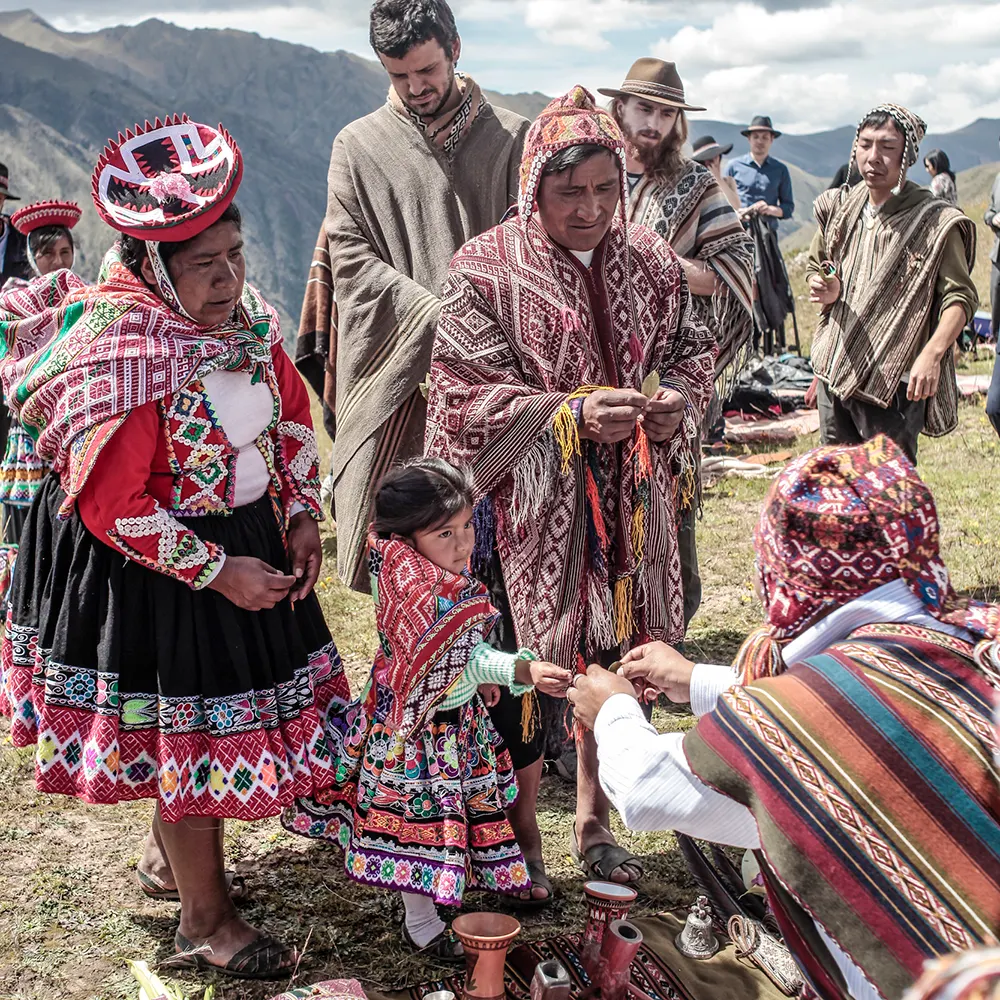
Our ceremony runs a full day from an 8 AM pickup, from $1,500 per couple, led by two Andean masters including native priestesses from Chinchero. It moves through five phases: Coca Q’away, a reading of the leaves for the couple; T’ikariy, the flower blessing; a marriage despacho built with your own hands; Ch’allay, the toast with chicha; and the exchange of symbolic gifts.
Notice what that list contains. If you have spent the week doing coca readings and building a despacho, you arrive at your own wedding already fluent in every element of it. You know what the k’intu is for. You know why the bundle gets burned. The ceremony stops being a beautiful thing performed at you and becomes something you can actually participate in.
It is symbolic rather than legally binding — most couples marry legally at home first — and it is equally available for vow renewals, at the same price, and to same-sex couples, with no surcharge and no difference in the ceremony. Costs are broken down in full in our guide to what an Andean wedding costs, and the location options are covered in where to hold one in the Sacred Valley.
One piece of advice from experience: don’t schedule the wedding the morning after ayahuasca. Give it a day. You want to be present for it, not still returning.
Practical Notes
Private or group. Couples often assume private is better. Not always — a group ceremony gives you other people’s presence to lean on, which can relieve the pressure of being each other’s only witness. Private suits couples doing specific work, or where one partner is very anxious. Private ceremonies run on your own dates year-round; group retreats run on fixed departures.
Book screening early for both of you. Two people means two health forms and twice the chance of a complication. Start six to eight weeks out, longer for June to August.
Budget honestly. Ceremony costs for a couple following the week above run roughly $1,340 for the two of you, plus the wedding if you add it. Accommodation, flights and meals are separate.
Rooms. Consider separate beds after ayahuasca night. It sounds unromantic. Sleep is scarce and neither of you will regret it.
Tell us if you’re menstruating on the wachuma date. It’s the most common reason a couple has to reshuffle a week, and it’s easily solved with two weeks’ notice.
Frequently Asked Questions
Can couples do ayahuasca together?
Yes, and current evidence mildly favours sitting in the same ceremony rather than separately. Expect separate internal journeys, not a shared one.
Is a spiritual retreat good for a struggling relationship?
No. Ceremony is not couples therapy and there is no professional in the room. If things are in crisis, address that at home first.
Which ceremony is best for couples?
The Pachamama offering. Non-psychoactive, no contraindications, built around two intentions becoming one bundle.
What if one of us is declined on health grounds?
Screening is individual and non-negotiable. The other partner can still do the coca reading, the despacho and the Sacred Valley, and many couples build the whole week that way.
Should we take our coca readings together or apart?
Apart first. It lets each of you ask the question you wouldn’t ask in front of the other.
What if one of us has a much harder night?
Common, and worth naming out loud immediately. Difficult ceremonies aren’t failures and often prove more useful later.
Can we combine the retreat with an Andean wedding?
Yes, and it works best as a closing rather than an opening. Leave a day between the last ceremony and the wedding.
Are same-sex couples welcome?
Fully, at the same price, in every ceremony including the Andean wedding.
Can we do this as a vow renewal?
Yes. Same ceremony, same cost. Couples married fifteen years often use it more deeply than newlyweds.
How long should we stay?
Eight nights for the full week above. Five if you drop one plant medicine — and dropping one is better than compressing both.
What We’d Tell You Over Coffee
The couples who get the most out of this are not the ones with the most ambitious plan. They’re the ones who arrive with two separate questions rather than one joint agenda, and who leave a day of nothing in the middle of the week.
Come with your own question. Sit in the same room. Don’t interpret each other’s night. And whatever surfaces about your life together, carry it home and look at it there, in the ordinary light of a Tuesday, before you act on it.
Tell us your dates and what you’re both hoping for — including if the two of you want different things. That’s a normal starting point, not a problem.Ceremony participation requires individual health screening and is undertaken on the basis of informed personal responsibility. Ayahuasca and wachuma are excluded for cardiac conditions, uncontrolled hypertension, epilepsy, pregnancy and breastfeeding, and personal or family history of psychosis or bipolar disorder, among others; serotonergic medications are contraindicated. Consult your physician before travelling to high altitude or participating in any plant medicine ceremony. No ceremony described here is a treatment for any medical, psychological or relational condition, and none is a substitute for couples therapy. The research cited is correlational and cannot establish causation. Andean traditions are administered as cultural heritage by Peru’s Ministerio de Cultura; for the pharmacology of ayahuasca and medication interactions, see Frontiers in Molecular Biosciences.