Andean Wedding Cost in Cusco: What You’ll Actually Pay
 By PumAdventures
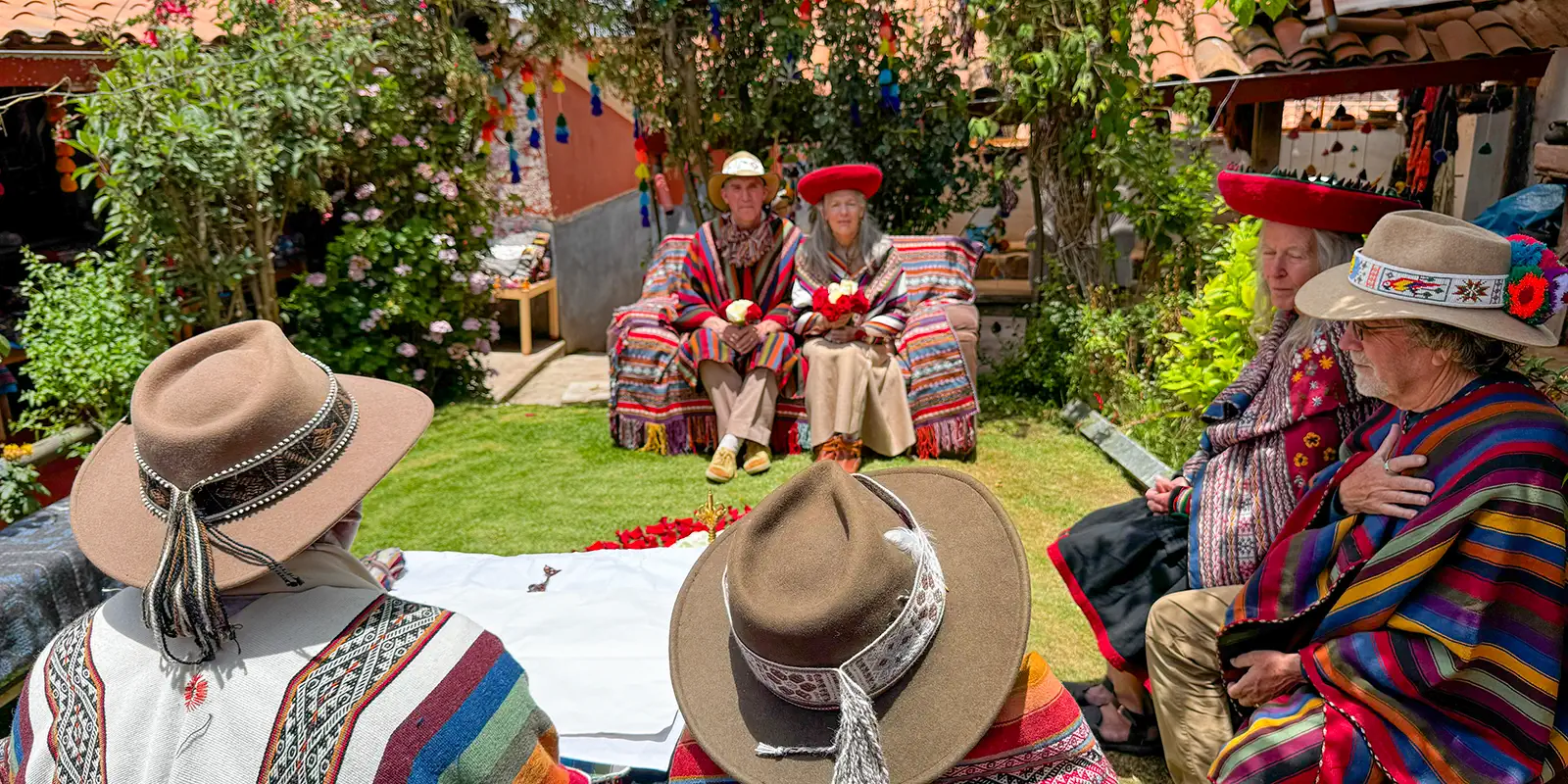
Search for an Andean wedding ceremony in Cusco and you’ll find quotes running from about $350 to well over $3,000 for what is described, in every case, as the same thing: a symbolic marriage blessed by an Andean priest in the Sacred Valley.
That’s a ninefold spread. No industry explains a ninefold spread by accident.
So this article does something most operators avoid. It breaks the Andean wedding cost Cusco down line by line — what the masters cost, what the flowers cost, what live music costs, what nobody mentions until the invoice arrives — and then explains, honestly, why our own ceremony is priced at $1,500 per couple when another company down the street will do it for $350.
Sometimes the cheap one is the right choice. We’ll say so where it is.
Prices below are in US dollars and reflect what couples are being quoted for ceremonies taking place in 2027.
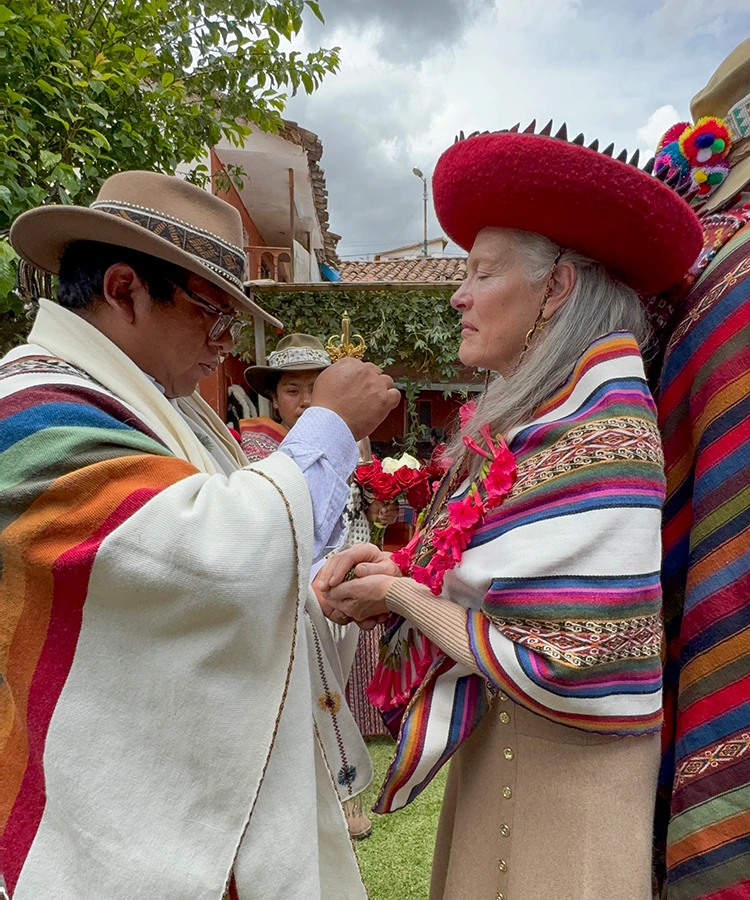
Table of Contents
The Short Answer
| Tier | Typical price | What you’re buying |
| Budget / group tour | $300–$600 per couple | Ceremony attached to a community tourism circuit. One officiant, basic attire, shared format. Photos usually extra. |
| Mid-range private | $600–$1,200 | Private ceremony, one officiant, simple flowers, transport, lunch. Photography sometimes included. |
| Full private ceremony | $1,200–$2,500 | Two masters, florist work, live musicians, dedicated translator, champagne, private throughout. |
| Luxury / destination event | $3,000–$15,000+ | Planner, venue hire, reception, guest catering, professional photo and video, multi-day programme. |
Our Andean wedding ceremony starts at $1,500 per couple, all day, in Chinchero. Where that sits in the table above, and what the gap buys, is the rest of this article.
What Actually Drives the Andean Wedding Cost in Cusco
Nine line items account for almost the entire difference between a $350 ceremony and a $1,500 one. Here they are in rough order of how much they move the number.
The masters — the single largest cost
This is where most of your money goes, and it should be.
A budget ceremony books one officiant, usually described as an Andean priest or paqo. Our ceremony is conducted by two — including native priestesses from Chinchero who hold the lineage they’re working in, not performers hired for the morning.
Two things follow from that. The obvious one is that two people cost roughly twice one person. The less obvious one is that lineage-trained masters are not interchangeable labour. There are not many of them, they are not available on 48 hours’ notice, and they do not work for tour-operator day rates. A company quoting $350 per couple, all in, cannot be paying two of them properly. The arithmetic doesn’t allow it.
If you take one thing from this breakdown: ask how many officiants, and ask who they are. It’s the question that separates the tiers.
Flowers — the most underestimated line
Couples consistently guess low here.
A floral arch, a flower carpet laid on the ground and a bouquet is real florist work: sourcing at the Cusco market at dawn, transport up to Chinchero, and two or three people building it on site before you arrive. It is easily a few hundred dollars of labour and stock, and it is the difference between photographs you frame and photographs you don’t.
Budget packages typically offer floral crowns instead. Lovely, genuinely traditional, and about a tenth of the cost. That’s not a criticism — it’s the single clearest place where you can see what tier you’re in.
Live music
Hiring musicians for a morning in the Sacred Valley costs what hiring musicians anywhere costs. Some cheaper packages list “folk music,” which in practice often means a recorded soundtrack or a community textile demonstration that includes a couple of songs. Both are pleasant. Neither is a booked ensemble playing while you exchange your vows.
Ceremonial attire
Traditional Andean garments for both partners — hand-woven, from Chinchero’s weaving tradition. Almost every operator at every price point includes this, and the quality varies more than the price does. Ours is optional; some couples prefer to marry in their own clothes, and we’ve stopped assuming.
Private transport
Chinchero is about an hour from Cusco. Private round-trip transport with hotel pickup is a real cost and a real convenience. Shared transport is cheaper and is one of the quiet ways a $350 package stays at $350.
Photography
Watch this line carefully, because it is the most common upsell in the market. One well-known Cusco operator includes the ceremony at $279 per person and then lists professional photos and video at $250 extra. Another includes photography in a $350 package — which tells you something about how much photography is actually in there.
We include a photo session. If you want a full professional wedding photographer for the day, that’s a separate booking and a separate budget, and we’ll tell you that upfront rather than let you discover it afterwards.
Champagne, chicha and the symbolic gift
Small individually, and they add up: champagne or wine for the toast, chicha for the ch’allay, and the symbolic gift representing your union. These are the items that quietly disappear from budget packages.
Site access and community agreements
Ceremonies don’t happen on neutral ground. Holding one properly means an agreement with the community whose land you’re on and, where a protected archaeological zone is involved, authorisation from the Dirección Desconcentrada de Cultura de Cusco.
This has become a live issue in Chinchero. In August 2026 regional authorities opened an inquiry into unauthorised access to the archaeological park. Operators cutting this corner are the same ones cutting the others, and “we know a spot” is not a permit.
The translator
A dedicated guide working across Quechua, Spanish and English for the whole ceremony. Not a driver who speaks some English. If you can’t follow what’s being said over you during your own wedding, you’ve bought a photo opportunity.
What’s Included at $1,500
From our Andean wedding page, in full:
- Two Andean spiritual masters, including native priestesses from Chinchero
- A full despacho — the marriage offering to Pachamama, built with your participation
- Coca Q’away: an oracle reading of the leaves for the couple
- T’ikariy: the flower blessing
- Ch’allay: the sacred toast with chicha
- Symbolic gift exchange
- Traditional Andean ceremonial clothing (optional)
- Floral arch, flower carpet and bouquet
- Live music
- Champagne or wine for the toast
- Dedicated Quechua–Spanish–English translator
- Private round-trip transport, hotel pickup at 8 AM
- Photo session
- A symbolic gift representing your union
Not included: guest accommodation and meals, catering beyond the ceremony, gratuities, flights, and travel insurance.
The day runs from an 8 AM pickup through preparation and cleansing with plants, water and incense, into the five ritual phases, and closes with photographs before the return to Cusco.
Two of those phases exist as standalone ceremonies on our site, which is a useful way to sanity-check the price: a coca leaf reading is $70 on its own, and an offering to Pachamama is $350. Both are inside the wedding package.
Duration Is a Cost, and It’s the One Couples Miss
Compare the listings carefully and you’ll notice the durations don’t match. A well-known booking platform sells an Andean wedding in Cusco as a four-hour experience. Another operator quotes six hours. Ours runs the full day.
That gap is not padding, and it’s not generosity either — it’s the second-largest hidden variable in the price after the officiants.
A four-hour version is realistically an hour of driving each way and roughly ninety minutes on the ground. Enough for a compressed ceremony and a handful of photographs. You will feel rushed, because you are being rushed.
A full day looks like this. Pickup at 8 AM and the drive up through Poroy and Cruzpata, with the Urubamba range opening on your right. Arrival in Chinchero with time to change into the ceremonial garments unhurried, which matters more than it sounds — nobody looks composed in photographs taken eleven minutes after they got dressed in a car park. Cleansing with plants, water and incense before anything begins. Then the five phases, each given its own time: the coca reading, the flower blessing, the despacho built with your own hands, the toast, the exchange of gifts. Then photographs while the light is still good, and an unhurried return.
Every hour on that list is a paid hour for two masters, musicians, a driver and a translator. That’s the cost. It’s also, if we’re honest, most of what makes the day feel like a wedding rather than an excursion.
Why Some Ceremonies Cost $350 and Ours Costs $1,500
Here’s the honest comparison, using real published prices from operators currently selling in Cusco.
| Budget operator A | Budget operator B | PumAdventures | |
| Price | $279 pp / $558 per couple | From $350 per couple | From $1,500 per couple |
| Duration | Full day | ~6 hours | Full day |
| Officiants | 1 Andean priest | 1 Andean priest | 2 masters, incl. native priestesses |
| Flowers | Floral crowns | Included, unspecified | Arch, carpet, bouquet |
| Music | Folk music / textile demo | Not listed | Live musicians |
| Photography | +$250 extra | Included | Photo session included |
| Format | Community circuit, alpacas, pachamanca lunch | Community welcome, lunch | Private to the couple |
| Champagne | Not listed | Not listed | Included |
What you genuinely get for $558. A real ceremony, a real paqo, alpaca-wool rings, a pachamanca lunch cooked underground, and a warm day in a Quechua community. Some couples want exactly that and are right to book it. It’s a good product at a fair price.
What you don’t get. Privacy, two officiants, florist work, live musicians, or a translator whose only job is you. The budget format is a community tourism circuit with a wedding placed inside it — you’ll share the day with the demonstration, the alpacas and, sometimes, other visitors.
The four real differences, stripped of marketing:
- Two lineage masters instead of one hired officiant. The largest cost and the largest difference in what the ceremony actually is.
- Private, not circuit. The day is built around you rather than you being placed inside an existing tour.
- Florist work. Visible in every photograph you’ll keep.
- A dedicated translator. You understand your own wedding.
Whether that’s worth roughly $950 is a question only you can answer. Plenty of couples decide it isn’t, and we’d rather they book the $558 ceremony happily than book ours resentfully.

What Pushes the Price Up
Guests. The single biggest multiplier. Two people is a ceremony; twenty is an event, needing transport, seating, catering and a bigger space. We recommend small groups anyway — intimacy is most of what makes these ceremonies work — but every additional guest has a real cost.
Professional photography and video. Budget $600–$1,500 for a proper wedding photographer in Cusco, more with video. Worth it if the images matter to you.
High season. April to October is the dry season and the busy one. June and July book out first, and masters, musicians and vehicles are all scarcer.
A Machu Picchu location. Expensive, heavily restricted, and not permitted inside the citadel. Doing something symbolic nearby means train tickets, entry permits and a very early start for everyone attending.
Legal marriage on top of the symbolic one. The Andean ceremony is spiritual and symbolic — it is not legally binding. Most couples marry legally at home first. Doing it in Peru instead adds notarised and apostilled documents, sworn translations and municipal fees, and a timeline measured in weeks.
Wrapping the wedding inside a longer journey. Adding ceremonies, Sacred Valley sites or Machu Picchu around the wedding. Our Essence of Cusco – 5 Days runs from $1,950 per person and gives you a structure to build around.
What Doesn’t Cost Extra
Worth saying, because couples brace for surcharges that don’t exist.
Your own vows. Write them, read them in whatever language you like. No charge, and it’s the part guests remember.
Being a same-sex couple. Our ceremonies are open to same-sex couples at the same price. There is no version of this where that costs more.
A vow renewal instead of a first marriage. Same ceremony, same price. Couples married fifteen years use it differently, and often more deeply.
Low season. November to March brings afternoon rain and fewer visitors. Mornings are frequently clear, the Valley is green in a way it never is in July, and availability is far better.
Small guest numbers. Two to six people doesn’t add cost. It usually improves the ceremony.
How It Compares to a Wedding at Home
A $1,500 ceremony sounds like a lot until you set it beside what it’s replacing.
The average wedding in the United States or the UK runs into the tens of thousands, most of it spent on venue hire and feeding people. An Andean ceremony has no venue hire, no reception, no catering for eighty, no DJ. You are paying for officiants, flowers, music and transport — and nothing else, because there is nothing else.
Couples who elope to Cusco routinely spend less on the entire trip, flights included, than they would have spent on catering alone. That is the actual comparison, and it’s the one worth running before deciding $1,500 is expensive.
Hidden Costs Nobody Quotes You
Not in anyone’s package, ours included, and every one of them real.
- Flights. The largest single expense of the trip for most couples, and entirely outside any operator’s quote.
- Acclimatisation nights. Cusco is at 3,399 m and Chinchero at 3,762 m. You need two nights before you do anything demanding — that’s two hotel nights nobody puts in the wedding budget. Our 7-day itinerary covers why this isn’t optional.
- Gratuities. Customary and not included anywhere. Budget something for the masters, musicians, driver and guide.
- Guest logistics. If people are flying in, someone coordinates their transport and accommodation. That someone is usually you.
- Travel insurance. Not included in any package. Get it.
- Getting the dress there. Sounds trivial until you’re carrying it through Lima airport.
- Apostilles and sworn translations, if you’re marrying legally in Peru rather than symbolically.
Three Sample Budgets
Ceremony and local costs only — flights excluded, since they vary enormously by origin.
Just the two of us — from about $1,500 The ceremony as it stands. No guests, no extras. Add hotel nights and meals at whatever standard you’re travelling.
Ceremony with six guests and a professional photographer — roughly $2,600–$3,500 Ceremony from $1,500, plus additional guest costs, plus $600–$1,500 for a photographer. Guests handle their own hotels.
Wedding inside a week in the Sacred Valley — from about $5,400 per couple The 5-day journey from $1,950 per person, plus the ceremony from $1,500. Accommodation, Machu Picchu and other ceremonies built in — see the full Sacred Valley retreat options.
All figures are starting prices, generally based on two travellers. Ask for a written quote before budgeting seriously.
Booking, Deposits and Lead Time
How far ahead to book. Three to six months for dry-season dates, and longer for June or July. Two lineage masters, musicians and a florist all have to align on one morning; that is not a 48-hour arrangement, whatever the booking widgets suggest.
Deposits. We take a deposit to hold the date, with the balance settled before the ceremony. Methods and current terms are on our payments page, or just ask — we’d rather explain it directly than have you guess from a form.
Get it in writing. Number of officiants, what the flowers actually consist of, whether music is live, whether photographs are included or an upsell, and what happens if it rains. A reputable operator will put all of that in an email without being pushed.
Changing the date. Weather, illness and delayed flights all happen. Ask about rescheduling terms before you pay, not after.
Start with the contact form and tell us your dates, guest count and whether photography matters to you. Those three things determine almost the entire quote.
How to Tell a Real Operator From a Cheap One
Price alone won’t tell you. These four things will.
Registration. Travel agencies operating in Peru must be registered with MINCETUR and comply with regional requirements through GERCETUR Cusco. Ask for the registration. A formal operator produces it immediately.
Site permissions. Ask where the ceremony happens and under what agreement. Community land with a community arrangement is the right answer. Vagueness about a protected archaeological zone is not.
Named officiants. Ask who is leading your ceremony and where they’re from. If nobody can tell you before you pay, nobody knows yet.
A written inclusions list. Anyone unwilling to itemise in writing is leaving room to substitute later.
You can see who you’d be working with on our team page, and the rest of our ceremonies are priced openly for the same reason this article exists.
Frequently Asked Questions
How much does an Andean wedding in Cusco cost?
Between roughly $300 and $2,500 per couple depending on tier. Budget group ceremonies start around $350; full private ceremonies with two masters, florist work and live music run $1,200–$2,500. Ours starts at $1,500.
Is the Andean wedding legally binding?
No. It is a spiritual and symbolic ceremony. Most couples marry legally in their own country first and come to Cusco for the ceremony that means something to them.
Why is there such a big price difference between operators?
Number of officiants, private versus group format, real florist work versus floral crowns, live versus recorded music, and whether photography is included or a $250 add-on.
Can we bring guests, and what does that cost?
Yes. Small groups are recommended. Each guest adds transport, seating and catering costs — ask for a quote with your exact number.
Is a $350 ceremony a scam?
Usually not. It’s a genuine ceremony inside a community tourism circuit, and for many couples that’s the right choice. Just know what you’re buying: one officiant, shared format, photos likely extra.
When is the cheapest time to marry in the Sacred Valley?
November to March. Fewer visitors, better availability, afternoon rain to plan around. Mornings are often clear.
Do we need to pay for the despacho separately?
No. The marriage despacho is part of the ceremony. Our standalone Pachamama offering is a separate $350 service for people not marrying.
How far in advance should we book?
Three to six months, longer for June and July.
Are same-sex couples charged the same?
Yes, identically. Our ceremonies are fully open to same-sex couples.
Can we do a vow renewal at the same price?
Yes. Same ceremony, same cost.
What We’d Tell a Friend
If your budget is tight, book the $558 ceremony and spend the difference on an extra week in Peru. It’s a real ceremony with a real paqo and you will not regret it.
If the photographs will hang on your wall for thirty years, and you want two masters who carry the lineage, flowers built at dawn, musicians playing while you’re blessed, and a day belonging to nobody but the two of you — that’s what the extra buys. Not a better ceremony in the eyes of the mountains. A different one in yours.
Either way, ask for the itemised list before you pay. Any operator worth booking will hand it over gladly.
Talk to us about your dates — or read the full Andean wedding ceremony details first.Prices are starting rates in US dollars for ceremonies in 2027 and are subject to change and availability. Third-party prices cited were published by those operators at the time of writing and are included for comparison only. The Andean wedding ceremony is symbolic and does not constitute legal marriage under Peruvian law.