Pachamama Raymi: Inside Peru’s Month of Mother Earth
 By PumAdventures
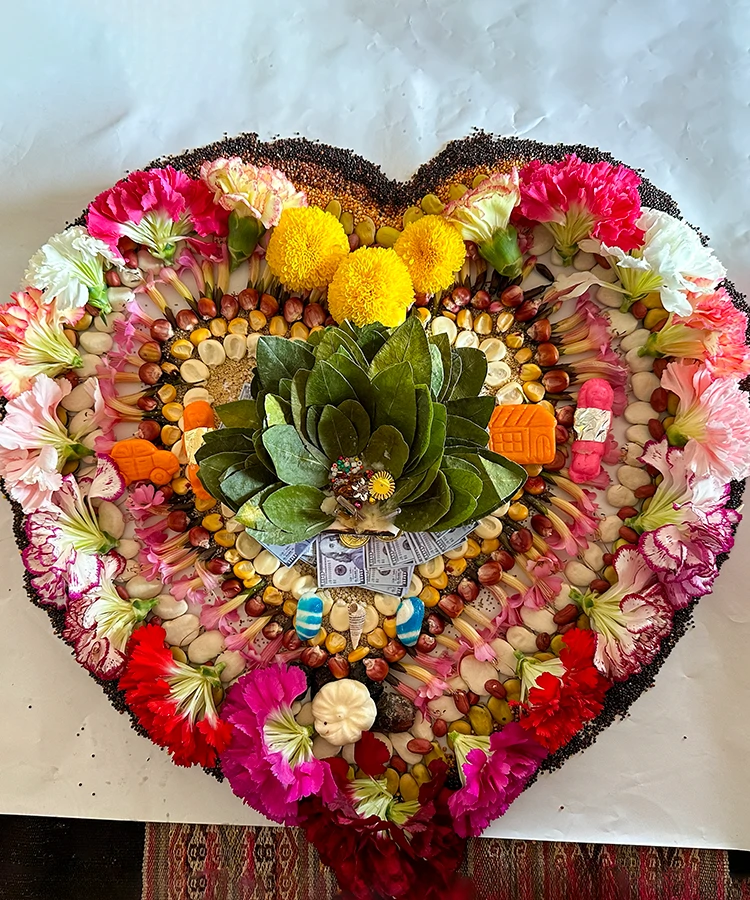
On the morning of 1 August, if you were somehow able to see the whole southern Andes at once, you would see thousands of small fires.
Not a festival. No grandstand, no parade route, no ticket. Just families in courtyards and fields from Cusco down through Puno, across the altiplano into Bolivia and south into Jujuy and Salta, digging a small hole in the ground before the sun comes up and feeding it.
Pachamama Raymi — the feast of Mother Earth — is the largest religious observance in the Andes that almost no visitor ever sees. It happens behind walls, in family plots, at the edges of fields. And the reason travellers miss it is not secrecy. It’s that most arrive in August expecting the Andean calendar to look like Inti Raymi, and this is the opposite kind of thing entirely. In 2027, 1 August falls on a Sunday. Here’s what actually happens, why it happens in August specifically, and how a visitor can take part without turning someone’s act of devotion into a photo opportunity.

Table of Contents
What Pachamama Raymi Actually Is
The name is Quechua: Pachamama, Mother Earth, and raymi, feast or celebration — the same word you know from Inti Raymi, the feast of the sun.
The central date is 1 August, but this is the part most articles get wrong: it isn’t a one-day holiday. The whole of August is the month of Pachamama. The first day is the most concentrated, the first week is intense, and offerings continue throughout the month. In many communities the rule for 1 August is simply that nobody works the soil — the earth is left to rest.
It is observed across an enormous area: Peru, Bolivia, northern Argentina — particularly Jujuy, Salta and Tucumán — along with parts of Chile, Ecuador and Colombia, and among Andean migrant communities far beyond. In Argentina the feeding ceremony is called a corpachada. In the Cusco region the offering is a despacho, and the act of payment is haywarisqa.
Different words, one gesture: opening the earth and feeding it.
Who Pachamama Actually Is
Worth pausing here, because the translation Mother Earth carries a set of associations that don’t quite fit and that quietly distort everything that follows.
She is not a planet. The environmental framing — Pachamama as the Andean name for ecological consciousness — is well-intentioned and appears often in modern speeches, including at the Cusco ceremonies. But traditionally she is far more local than that. She is this ground, this valley, the specific plot a family works. People make offerings to the earth they stand on, not to a global abstraction.
She is not only benevolent. This is the part most travel writing sands off. Pachamama in Andean understanding can be neglected, offended and angered, and the consequences are practical: poor harvests, illness, accidents, livestock lost. Offerings are made partly out of gratitude and substantially out of a well-founded caution. A being who must be fed is a being who can go hungry, and a hungry Pachamama is not a comfortable idea.
She is not alone. She exists in relationship with the Apus, the mountain spirits, each attached to a specific peak. Cusco’s ceremonies address both — the ground below and the summits above — and a despacho is typically dedicated to Pachamama and the Apus of the immediate horizon. Which ones depends entirely on where you’re standing.
And she is not a metaphor for anyone in particular. The Virgin Mary overlay that colonial Catholicism produced is real and lived, and we’ll come to it — but Pachamama predates it by a very long way and has never been fully absorbed by it.
Hold those four things and the August rituals stop looking like a nature festival and start looking like what they are: a working relationship with a demanding neighbour.
Why August, and Not Any Other Month
This is the question nobody answers well, and the answer is agricultural before it is spiritual.
The seasonal logic
Remember the hemisphere. In the southern Andes, the harvest comes in around February and March. By August the land has been giving for months and has nothing left to give — it’s the depth of the dry season, cold at night, dusty, windy, with little growing. The rains return in September and with them the planting.
August is therefore the pause: after the taking, before the asking. The earth is empty and is about to be asked to produce again.
The earth is hungry — and that isn’t a metaphor
In Andean cosmology Pachamama in August is understood to be genuinely hungry and thirsty. Weakened. In need.
This is the conceptual hinge that Western visitors most often miss. The August rituals are not primarily a harvest thanksgiving, and they are not a request for future favours. They are feeding someone who is depleted. The offering is food, put into the ground, because the ground is hungry.
Once that lands, the mechanics stop looking symbolic. The hole dug in the earth is described as a mouth — boca. The offering is described as a meal. Chicha is poured because she is thirsty.
Ayni: this is a debt
The whole of Andean practice runs on ayni, reciprocity — the understanding that everything exists in an exchange of giving and receiving. Our page on Andean rituals sets out how thoroughly this principle governs everything else.
Under ayni, a year of eating from the land creates an obligation. August is when it comes due. That framing explains why participation isn’t optional in rural communities and why people who have moved to cities still make offerings on their balconies: it isn’t devotion in the sense of choosing to worship. It’s settling an account.
What Happens on 1 August
Practice varies by community, family and altitude. The shape below is broadly what you would find in the Cusco region.
Before dawn
Most offerings begin in darkness, often around midnight or in the hours before sunrise. Fasting or eating lightly beforehand is common. People remove their shoes — at the public ceremony in Cusco, participants stand barefoot, as the practice describes the Inca doing.
Opening the earth
A hole is dug — small, sometimes no wider than a dinner plate — in a field, a courtyard, or the corner of a plot that belongs to the family. This is the mouth.
In many households it’s the same spot every year, reopened annually. Some families have fed the same hole for generations.
What goes in
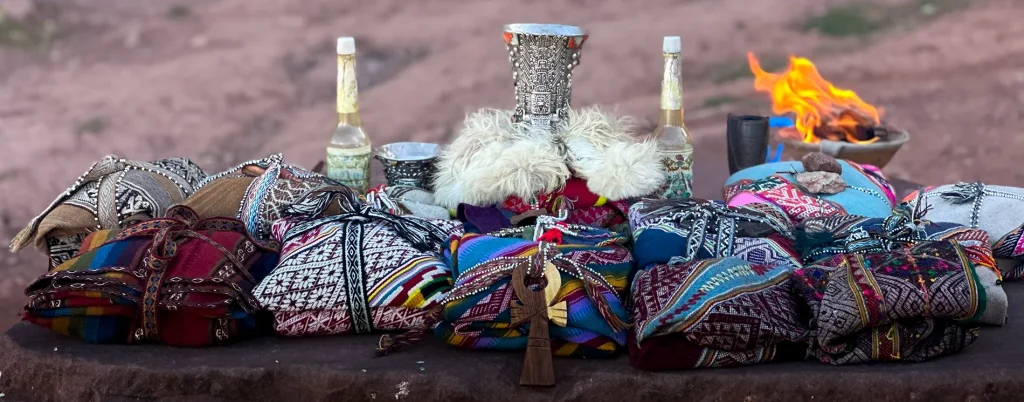
A paqo, an Andean ritual specialist, usually leads, working on a woven cloth spread on the ground. Onto it goes a despacho: an offering arranged by hand from elements each carrying meaning.
Typically: coca leaves, formed into k’intus of three; chicha de jora, the fermented maize beer; cooked food, especially maize and potatoes — what Pachamama herself produced; huayruro seeds, red and black; sweets, wine, sometimes tobacco; llama fat; flowers; wool in different colours. Every element is placed with intention, never dropped in.
We describe the full contents and their meanings in our despacho offering guide.
Burned or buried
Two endings, both traditional and regionally variable.
Buried, placed in the mouth and covered over, sometimes in a clay pot — the offering literally becoming part of the ground.
Burned, given to a sacred fire so it rises. In the Cusco region burning is the more common finish, and the smoke is read while it goes.
Either way, the ritual is not complete until the offering has been given. Nothing is kept.
And then the rest of the day
Afterwards, people eat. Families gather, there’s music, chicha is shared, and in many places the offering is followed by a straightforward, unmystical lunch that runs into the afternoon.
The soil is not worked. That’s the one widely shared prohibition — no digging, no ploughing, nothing that disturbs. She’s resting.
The Same Gesture, Different Across the Andes
The August offering is remarkably consistent in its core and remarkably varied in its detail. A few of the differences a traveller might actually notice:
Cusco and the Sacred Valley. The despacho on a woven cloth, built by a paqo, most often finished in fire. Coca is central and formed into k’intus. The Apus of the immediate skyline are named aloud.
Puno and the altiplano. Closer to Bolivian practice, with more emphasis on burial and on livestock — offerings tied to alpaca and llama herds, and ceremonies marking the animals as much as the ground.
Bolivia. The mesa bought ready-assembled at markets like La Paz’s Mercado de las Brujas is a normal part of urban practice, and burning is standard. In the mining regions the earth offering coexists with offerings to el Tío, the spirit understood to own the underground.
Northern Argentina. In Jujuy, Salta and Tucumán the ceremony is the corpachada. The hole is opened, fed with cooked food, wine and coca, then closed with stones. Drinking an infusion with rue on the morning of the first is widespread.
Cities everywhere. Andean families who have moved to Lima, Buenos Aires, Madrid or New Jersey still make offerings on 1 August, in plant pots, courtyards and back gardens. The practice travels remarkably well, which says something about how deep the obligation runs. What doesn’t vary: the date, the digging, the feeding, and the principle that you give before you ask.
How the Tradition Survived
There’s an obvious question hanging over all of this: how does a pre-Hispanic earth cult end up practised openly, five centuries after a colonial administration set out to eliminate exactly this?
The short answer is that it went underneath, not away.
Colonial campaigns to extirpate Andean religion in the sixteenth and seventeenth centuries were systematic and often brutal, targeting huacas, mummified ancestors and precisely the kind of offering described here. What happened next is the pattern across the Andes: the practice continued, and acquired a Catholic surface.
Pachamama and the Virgin Mary drew close enough that in many communities they’re addressed in the same breath. Offerings picked up crosses and saints’ names. Ceremonies migrated onto the Christian calendar. And the ritual specialists kept working, in the high communities where the Church’s reach was thinnest — which is why the Q’ero lineages of the Cusco region matter so much to the tradition’s survival.
The result is genuinely syncretic rather than a disguise. Ask a family in Chinchero whether they’re Catholic and the answer is usually yes, without any sense of contradiction. The despacho they build on 1 August may include a cross. Both things are true and have been for four hundred years.
For visitors from traditions that treat religious categories as exclusive, this takes some adjusting to. It’s worth doing the adjusting rather than deciding which layer is the real one.
Pachamama Raymi and Inti Raymi Are Not the Same Kind of Thing
This comparison matters more than any other point in this article, because getting it wrong is how visitors end up disappointed.
| Inti Raymi | Pachamama Raymi | |
| Date | 24 June | 1 August, and all month |
| Form | Staged public spectacle | Domestic and communal ritual |
| Audience | Tens of thousands, ticketed seating | Family, community, often nobody |
| Location | Sacsayhuamán, on a built stage | Fields, courtyards, private plots |
| Performers | Hundreds of costumed actors | A paqo and a family |
| Can you watch? | Yes — buy a ticket | Mostly no, unless invited |
Inti Raymi is magnificent, and it is a reconstruction performed for an audience. Pachamama Raymi is what people actually do when no audience is present.
If you arrive in Cusco on 1 August expecting a festival, you will spend the day wondering where it is. The city will look ordinary. Meanwhile, several thousand offerings will be taking place within a few kilometres of your hotel, none of them advertised.
Where Travellers Can Actually Take Part
Three honest options, in ascending order of meaningfulness.
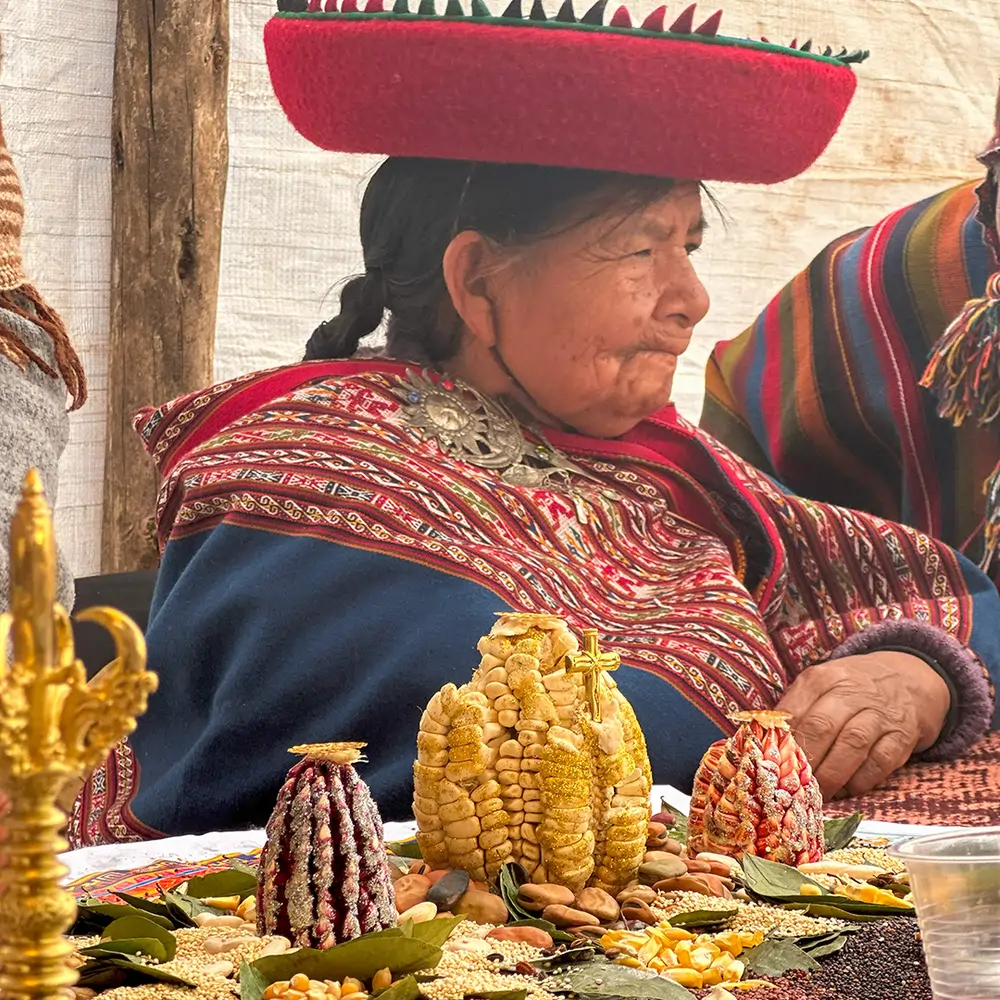
The public ceremony at Sacsayhuamán. Cusco holds an open ceremony at the archaeological site above the city, led by Andean priests, with participants barefoot. It’s real, it’s accessible, and it’s crowded — and Sacsayhuamán, the temple of lightning, is an extraordinary place to stand at dawn regardless. Go early. Take nothing you’d mind carrying for three hours.
A guided offering with a paqo. A Pachamama offering conducted for you and a small group in Chinchero — two to three hours, from $350, with masters of the Rainbow Lineage. You build the despacho yourself; the intentions woven into it are your own. In August this books out, and we say so bluntly below.
A longer immersion. Our Pachamama immersion places the offering inside a broader stay, which is closer to how the tradition works — the ritual isn’t really separable from the days around it.
And the honest fourth option: being invited. The most meaningful August ceremonies happen in families and communities and are not for sale. If you spend time in a community and someone invites you, that is worth more than anything on this list. It cannot be booked, and any operator promising it is selling you a performance.
How to Take Part Respectfully
Direct guidance, because August brings a great deal of well-meaning clumsiness.
Ask before photographing. Every time. A despacho is not a photo opportunity, and the moment of burning is the moment people most want to photograph and most shouldn’t without permission.
Take your shoes off if others do. Follow, don’t improvise.
Don’t step over the offering. Ever. Walk around the cloth.
Bring an intention, not a wish list. The ceremony is about feeding, not requesting. Turning up with a shopping list of things you want misreads the whole exchange.
Don’t lead it yourself. Buying despacho materials at the San Pedro market and conducting your own ceremony because you watched one is the definition of superficial appropriation. Sit with someone who carries the practice.
Don’t take the offering home. It belongs to the ground or the fire.
Contribute. If you’re welcomed into a community ceremony, bring something — coca, chicha, food, or money given discreetly to whoever organised it. Ayni applies to you too.
Be quiet. Silence during the building of the despacho is normal and expected. Filling it with questions is the most common visitor error we see.
Planning August in Cusco
August is the best month to be in Cusco and the hardest month to be in Cusco, at the same time.
Weather. Peak dry season. Clear skies, strong sun, and genuinely cold nights — near freezing on the high plateau. Rain is unlikely. For outdoor ceremony, it’s the most reliable weather of the year.
Crowds. August is the busiest tourist month in Peru. Machu Picchu tickets, the Inca Trail and good accommodation all sell out well in advance, and prices rise accordingly.
Book early. For a ceremony on or near 1 August, three to four months ahead is not excessive. Paqos in the Cusco region are extraordinarily busy in the first week of August — they are conducting offerings for their own families and communities, who come first, as they should. Contact us in April or May for August dates and we can plan properly; contact us on 28 July and we will likely be telling you no.
Altitude. Cusco is at 3,399 m and Chinchero at around 3,760 m. Give yourself two nights before any early-morning ceremony at altitude in the cold. Our 7-day itinerary sets out the acclimatisation logic.
What to wear at dawn. Layers, a hat, and warm socks — you may be standing barefoot on cold ground. Nobody regrets over-dressing for a 5 AM ceremony in August.
Where It Sits in the Cusco Year
Pachamama Raymi completes a calendar that a great many visitors experience only in fragments.
June brings Corpus Christi and then Inti Raymi on the 24th — the loudest, most public month in the Andean year.
July brings the Virgin of Carmen in Paucartambo, where Catholic and Andean devotion sit alongside each other in a way that takes some getting used to.
August turns inward. After two months of spectacle, the calendar goes quiet, domestic and agricultural.
That arc — public, then private — is the actual shape of the Andean year, and it says something about the tradition that the biggest festivals are for the sun while the most universally observed obligation is to the ground. Our roundup of the most important festivities in Cusco covers the full calendar.
Frequently Asked Questions
What is Pachamama Raymi?
The Andean feast of Mother Earth, centred on 1 August, when offerings of food, coca and chicha are placed into the ground to feed Pachamama at the point in the year when she is understood to be depleted.
When is Pachamama Raymi 2027?
Sunday 1 August 2027, with observances through the whole month and most intensely in the first week.
Is the whole of August the month of Pachamama?
Yes. The first is the concentrated date, but offerings continue all month and August is spoken of as belonging to her.
Why is 1 August the day of Mother Earth?
It falls after the February–March harvest and before the September rains and planting — the point in the agricultural year when the land has given everything and is about to be asked again.
Is it a public holiday in Peru?
No. It’s a widely observed cultural and spiritual practice, not an official national holiday.
Can tourists attend a Pachamama ceremony?
Yes — the public ceremony at Sacsayhuamán is open, and private offerings with a paqo can be arranged. Family and community ceremonies are by invitation only.
What is offered to Pachamama?
Coca leaves, chicha de jora, cooked maize and potatoes, huayruro seeds, sweets, wine, flowers, wool and llama fat, arranged as a despacho and then buried or burned.
Is the offering burned or buried?
Both are traditional. Burning is more common around Cusco; burial is widespread elsewhere.
Is it celebrated outside Peru?
Yes — Bolivia, northern Argentina, Chile, Ecuador and Colombia, and among Andean communities abroad.
How far ahead should I book a ceremony for early August?
Three to four months. The first week of August is the busiest of the paqos’ year.
Why It’s Worth Understanding Before You Come
Most visitors to Cusco in August will never know it’s happening. They’ll queue for Machu Picchu in perfect weather and fly home.
The ones who do know tend to describe it as the moment Peru stopped being scenery. There’s something clarifying about watching a family put food into the ground for a mountain they’ve lived under for six generations — an idea about obligation that most of us don’t have a working equivalent for.
You don’t need to believe the earth is hungry to find that worth a morning. And if you go, go quietly, ask before you photograph, and bring something to give.
Ask us about ceremonies for August — and please ask early. The first week fills months in advance.Practices described vary by region, community and family; the account here reflects the Cusco region and the tradition of our masters in Chinchero. Peru’s cultural heritage framework is administered by the Ministerio de Cultura, and tourism services in the region are regulated through MINCETUR and the regional DIRCETUR Cusco. For background on the date’s significance, see National Geographic’s account of 1 August.