Machu Picchu’s Sacred Architecture: What We Know and What We Don’t
 By PumAdventures

Machu Picchu Sacred Architecture: The Intihuatana, the solstice window, the Temple of the Condor. What Machu Picchu’s builders were actually doing, read as ceremony rather than ruins. There are two kinds of writing about Machu Picchu online, and neither is much use if you want to understand what you’re looking at.
The first is the listicle — ten astonishing facts, most of them repeated from another listicle. The second is the energy blog, where the Intihuatana is a cosmic antenna and the site sits on a vortex. Both are written with total confidence. Neither tells you which claims survive contact with the people who have actually surveyed the stones.
This article does something less comfortable and more useful. It goes through the ceremonial architecture piece by piece and labels each claim honestly: what is documented, what is genuinely debated among specialists, and what is modern interpretation wearing Inca clothing.
Some of what follows will disappoint people who arrive attached to the popular version. The Machu Picchu spiritual meaning that emerges from the actual research is stranger and, we’d argue, better — because it turns out the most astronomically precise structure on the site is one almost no visitor has heard of, and the most famous one probably wasn’t doing what everyone says it was.
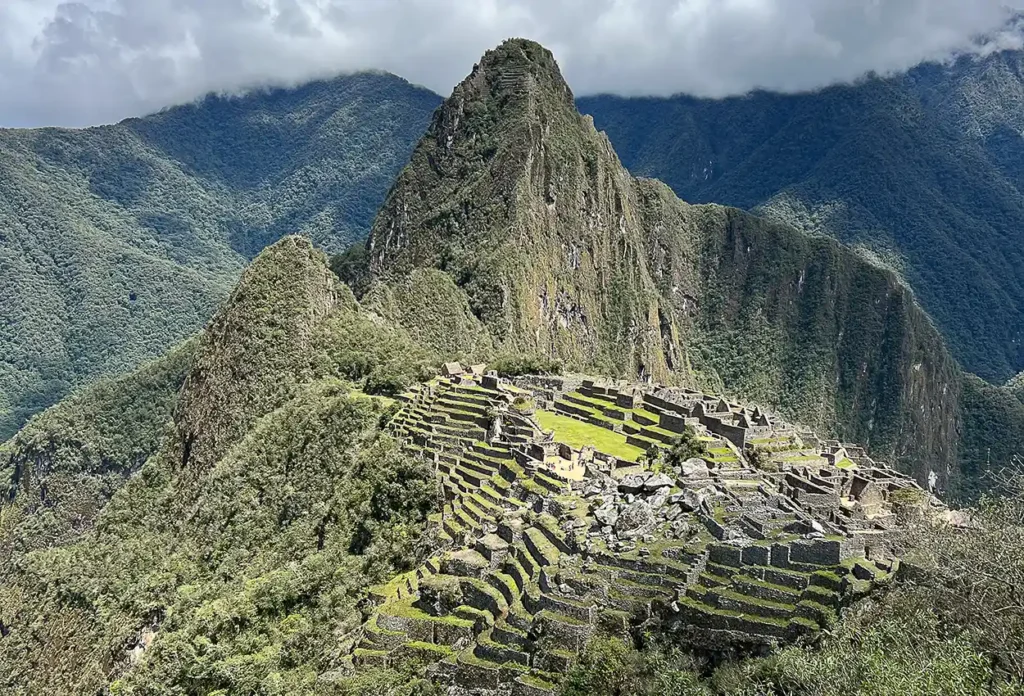
Table of Contents
How This Article Handles Evidence
Three labels, used throughout.
Documented — supported by archaeological survey, measurement or primary colonial sources, and not seriously contested.
Debated — specialists disagree, and the disagreement is live rather than fringe.
Modern interpretation — a reading developed in the twentieth or twenty-first century, often meaningful to people today, but not something we can attribute to the builders.
That third category is not an insult. Traditions grow, and a modern reading can be sincerely held. It simply isn’t the same kind of claim as a measured alignment, and conflating the two is how the internet ended up in its current state on this subject.
What the Site Actually Was
Documented. Machu Picchu was built in the mid-fifteenth century as a royal estate of the Inca ruler Pachacuti — the interpretation established by John Rowe from sixteenth-century Spanish land documents and now the settled scholarly position. Not a lost city, not a military fortress, not Vilcabamba, and not a convent of Sun Virgins. Hiram Bingham believed several of those things in 1911 and was wrong about most of them.
Documented. It was never lost. Local families were farming the terraces when Bingham arrived, and it was they who took him there. UNESCO’s own framing — the Historic Sanctuary of Machu Picchu, inscribed in 1983 under four criteria — notes only that it was unknown to the Western world.
Documented, and recent. A 2023 genetic study analysed 34 individuals buried at the site alongside 34 from Cusco. The results were striking: the people buried at Machu Picchu came from across the empire — the Peruvian highlands and coast, the Titicaca basin, the central and north-western Amazon, Ecuador, the south-eastern Amazon and Gran Chaco. Six individuals with Amazonian ancestry were all women. The authors concluded this was a diverse retainer community of yanacona and former aclla, living, marrying across origin groups and being buried together.
That last finding matters for how you read the buildings. This was not a monoculture. It was a royal estate staffed by people brought from every corner of Tawantinsuyu, which is a very different atmosphere to imagine yourself standing in.
Machu Picchu Spiritual Meaning Starts With the Stonework
Before any individual building, learn to read the walls. It is the most useful skill you can take through the gate, and it takes about ninety seconds to explain.
The masonry tells you what mattered
Documented. Inca construction runs on a clear hierarchy of quality, and that hierarchy maps onto importance.
At the bottom is pirca — rough fieldstone set in mud mortar, used for terrace walls, storehouses and the dwellings of retainers. In the middle sits coursed rectangular masonry, tidy and regular. At the top is the polygonal and coursed ashlar work: blocks dressed so precisely that they lock without mortar, faces slightly pillowed, joints you cannot get a blade into.
The rule for visitors: the better the stone, the more sacred the structure. You do not need a guide to tell you the Temple of the Sun mattered. The wall says so.
Walk from the agricultural terraces into the urban sector and you can watch the quality climb. That gradient is a map of significance, laid out by the builders in a language that survives them.
Stone that grows out of the bedrock
Documented, and easy to miss. Repeatedly at Machu Picchu, worked masonry does not sit on the rock — it emerges from it. The Torreón is built onto a granite outcrop that continues, uncut, into the chamber beneath. The Intihuatana is carved from bedrock rather than placed on it.
Well-supported reading. Andean practice treats certain rocks as huacas — beings, not materials. Building that grows out of living rock rather than replacing it is consistent with a tradition in which the outcrop was already significant before anyone touched it. This is one of the most reliable interpretive keys at the site, and it’s visible everywhere once you’ve noticed it.
The Water
Documented. A spring on the flank of Machu Picchu mountain feeds a stone channel that runs into the site and descends through a linked series of sixteen fountains, dropping from the highest to the lowest through the urban sector. The engineering is precise: the channel maintains a gradient across the whole site, and the system still functions.
Documented. The uppermost fountain sits beside the finest residential compound, immediately adjacent to the Temple of the Sun.
Well-supported reading. Water in Andean cosmology is not a utility. Springs are paqarinas — points of origin — and the sequencing of fountains from the most important structure downward reads as a hierarchy rather than mere plumbing. Reinhard’s argument that the site functions as a hydrological as much as a cosmological centre rests substantially on this.
Modern interpretation. Specific claims about the fountains as a chakra system or an energy circuit.
If you take one detail from this article into the citadel, make it this: follow the water. It runs from the sacred to the ordinary, and it tells you how the builders ranked their own site.
The Sacred Rock
Documented. A large flat slab set on a low platform at the northern end of the site, near the path to Huayna Picchu.
Debated. The most repeated observation is that its outline echoes the silhouette of the mountain directly behind it — Yanantin — as a kind of sculptural quotation of the horizon. Similar mirroring has been proposed at other Inca sites, and the resemblance here is genuinely striking. Whether it was intended is not settled.
Modern interpretation. The instruction to place your palms on it to receive the mountain’s energy. Common on tours, and not attributable to the builders.
The Temple of the Sun — and the Correction Nobody Publishes
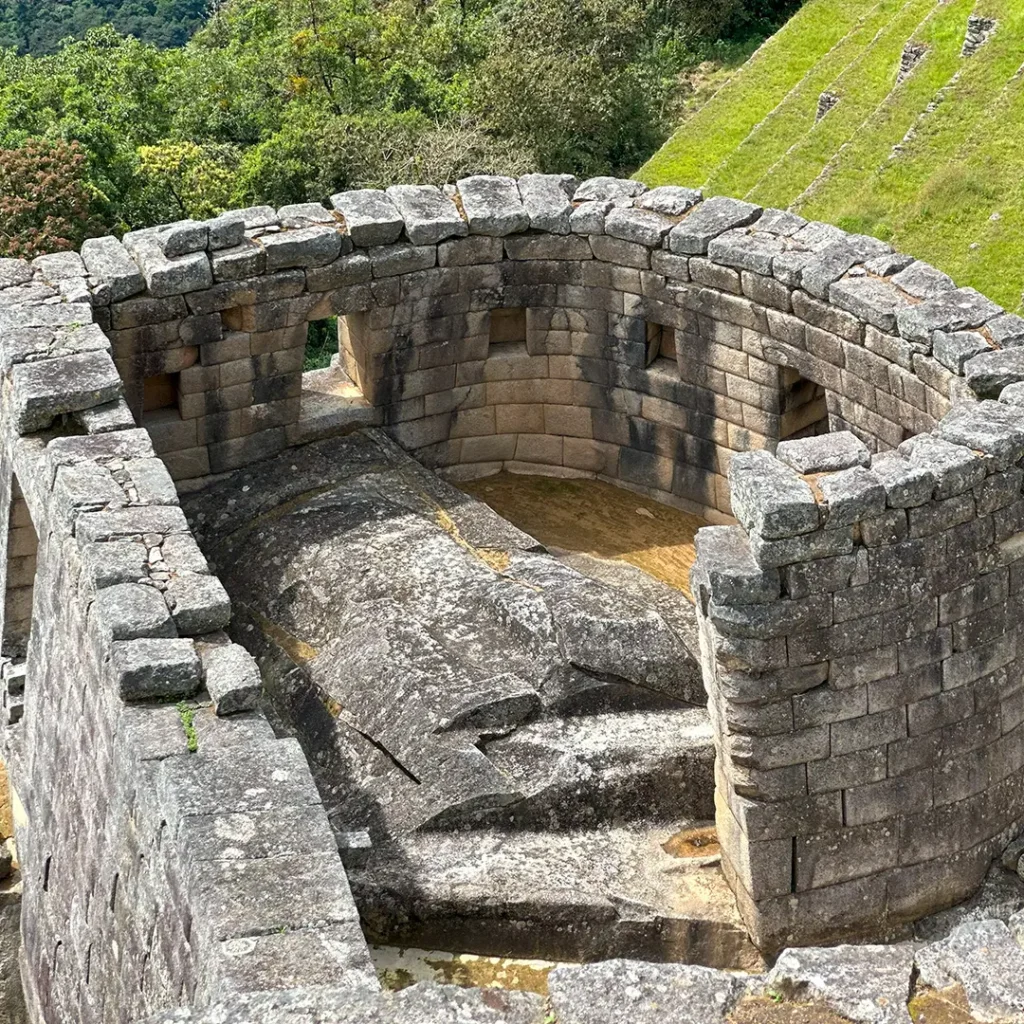
The Torreón, the curved tower built onto the living rock, is the finest stonework at Machu Picchu and the structure most written about.
Documented. Its windows are solar-oriented. On the June solstice, light entering the eastern window falls across the carved rock inside. The building was deliberately laid out with reference to the sun’s positions, and the June solstice sunrise is the dominant orientation across the whole site.
And here is the part that gets left out. The most careful recent survey of Machu Picchu’s astronomy — Ziółkowski and Kościuk’s study of the site’s alignments, which sorts the evidence into facts, hypotheses and wishful thinking — concludes that the Torreón was not a precision observatory. Their finding is that the builders designed the structure according to solar orientations, but without the purpose of erecting an astronomical instrument. The spatial constraints and the absence of precision markers point to ritual rather than measurement.
So the popular claim — that this was an Inca observatory where priests tracked the solar year — overstates it. What the evidence supports is a ceremonial building oriented to the solstice, which is a different and arguably more interesting thing: not a laboratory, but a room built so that on one morning a year the sun does something specific inside it.
Debated. The function of the second window, and whether any Pleiades alignment is real. Treat confident claims about the Pleiades with caution.
The Intihuatana — Famous, and Misdescribed
The carved granite outcrop on the upper platform is the single most photographed object at Machu Picchu after the citadel itself.
Start with the name. Intihuatana is usually translated “hitching post of the sun,” and the term was popularised by nineteenth-century travellers rather than recorded from Inca usage. What the builders called it, we do not know.
The popular claim is that it functioned as a precision solar calendar — a gnomon casting shadows that tracked the year, with the famous assertion that at midday on the equinoxes it casts no shadow at all.
What the specialist literature actually concludes is more restrained. The same survey that examined the Torreón finds the Intihuatana has limited confirmed astronomical function, and reads it primarily as a focal point for sacred landscape alignments rather than as a measuring device. Its significance appears to be about the relationship between the stone and the mountains around it, not about shadow-casting precision.
Modern interpretation. The no-shadow-at-equinox story, the “cosmic antenna” reading, and the practice of hovering hands over the stone to feel energy. People find these meaningful and we’re not going to sneer at them, but none is attributable to the builders, and the last one is now impossible anyway.
Documented, and worth knowing before you go: in 2000, a crane being used to film a beer commercial fell onto the Intihuatana and chipped it. The incident caused an outcry in Peru, prosecutions followed, and it is a large part of why access to the stone has been restricted ever since. If you cannot get close to it on your circuit, that is why.
Intimachay — The One That Actually Works
Here is the reversal at the heart of this article.
The structure at Machu Picchu that best meets the requirements of a genuine astronomical instrument is not the Torreón and not the Intihuatana. It is Intimachay — a modest cave on the eastern side of the site, with a carefully constructed front wall and a narrow slit window.
Documented. The same survey that downgrades the famous structures concludes that Intimachay does meet the requirements for precision observation, and was used to observe the cycles of the sun and the moon. The slit admits light in a way that marks the December solstice period with real accuracy.
Almost no visitor has heard of it. It appears on virtually no tour narration. It is not on the postcards.
There is something instructive in that. The building the Incas apparently used as an instrument is a plain cave nobody photographs, while the buildings we have decided were instruments turn out to have been ceremonial. It’s a useful corrective to the habit of assuming that the most impressive stonework must have had the most technical purpose.
The Temple of the Condor
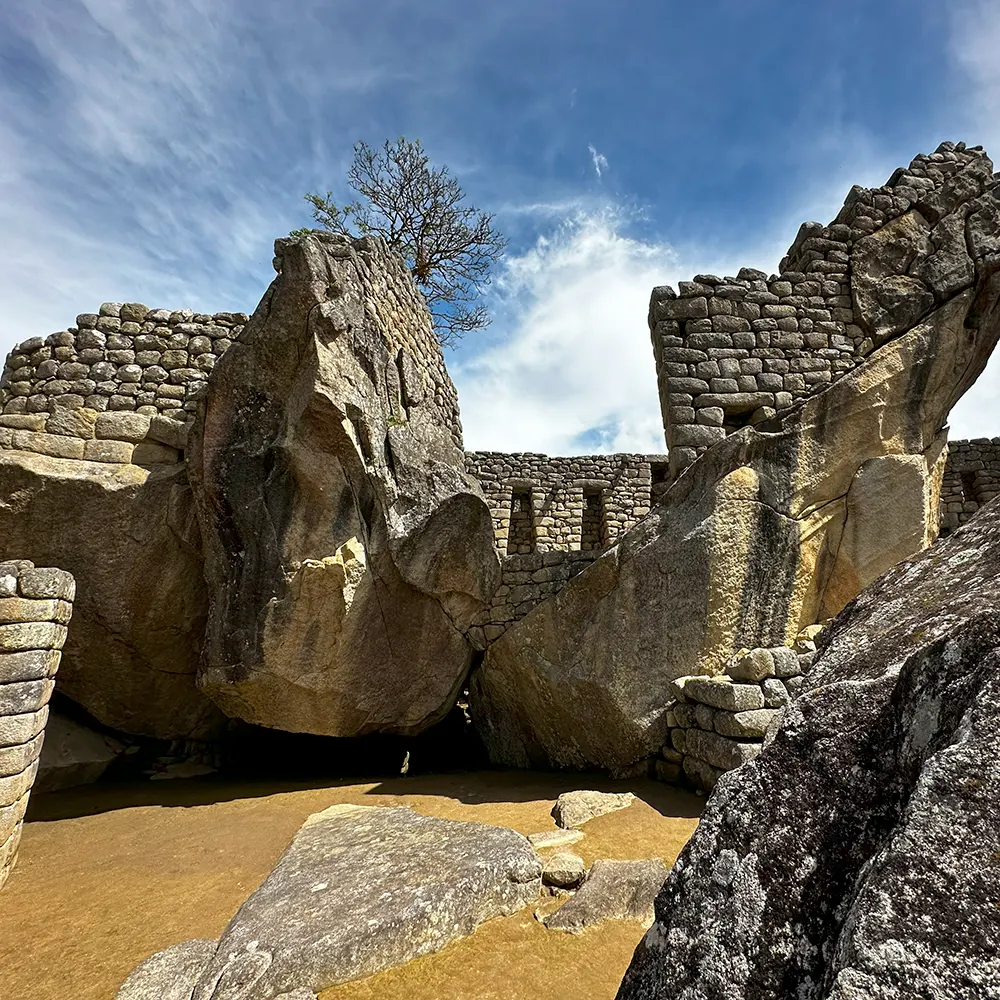
Documented. The structure shows an astronomical alignment; it appears among the six at Machu Picchu with well-supported orientations.
Modern interpretation. The condor itself. Two natural rock outcrops form what reads convincingly as outstretched wings, with a carved stone below suggesting a head and neck collar. It is genuinely evocative and the resemblance is not imaginary — but the identification as a deliberate condor effigy, and the name, are modern. We have no Inca source calling it that.
Modern interpretation, and very widespread. The neat “Andean trilogy” — condor for the upper world, puma for this world, serpent for the inner world, one animal per pacha — as an explanatory key to Inca architecture. The three worlds are a real and documented feature of Andean cosmology, treated at length in our guide to the best sacred sites in Cusco. The tidy one-to-one animal scheme applied to buildings is a much later systematisation, popular with guides because it’s memorable.
We mention this not to spoil it but because you will hear the trilogy recited at every site in the region as though it were carved into the walls. It isn’t.
The Mountains — Why It Is Where It Is
This is where the site’s ceremonial logic becomes hardest to dismiss.
Well-supported hypothesis. Johan Reinhard’s work on Machu Picchu as a sacred centre argues that the location was chosen for cosmological rather than practical reasons: the site sits at the centre of a ring of sacred mountains, wrapped by a sacred river, with that river symbolically linked to the sun’s passage. He describes it as functioning as a cosmological, hydrological and sacred geological centre for a vast region.
Look at what surrounds it. Salkantay, one of the greatest Apus of the Cusco region, to the south-west. Verónica — Waqay Willka, the crying sacred one — to the east. Pumasillo to the west. The Urubamba wrapping the ridge on three sides in a near-complete loop.
The Andean framework here is not decorative: mountains are living beings with names, territories and relationships, and any ceremony in this landscape addresses the specific Apus on the specific horizon where you stand. Our article on the Apus sets out how that relationship actually works.
Why this is a hypothesis and not a fact: the mountains are demonstrably there and demonstrably sacred, and the site is demonstrably in the middle of them. What cannot be proven is the intention. It is a strong, well-argued reading that most specialists take seriously — which is a fair distance from a measured alignment, and a fair distance from a guess.
The Intipunku as a Threshold
Documented. The Sun Gate sits on the ridge to the south-east, and the Inca Trail arrives through it. Everyone walking the route entered the estate through that gap rather than from below.
Well-supported. That is an architectural decision about arrival. A visitor was made to climb, crest a pass, and see the whole site at once from above — a designed reveal, not an accident of topography. Our piece on the Inca Trail as pilgrimage covers how the passes and apachetas along the route work as a sequence of thresholds.
Modern interpretation. Precise claims about the Intipunku framing the June solstice sun for observers in the plaza. The general solar orientation of the site is documented; specific sightline claims vary between sources and should be treated carefully.
What Is Honestly Modern
Said plainly, and without contempt for anyone who finds these meaningful.
Energy vortices. The vocabulary comes from Sedona, Arizona, in the 1980s and entered Cusco through the spiritual tourism market. It is not an Andean concept. The Andes have their own, older, better-documented sacred geography — the ceque system of lines and huacas radiating from the Coricancha — which is genuinely extraordinary and rarely mentioned by the same people selling vortex tours.
Ley lines connecting Machu Picchu to Giza or Easter Island. No.
Extraterrestrial construction. No, and it is worth naming what this claim implies about the Andean people who quarried, moved and dressed the stone.
Crystal skulls, Atlantis, and lost Lemurian records. No.
The Intihuatana as an energy-transmission device. Modern.
Feeling something profound while you are standing there. Entirely real, entirely yours, and not a claim about the fifteenth century. Nobody can take it from you and this article isn’t trying to.
Seeing It With All This in Mind
The awkward practical consequence of everything above: the ceremonial architecture is split across two circuits and you cannot see it all in one visit.
The Temple of the Sun and the royal sector sit on Circuit 3, route 3-B. The Sacred Rock, the Temple of the Condor and the classic upper view sit on Circuit 2. Access to the Intihuatana has varied and needs confirming at the time of booking.
If the architecture is why you’re coming, plan two days — Circuit 2, then 3-B. Our guide to the Machu Picchu circuits explains the whole system and which route reaches what, and our 2-day tour by train is built around exactly that pairing. For a single visit, the full-day trip on Circuit 2 remains the best compromise.
If you are going for the June solstice, book months ahead — the site and the whole region fill for Inti Raymi and the surrounding fortnight.
Before You Go — Sitting With the Tradition That Built It
There’s a limit to how much a two-hour guided walk can give you, however well you’ve read.
The tradition that produced this architecture did not end in 1572. It is practised an hour from Cusco, in Chinchero and the villages around it, by people whose families never stopped — and you can sit with it rather than photograph its ruins.
Do it before the citadel, not after. An hour with a master at a coca leaf reading, from $70, or a Pachamama offering at $350, changes what you understand when you reach the Temple of the Sun. You’ll have handled a k’intu and watched a despacho built and given away. You’ll know why the Apus on the horizon get named aloud, and why the direction a building faces was a decision rather than a convenience.
On the plant medicines, timing is a safety question. Our wachuma ceremony runs eight to twelve hours in daylight; our ayahuasca ceremony runs through the night with an integration circle the following morning. Do not schedule Machu Picchu the day after either. A 4 AM alarm, a train, a bus up switchbacks and two hours in a crowd is close to the worst possible day to have twenty-four hours after ayahuasca, and wachuma often keeps working for a day or two in a quieter register. Leave a clear day between them — the reasoning, including why wachuma should precede ayahuasca and never sit on consecutive days, is in our 7-day Cusco itinerary.
Plant medicine ceremonies require individual health screening and are not suitable for everyone; contraindications include cardiac conditions, pregnancy and a range of medications. The coca reading and the Pachamama offering carry no such restrictions. The full range is on our ceremonies page.
And a boundary worth stating: you cannot hold a ceremony inside Machu Picchu. Offerings, instruments, gatherings and alcohol are all prohibited within the citadel, which is administered as national heritage by the Ministerio de Cultura. Anyone offering you one there is offering something they cannot deliver.
Frequently Asked Questions
What is the spiritual meaning of Machu Picchu?
It was a royal estate built with strong ceremonial intent — oriented to the June solstice sunrise, placed at the centre of a ring of sacred mountains and wrapped by the Urubamba. Its meaning lies in that relationship between stone, sun and landscape.
Was Machu Picchu an astronomical observatory?
Not in the precision sense usually claimed. Recent survey work concludes the Temple of the Sun was solar-oriented for ritual rather than built as an instrument. The cave of Intimachay is the structure that best meets observatory criteria.
What is the Intihuatana for?
Uncertain. Specialist work finds limited confirmed astronomical function and reads it mainly as a focal point for sacred landscape alignments rather than a solar calendar.
Does the Intihuatana really cast no shadow at the equinox?
Treat that claim with caution. It is widely repeated and not well supported by the survey literature.
Can I touch the Intihuatana?
No. Access has been restricted since a crane damaged it during a beer commercial shoot in 2000.
Is the Temple of the Condor really a condor?
The rock formation genuinely resembles one and the alignment is documented, but the identification and the name are modern rather than Inca.
Which mountains surround Machu Picchu?
Salkantay to the south-west, Verónica (Waqay Willka) to the east, Pumasillo to the west, with the Urubamba looping the ridge.
Who actually lived there?
A diverse retainer community. Genetic analysis of 34 burials found people originating from across the empire, including the Amazon, the coast and the Titicaca basin.
Are there energy vortices at Machu Picchu?
The vortex concept is a twentieth-century North American import. The Andes have their own documented sacred geography in the ceque system.
Which circuit should I book for the temples?
Circuit 3-B for the Temple of the Sun and royal sector; Circuit 2 for the Sacred Rock, Temple of the Condor and classic view. Two visits to see both.
How can I tell which buildings were sacred?
By the masonry. Rough fieldstone means utility; finely dressed mortarless ashlar means significance. The walls rank the site for you.
Why is so much building attached to bare rock?
Certain outcrops were treated as huacas — beings rather than materials. Construction grows out of them rather than replacing them.
What is Intimachay?
A modest cave on the eastern side with a slit window, and the structure at Machu Picchu that best meets the criteria for a genuine astronomical instrument. Almost nobody visits it.
Why We Wrote It This Way
It would have been easier to write the version where every stone is an instrument and the whole site hums.
But the honest account is more interesting. A royal estate staffed by people from across an empire. A tower built so that one morning a year the light lands in a particular place. A plain cave that turns out to be the real instrument. A ring of mountains that were, and still are, addressed by name.
You don’t need any of it embellished. Read this before you go, book the right circuit, and spend an afternoon beforehand sitting with someone whose grandmother made offerings to the same mountains you’ll be looking at.
Tell us your dates and we’ll build it around that.Claims in this article are labelled as documented, debated or modern interpretation to the best of current published scholarship; archaeological interpretation evolves and readers are encouraged to consult primary sources. Sources include the UNESCO World Heritage listing, Ziółkowski and Kościuk’s survey of Machu Picchu’s astronomical alignments, Reinhard’s work on the site as a sacred centre, and Peru’s Ministerio de Cultura. Plant medicine ceremonies referred to here require individual health screening, are not suitable for everyone, and are not treatments for any condition; consult your physician before travelling to high altitude or participating in any ceremony.