Ayni: The Andean Law of Reciprocity, Explained
 By PumAdventures
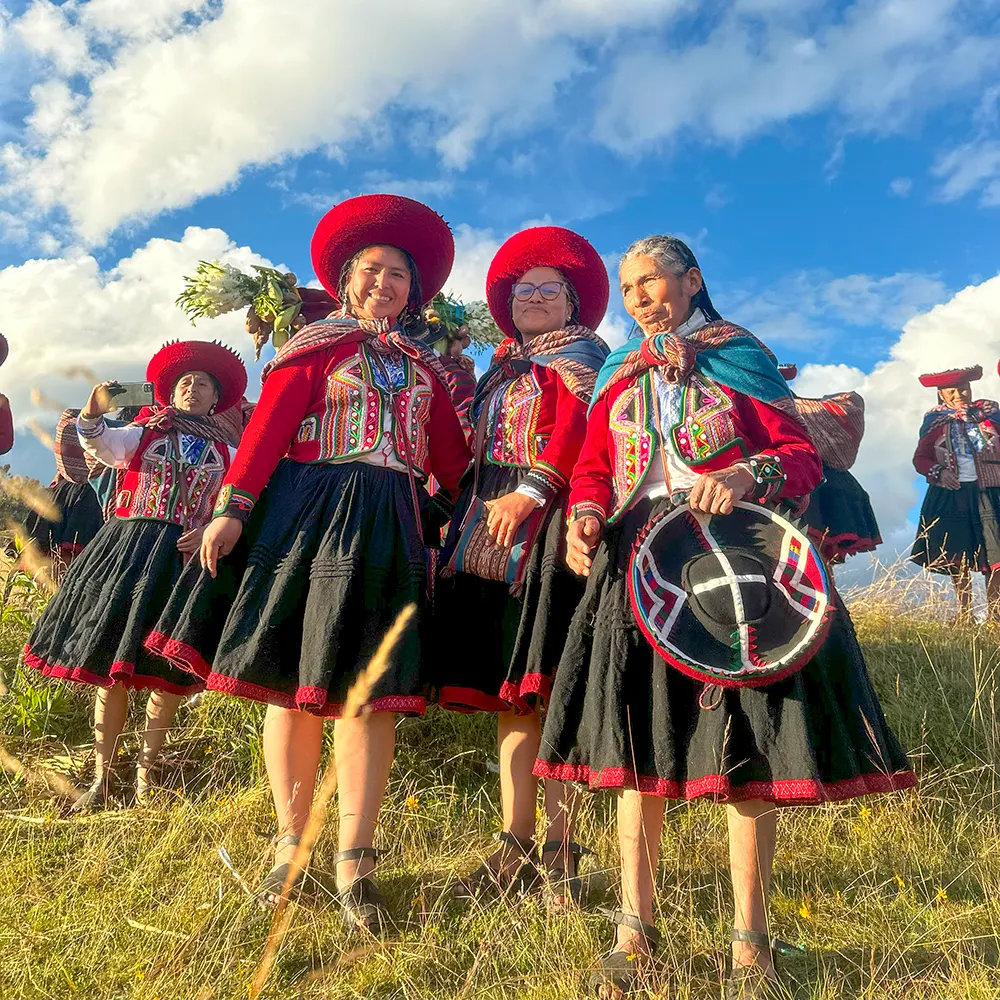
In May, when the potatoes come up in the fields around Chinchero, you will see groups of ten or fifteen people working one family’s plot together. They dig in a line, bent double, while someone keeps the sacks moving and someone else keeps the chicha moving. At midday everyone eats on a blanket at the edge of the field. Next week the same group will be in a different field, working for a different family.
Nobody is paid. Nobody is volunteering either. Each person there is either repaying a debt or creating one, and everyone knows exactly which.
That is ayni: reciprocity, the oldest and most practical rule of Andean life. It is the reason a despacho exists, the logic behind an Andean wedding, the glue of village politics and, if you listen to the paqos, the way the whole world stays in balance. It is also far stricter, and far more interesting, than the soft version that appears on yoga retreat posters.
This guide explains what ayni actually means, how it works in daily life in the Cusco region, how it extends to Pachamama and the mountains, and how you, as a visitor, can take part in it honestly.
Table of Contents
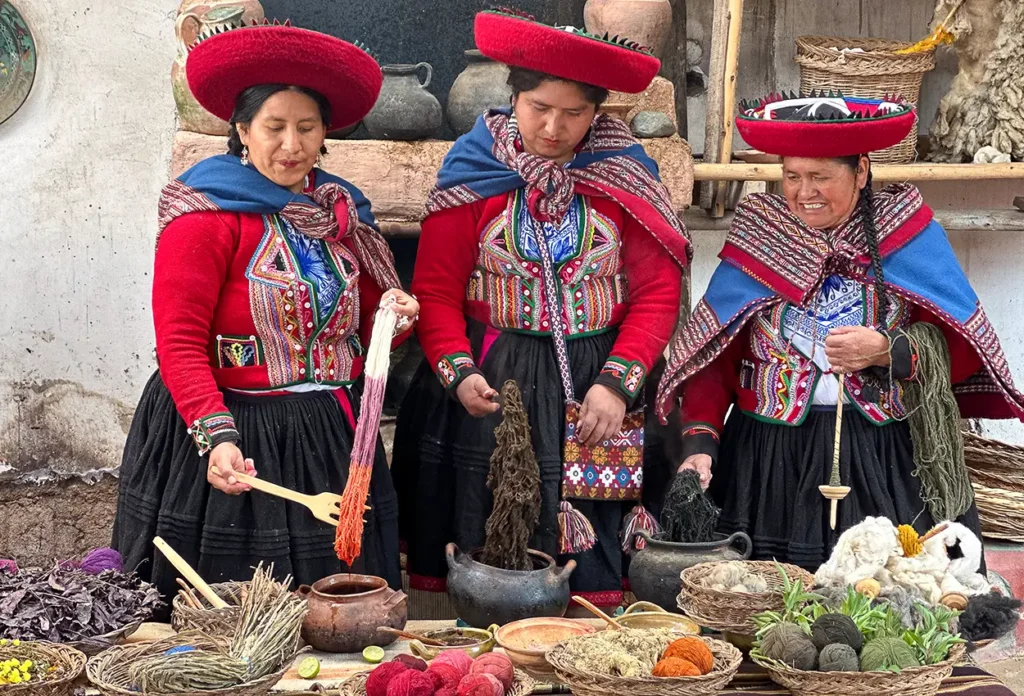
What Does Ayni Mean?
Ayni is a word shared by Quechua and Aymara, the two great indigenous languages of the southern Andes. In its simplest sense it means mutual help that must be returned: I help you now, you help me later, with something of comparable value.
The Smithsonian’s National Museum of the American Indian describes ayni as ongoing cycles of reciprocity in which Andean communities exchange comparable work or goods, a value that predates the Incas.
Three features make it different from ordinary kindness:
- It is an obligation, not a favour. Receiving help creates a debt. Not returning it damages your reputation and, in a small village, your ability to get help next time.
- It is measured. Three days of work are repaid with three days of work. A sack of potatoes given at a wedding is remembered and returned at the next wedding in the other family.
- It runs in a circle. Ayni does not end when a debt is paid. Repaying creates a new relationship, and the cycle keeps families tied together across generations.
The linguist Bruce Mannheim, in a well-known 1986 study of the language of reciprocity in southern Peruvian Quechua, showed how deeply this idea is built into the grammar itself, through verb forms that express doing something for each other. Andean speakers do not just practise reciprocity. They speak it.
You will sometimes hear the verb form aynikuy, to help one another, and phrases like ayniykusunchis, “let us help each other”. In Cusco Spanish, people simply say hacer ayni: to do ayni.
Ayni in Daily Life
Most of what ayni means is ordinary and practical. Here is where you can see it working in the Cusco highlands today.
In the fields
Potato planting and harvest are the classic examples. One family cannot plant or dig several plots alone in the short windows the weather allows. So households lend labour to each other in turn. The host family provides food, drink and coca; the guests provide their backs. The debt is paid when the host family turns up, with the same number of people, to work in the guests’ fields.
Building a house
Raising a roof is a big job and an important event. Neighbours and relatives come to help lay the beams and tiles. The day ends with a small celebration, often with a cross, a pair of ceramic bulls or a flag placed on the roof ridge, and a lot of chicha. Everyone who came is owed the same help when they build.
Weddings, baptisms and funerals
Life events are where ayni becomes most visible, and most carefully recorded. Guests at a highland wedding bring gifts of food, drink, money or animals, and families often keep a list. When those guests later hold their own celebration, the gift comes back in kind, sometimes a little larger. The same happens at funerals, when relatives bring food and drink to support the grieving family.
The Andean wedding traditions we describe elsewhere make full sense only through this lens: a marriage is two families entering a long relationship of mutual obligation, witnessed by godparents who are bound into it too.
Care and knowledge
Ayni is not only about labour and goods. Looking after someone’s animals, sharing seed, teaching a skill, caring for an elderly relative: all of these create obligations of return. Not necessarily to the same person, and not always quickly, but they are remembered.
Ayni, Mink’a, Faena and Mit’a: Four Kinds of Shared Work
Ayni is often confused with other forms of cooperation. In the Andes they are distinct, and the differences matter.
| Term | Who works for whom | Is it returned? | Example |
| Ayni | One household helps another | Yes, with equivalent work or goods | Neighbours dig each other’s potato fields in turn |
| Mink’a (minga) | Many people work for one host or for a shared good | Not with equal work; the host provides food, drink and a celebration | Clearing an irrigation channel, rebuilding a bridge |
| Faena | All members of a community, by obligation | No; it is a duty of membership | Repairing the village road or school |
| Mit’a | Subjects work for the state, in turns | Indirectly, through state support | Inca labour on roads and terraces; later the brutal colonial mining mita |
The most famous mink’a near Cusco is the annual renewal of the Q’eswachaka bridge over the Apurímac river. Every June, families from four communities twist grass into ropes and rebuild the bridge by hand. UNESCO recognised the tradition in 2013.
The mit’a deserves a note. Under the Incas, it was a rotating labour obligation that built roads, terraces and storehouses, balanced in principle by the state’s duty to feed workers and support communities in hard times. The Spanish kept the name and turned it into forced labour in the silver mines of Potosí, where many thousands died. That history is one reason Andean people can be wary when outsiders talk romantically about “communal work”.
Ayni with Pachamama and the Apus
Here is where ayni stops being an economic rule and becomes the core of Andean spirituality.
In the Andean worldview, the earth, the mountains, the springs and the dead are alive and are part of the community. If ayni is how you keep good relations with your neighbours, it is also how you keep good relations with them. Pachamama feeds you every day; so you feed her. The Apus send the water that waters your crops and protect your animals; so they receive their share. Our guide to the Apus and Andean mountain spirits explains who they are.
Our guide to Andean cosmovision explains this living world in more detail. Here are the everyday gestures through which ayni with the land is practised.
The ch’alla
Before drinking, a few drops are spilled on the ground for Pachamama. It is so ordinary that people barely notice they do it. You will see it at family meals, at football matches and at the inauguration of a new shop.
The k’intu
Three perfect coca leaves held together and offered with a breath, phukuy, to the Apus and Pachamama before the coca is chewed or used in ceremony. It is the smallest complete offering in Andean practice.
The despacho
The great offering. A paqo builds a small world on a sheet of paper: coca, seeds, sweets, llama fat, coloured wool, flowers, shells, sometimes figures of what is being asked for. Then it is wrapped and given to fire or earth. Spanish-speaking families often call it a pago, a payment, which describes the logic exactly. Our guide to despacho ceremony ingredients goes through each element.
August
The whole agricultural year has a rhythm of ayni with the land. In August, when the earth is “open” and fields are prepared for planting, families feed Pachamama most generously. See Pachamama Raymi.
When ayni is broken
Many highland families understand misfortune partly through this lens. A sick animal, a failed crop or illness in the household may be read as a sign that a relationship has been neglected: an Apu not greeted, the earth not fed, a debt left unpaid. The response is not guilt but repair. A paqo reads the coca, an offering is made, and the balance is restored.
This is a cultural and spiritual understanding. It sits alongside, not instead of, practical remedies, and most families use both.
Ayni in Ceremony
If you take part in an Andean ceremony in Cusco, ayni will be present from start to finish, even if no one names it.
At the opening, the paqo greets the Apus and asks permission to work in their territory. You are a guest; guests greet their hosts.
In the coca, every k’intu you offer is a small gift. Many paqos also carry a mesa, a bundle of sacred stones, which is itself built from gifts received over a lifetime. In a coca leaf reading, the leaves are first offered before they are read.
In the offering, every item you place in a despacho is something given in exchange for what you have received or are asking for. Paqos often encourage people to give thanks first and ask second.
At the close, the offering is burned or buried, and nobody watches it too closely. It no longer belongs to you.
After the ceremony, ayni continues. Paqos will often tell you that the best way to honour a ceremony is to do something good for someone else when you get home.
If you are deciding between ceremonies, our guide on which Andean ceremony to choose compares them, and you can book an offering to Pachamama directly or see all our ceremonies in Cusco.
Ayni and paying for ceremony
Visitors sometimes ask whether it is wrong to pay for a spiritual ceremony. In the Andean frame, the question is a little different. A paqo gives time, knowledge, materials and years of training. Fair payment is ayni. What breaks ayni is paying so little that the paqo is exploited, or charging so much that the exchange becomes extraction.
That is one reason we publish our prices and explain what they include.
Ayni in the Inca World
The Incas did not invent ayni, but they built a state on top of it.
At the household level, ayni and mink’a organised work as they always had. At the level of the state, the Incas asked communities for labour, through mit’a, rather than for money or goods. In return, the state was expected to redistribute: to feed workers, to fill the great storehouses, qollqas, with food and cloth, and to open them in years of drought or war. The anthropologist John Murra famously described this as an economy of reciprocity and redistribution.
You can still see the evidence. Rows of qollqas line the hillsides above Ollantaytambo and other sites in the Sacred Valley. The terraces at Moray and Pisac were built and maintained by rotating labour. The Smithsonian notes that ayni helped the Incas accomplish monumental projects, from water management to diversified agriculture.
None of this means the Inca state was gentle. Conquered peoples were moved, labour was demanded and power was concentrated in Cusco. But it was built on a recognisable idea: those who give work are owed care in return.
The Hard Side of Ayni
It would be easy to make ayni sound like a gentle utopia. People who grew up with it will tell you it is more complicated than that.
- Debts are remembered for a long time. A family that cannot repay, because of illness, migration or a bad harvest, can feel the weight of that for years. Ayni builds security, but it also builds pressure.
- Celebrations can become expensive. Because gifts at weddings and festivals are returned, and often returned with a little extra, the cost of hosting can climb from one generation to the next. Some families take on serious debt to sponsor a festival, partly out of devotion and partly because refusing would break a long chain of obligation.
- Not everyone gives the same kind of work. Who digs, who cooks, who serves the chicha and who sits with the elders is shaped by age and gender. Many women in the valley do a double share: field work in the morning, cooking for twenty in the afternoon.
- It can exclude. Ayni works between people who are already inside a network of kin and neighbours. Newcomers, the very poor and families who have fallen out with the community can find themselves outside it, with no one to call on at harvest.
None of this makes ayni less valuable. It makes it real. When paqos speak about ayni in ceremony, they are not describing a fantasy of perfect harmony. They are describing something people work at, argue about and keep returning to, because the alternative, in a harsh landscape at 3,800 metres, is to face everything alone.
For visitors, this is worth keeping in mind. The people who welcome you into a ceremony or a home are not performing a timeless ideal. They are living inside a system of obligations that is demanding as well as generous, and your fair share of the exchange matters to them.
Ayni Today: From Villages to Wellness Retreats
Ayni is alive in highland communities, and it has also travelled far beyond them.
In communities
In the villages around Chinchero, ayni still organises harvests, house-building and life events. It also shapes politics. Community authorities who serve the village for a year are, in a sense, repaying the community for what it has given them, and they expect the next generation to do the same.
Migration and money have changed it. Young people work in Cusco or Lima and send cash instead of labour. Some families hire workers rather than calling on neighbours. Ayni bends, but it has not broken.
In modern Andean teaching
Since the 1970s, teachers in Cusco who explain Andean spirituality to foreigners have expanded ayni into a broader idea: an exchange of energy between people, nature and the cosmos, connected with the concepts of sami (refined energy) and hucha (heavy energy). This is a sincere and often useful teaching, but it is a modern interpretation. In a village, ayni is first of all about potatoes, roofs and weddings.
You will also see “ayni” used in yoga studios, cafés and wellness brands around the world, often meaning something like “good vibes” or “giving back”. Some Andean writers and organisations have asked, reasonably, that the word not be turned into a slogan detached from the communities it belongs to. We agree. Ayni without obligation, measurement and return is not ayni. It is just generosity, which is good, but different.
How Travellers Can Practise Ayni in Cusco
You will be on the receiving end of a great deal in Peru: hospitality, teaching, landscape, ceremony. Here are some concrete ways to give back that make sense in Andean terms.
- Pay fairly, and directly when you can. Buy textiles from weavers in Chinchero rather than from resellers, and accept the asking price for fine work. Hand-woven pieces take weeks.
- Tip guides, porters, cooks and drivers properly. On treks especially, porters’ tips make up a meaningful part of their income.
- Give something to the land. Accept coca when it is offered and make a k’intu. Spill a little of your drink before drinking. Add a stone to an apacheta at a high pass. Do not take stones from huacas.
- Learn a few words. Allillanchu? (How are you?) and sulpayki (thank you, in Cusco Quechua) are received with obvious pleasure.
- Ask before you photograph, and if someone poses for you, the polite answer is a small payment or a print sent back.
- Support the communities, not just the sights. Our social project is one way, and there are many good local initiatives in the valley.
- Carry it home. Paqos often say that the real ayni of a ceremony is how you treat people afterwards.
If you want to see ayni in practice rather than read about it, a spiritual retreat in the Sacred Valley or a spiritual journey in Peru with time in the communities will show you more than any article.
Words Related to Ayni
A few terms you will hear alongside ayni. Our Andean spiritual glossary has the full list.
| Term | Meaning |
| Ayllu | The extended kin community within which ayni is practised |
| Mink’a | Collective work for a host or shared good, repaid with food and celebration |
| Ch’alla | Sprinkling drink as an offering to the earth |
| K’intu | Three coca leaves offered with a breath |
| Despacho | The great offering bundle given to Pachamama and the Apus |
| Yanantin | Complementary pairs; the idea that opposites complete each other |
| Sumaq kawsay | “Good living” in balance with community and land |
Ayni: Frequently Asked Questions
What does ayni mean?
Ayni is the Quechua and Aymara word for reciprocity: help that must be returned with something of comparable value. It organises shared work, gifts at weddings and funerals, and the relationship between people, Pachamama and the mountains.
Is ayni the same as kindness or charity?
No. Ayni is an obligation, not a favour. Receiving help creates a debt that is remembered and repaid. Generosity is welcome in the Andes, but ayni is specifically about balanced exchange over time.
What is the difference between ayni and mink’a?
Ayni is one household helping another and receiving the same help back. Mink’a is many people working for one host or a shared good, repaid with food, drink and celebration rather than equal work.
How does ayni relate to Pachamama?
The earth feeds people, so people feed the earth. Offerings such as the despacho, the ch’alla and the k’intu are ayni with Pachamama and the Apus, the mountain spirits.
Is ayni a Q’ero concept?
Ayni is shared by Quechua and Aymara communities across the southern Andes, including the Q’ero. It is not exclusive to any one community or to Peru.
Do people in Cusco still practise ayni?
Yes, especially in rural communities, where it organises harvests, house-building and life events. Migration and paid work have changed it, but it remains central.
How can visitors practise ayni?
Pay fairly, buy directly from makers, tip guides and porters properly, ask before photographing, make small offerings such as a k’intu or a ch’alla, and support local community projects.
Is it against ayni to pay for a ceremony?
No. Fair payment for a paqo’s time, knowledge and materials is itself reciprocity. What breaks ayni is exploitation in either direction.
What is the ayni principle in Andean mysticism?
In modern Andean teaching, ayni is expanded into an exchange of energy between people, nature and the cosmos. It is a modern interpretation built on the older, practical meaning.
How do you pronounce ayni?
Roughly “EYE-nee”, with the stress on the first syllable.
Giving Back
Before you leave Cusco, think about what you received and who gave it to you: the woman who sold you a hand-woven belt, the porter who carried your tent over a 4,600-metre pass, the paqo who read your coca, the mountain you could not stop looking at.
Then decide what you will give back, here or at home. That is ayni. It does not need to be grand. It needs to be remembered.