Apus: What Andean Mountain Spirits Actually Are
 By PumAdventures
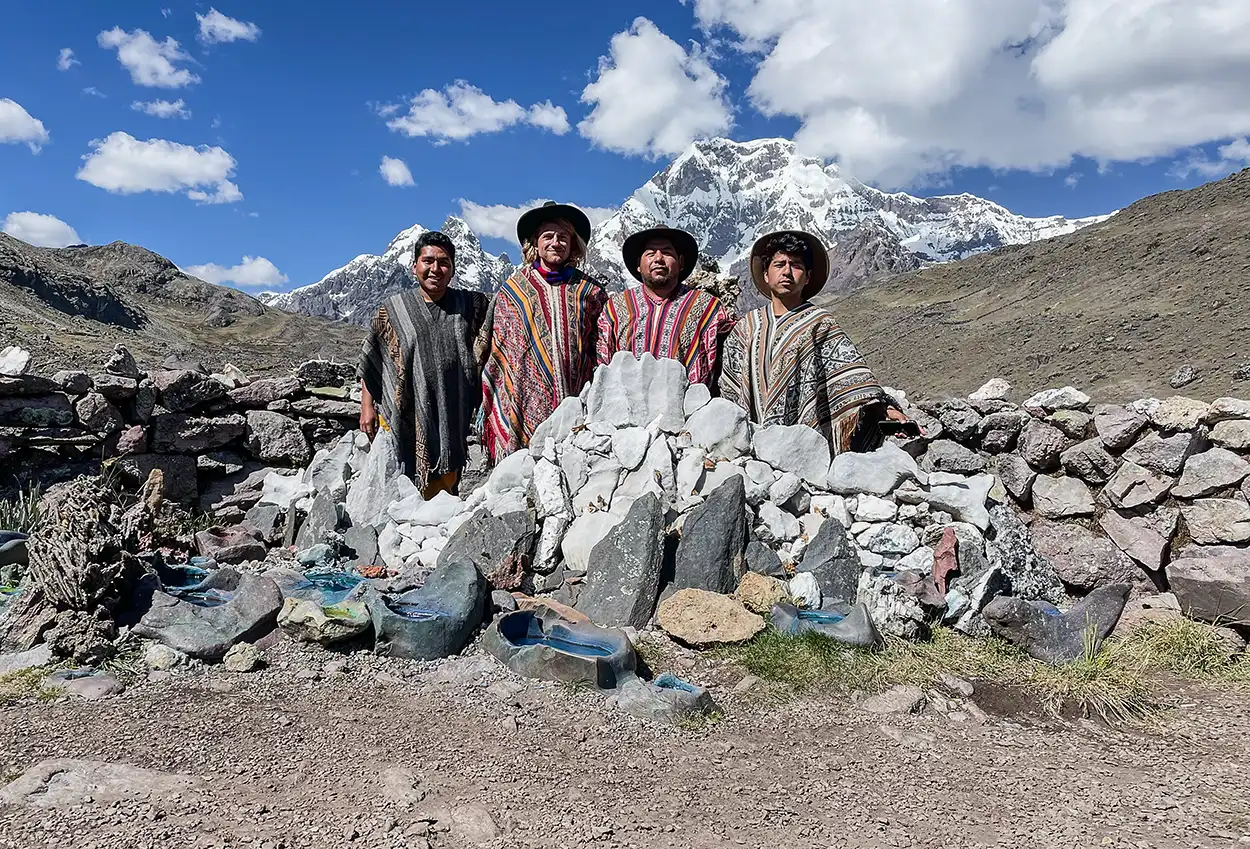
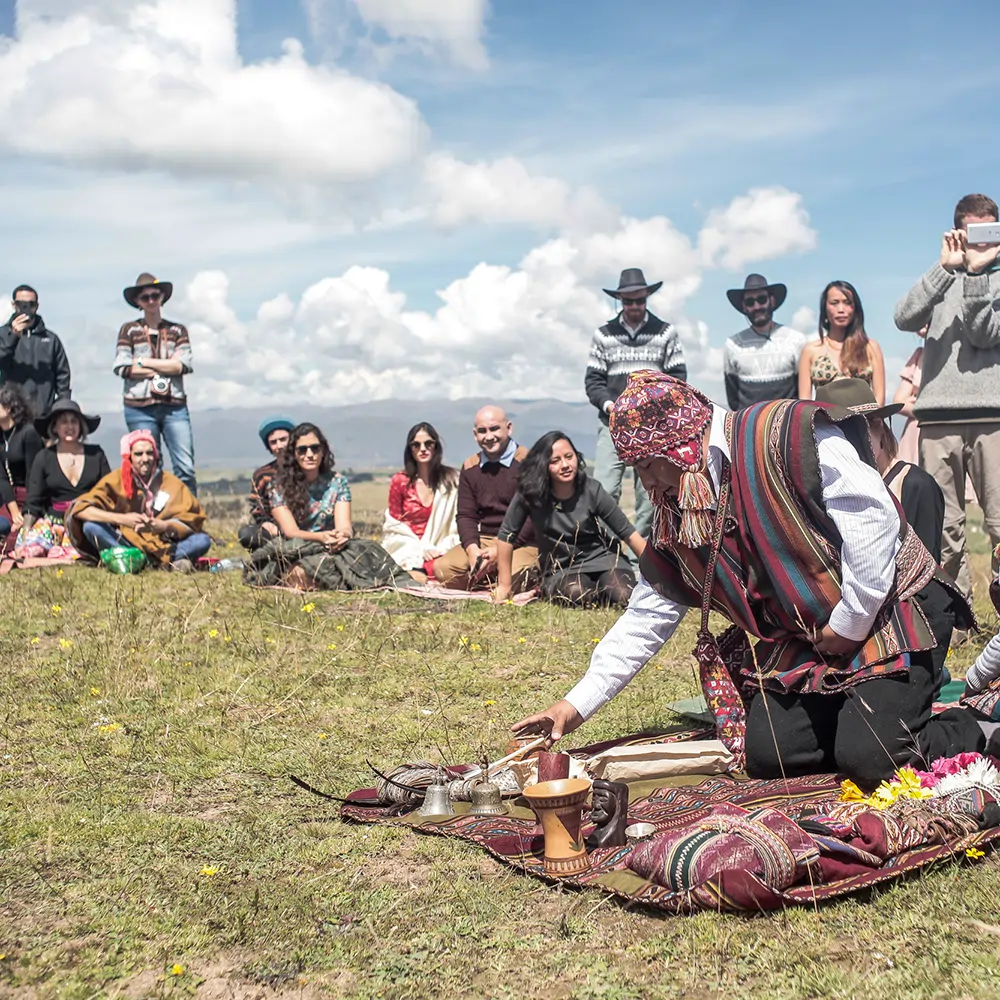
Sit through a despacho in Chinchero and you will notice the paqo is not praying in general. He is listing.
The names come in a particular order — the great snow peaks first, then the regional mountains, then the hills of that specific valley, and last the one you happen to be standing on. Each name gets its own breath across three coca leaves. Nobody is improvising. He is working through a map.
That list is what this article is about. Andean mountain spirits — Apus — are not a poetic way of saying the scenery feels impressive. They are named beings with territories, ranks, appetites and tempers, and relating to them is a practice with rules.
The word appears on half the pages of this site and on every tour brochure in Cusco. Almost nobody explains it.
Table of Contents
The Word Means Lord, Not God
Apu is Quechua for lord. It was and is used for people — a chief, a man of standing, an authority. The same word applied to a mountain says something precise about the relationship: not worship from below, but obligation between parties of unequal power.
“Mountain god” is the usual English rendering and it drags in the wrong furniture. A god in the Mediterranean sense sits outside the world and receives devotion. An Apu is in the world, owns a specific stretch of it, and can be negotiated with, neglected, offended and placated.
Sabine Dedenbach-Salazar Sáenz, in a 2017 study in Anthropos, describes Apus as localised deities who communicate with humans and whose arrangement mirrors the human social and economic order. That last part is the useful insight: the hierarchy of mountains looks the way it does because it reflects how Andean communities themselves are organised.
So the mountains have lords, and the lords have jurisdictions.
Not a Metaphor. An Owner.
Here is the part that most travel writing softens into something comfortable.
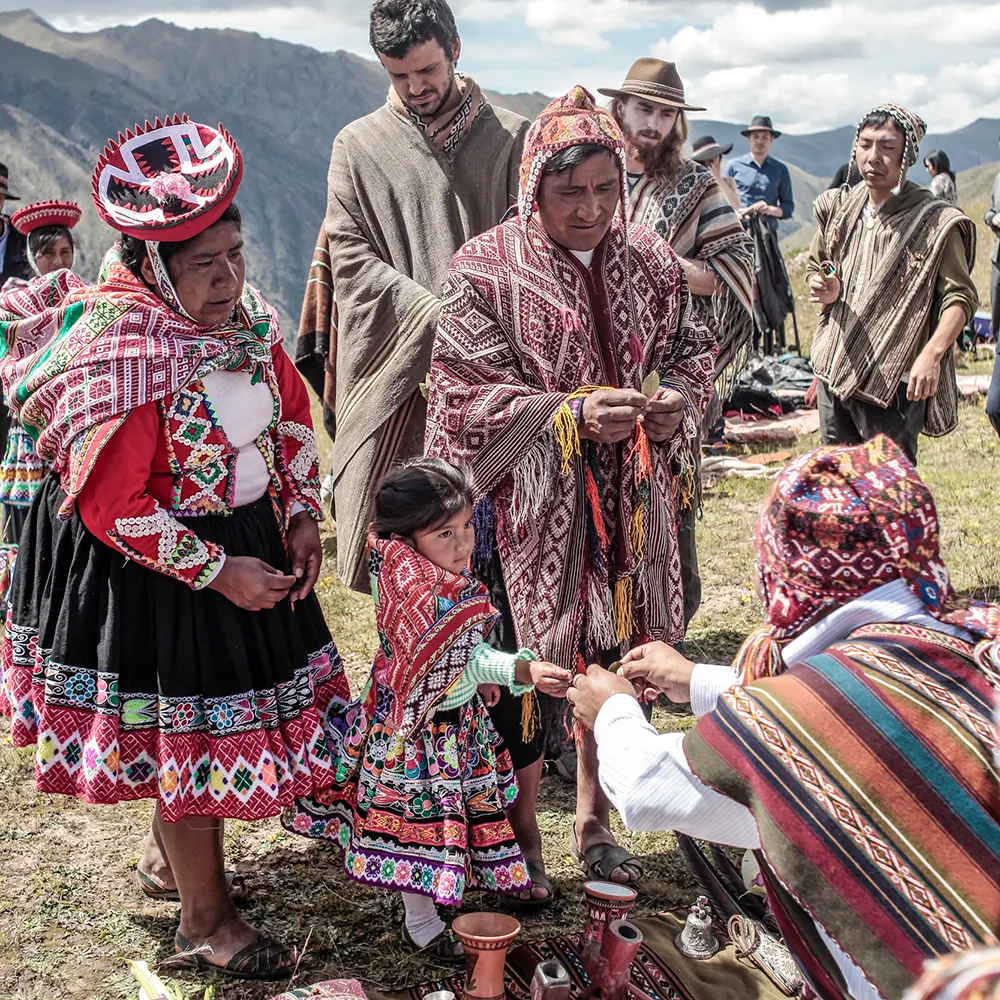
In the high communities, the Apu is understood as the owner of its territory — the land, the water running off it, and the animals grazing on it. The alpacas on a slope above Ocongate are not merely pastured on the Apu’s mountain. In the local framing they belong to it, and the herder holds them on terms.
That changes what an offering is for. It is not a compliment. It is a payment on an account that is always open.
The Quechua word is ayni — reciprocity, mutual obligation, the same principle that governs who helps whom at harvest. Applied to a mountain, it means the relationship has two sides and both are expected to deliver. Water comes down; something goes up.
And the account can go bad. Apus are not benevolent by default. Published ethnography records them held responsible for illness, accidents, lost animals and landslides when obligations have been skipped. One Bolivian account collected in the literature has a mountain killing a healer who broke his side of a bargain.
Keep that in view when you read websites offering to connect you with the loving energy of the mountains. The tradition is not sentimental about them.
The Same Beings, Different Names
Travel four hundred kilometres and the vocabulary changes while the concept holds.
- Apu — Cusco and the southern Quechua-speaking highlands. The term you will hear.
- Wamani — Ayacucho.
- Awkillu — Huánuco.
- Achachila, mallku, machula — the Aymara regions of Bolivia, varying by district.
- Si-pong — recorded for the Chimu language of the north coast.
Researchers have argued these likely represent a pan-Andean category of spirit rather than separate inventions. Johan Reinhard’s point is subtler and worth holding: the terms can function as straightforward synonyms, or they can mark different ranks within one hierarchy — with the most powerful beings residing in the tallest mountains.
Which means the geography is not decorative. Altitude correlates with authority.
The Hierarchy of Andean Mountain Spirits
Ask two paqos from different valleys to list the Apus and the lists will not match. This is not confusion. It is the system working as designed.
At the bottom, the hills you can see from your doorway. The small rises around a community have names and are addressed. Dedenbach-Salazar notes that the minor mountains, the awkis, carry a word that also means ancestor — the dead and the hills are not filed in separate categories.
In the middle, the mountains a whole valley shares. These get named at every ceremony held within sight of them.
At the top, the great snow peaks. Ausangate and Salkantay are named in despachos across the entire Cusco region, including by people who have never stood at their base.
The ordering is territorial, and this is the single most misunderstood thing about the whole subject. Your Apu is not a preference. It is a function of where you are standing. Walk over a pass into the next drainage and the list of who must be greeted changes, because you have entered someone else’s jurisdiction. The naming always finishes with the local one, because that is the authority whose ground your feet are on.
The Apus Above Cusco
Locally you will hear a list of the city’s tutelary mountains, and the version most often given runs: Ausangate, Salkantay, Pachatusan, Senqa, Wanakawri and Mama Simona.
Treat that as a widely repeated local convention rather than a fixed canon. The composition shifts depending on who is speaking and from which neighbourhood.
Ausangate — the greatest
At 6,384 m, Ausangate is the highest mountain in the Cusco region and the ninth highest in Peru, rising from the Vilcanota range about a hundred kilometres southeast of the city. It is the paramount Apu of the region, associated with the condor, and the source of the water that the whole southeastern quarter depends on.
You cannot see it from the Plaza de Armas. From high ground above the city on a clear winter morning you can, and the effect of picking it out on the horizon explains a great deal about why it holds the rank it does. Our complete Ausangate trek guide covers walking beneath it, and the three-day route is the shortest way to spend real time in its territory.
Salkantay — the wild one
6,271 m, west of Cusco, and the second of the great regional Apus. The name is usually read as salqa — wild, untamed, savage — and the reading tells you how the mountain is handled. It is not the gentle one.
Salkantay also guards the western approach to Machu Picchu, which is why the trek beneath it carries a weight that the pure logistics never explain. We go into the route in the Salkantay trek guide and sell it as a five-day crossing.
Pachatusan — the pillar of the world
East of Cusco, visible from much of the city, and carrying one of the better names in the Andes: pacha tusan, the pillar or support of the world. A mountain whose job description is holding things up.
Wanakawri — the origin hill
South of the city, and important out of all proportion to its height. Wanakawri belongs to the Inca origin narrative — the hill where one of the founding brothers turned to stone — and it was among the most significant shrines of the Inca state. It sat on the ceque network that organised Cusco’s sacred geography, which we map in our guide to the power places of Cusco.
Senqa — the near guardian
A hill of the immediate ring north of Cusco, named at ceremonies held in and above the city.
Mama Simona — the female one
Northwest of Cusco, adjacent to the Sacsayhuamán sanctuary, and visible from the main square and from the junction of Plaza del Cabildo and Santa Teresa.
Almost all the Apus are addressed as male. Mama Simona is not. Local scholarship has suggested her feminine identity arose from a need for a complementary presence in an otherwise masculine arrangement, and the shape of the hill supports the reading — soft lines where the others are rough and abrupt.
She is not an isolated case. Paired peaks elsewhere in the region are told as couples, and the Pitusiray and Sawasiray pair above Calca is the best-known example. The gendering of the landscape is more varied than the standard “father mountains, mother earth” shorthand suggests.
How a Relationship Actually Works
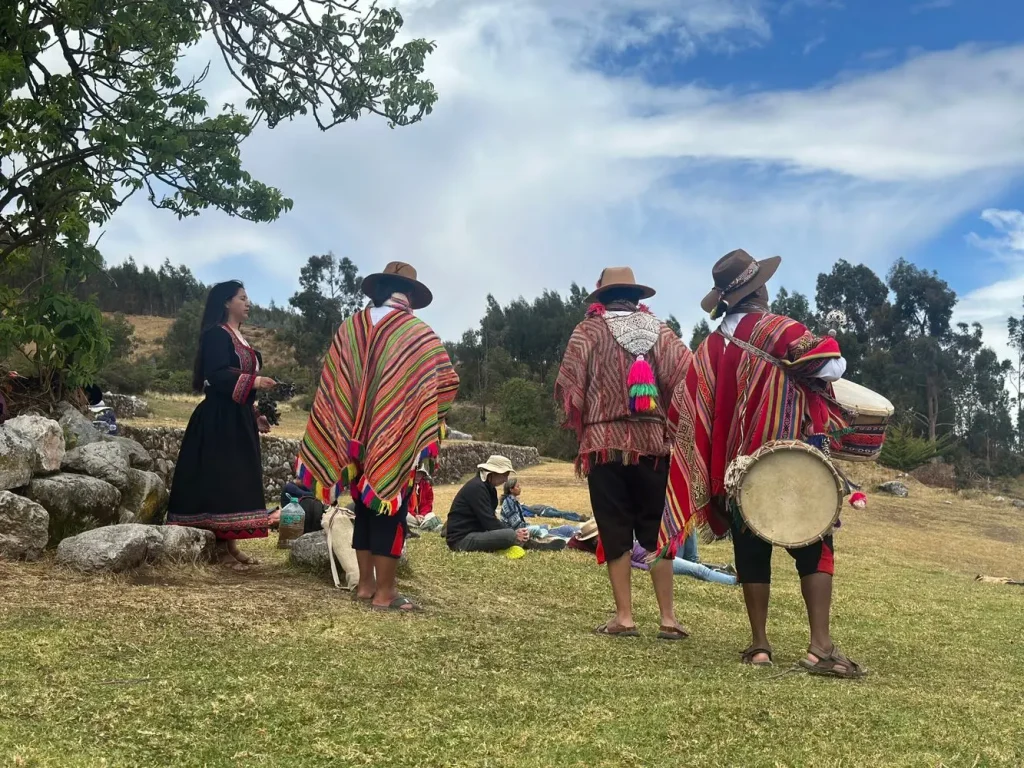
Four practices, all of them ordinary rather than exotic.
The k’intu. Three perfect coca leaves held in a stack, stems towards you. This is the basic unit of offering — the smallest complete gesture you can make. Our article on what the coca leaves mean covers the leaf’s wider role in Andean practice.
The phukuy. You blow across the k’intu while naming the mountain. The breath carries the name. This is why the paqo’s lips move over the leaves before anything is burned or buried.
The challa or t’inka. A few drops of chicha or trago flicked towards the ground and towards the peaks before anyone drinks. Done at construction sites, before a journey, at the start of a drinking session. It is the most common ritual act in the southern Andes and most visitors watch it happen without registering it.
The despacho. The full offering — a bundle built from coca, llama fat, seeds, sweets, wool, shells and more, assembled in a specific order and then burned or buried. The naming of the Apus is the spine of the ceremony. Every element in it is catalogued in our guide to despacho ingredients.
August concentrates all of this. The earth is said to open at the start of the month and offerings are made across the region, which we cover in the piece on Pachamama Raymi.
Who Is Allowed to Speak to Them
Not everyone. The distinction matters and the marketing blurs it.
A pampamisayoq works with the earth, with the mesa and with the ordinary run of ceremony — healing, offerings, divination. Most practitioners you will meet, including excellent ones, sit here. The word appears on this site as one of several names for a mesa carrier, and our page on what a mesa is describes the working kit.
An altomisayoq is held to speak directly with the Apus. Dedenbach-Salazar’s survey of the ethnographic record puts it plainly: the altomisayuq is the highest and most reliable person to consult, specifically because he can talk with the deities. The initiation is attributed to the mountain rather than to a teacher, often through lightning, and it is not a qualification anyone awards themselves.
A kuraq akulleq sits above that again in some accounts, and the tier is reported thinly enough that honest treatment means saying so.
Two honest cautions. First, the ranks are not administered by any body; there is no register. Second, “altomisayoq” has become a marketing word in Cusco, and the number of people described that way in brochures exceeds the number recognised as such by the communities. A real indicator is simple and unglamorous: who vouches for them where they come from. Our team page names who we work with and where they are from, and the wider frame is in our overview of the Andean healing world.
Ice, Water and What Is Being Lost
The Apus are not abstractions to the communities beneath them, because the glaciers are the water supply. Rank, altitude and survival sit on the same axis.
Which makes the clearest example of change in Andean ritual also the saddest.
Qoyllur Rit’i — the Snow Star pilgrimage — draws some ninety thousand people into the Sinakara hollow beneath Ausangate, beginning fifty-eight days after Easter Sunday. Pilgrims arrive grouped into eight nations by village of origin: Paucartambo, Quispicanchi, Canchis, Acomayo, Paruro, Tawantinsuyo, Anta and Urubamba. UNESCO inscribed it on the Representative List of the Intangible Cultural Heritage of Humanity in 2011.
The masked figures who keep order — ukukus, also called pablitos or pabluchas — traditionally climbed onto the glacier at night and brought blocks of ice down to their communities, where the meltwater was treated as carrying the mountain’s healing.
That stopped in 2004, when festival organisers banned the cutting of ice blocks in an effort to slow the glacier’s retreat. Peru’s tropical glaciers have lost roughly a third of their area in recent decades, as National Geographic reported in its coverage of how Andean ritual is being reshaped by ice loss.
A practice that ran for generations was given up voluntarily to protect the being it honoured. Read that as ayni working exactly as described — the obligation flowing uphill for once. Our page on the Snow Star pilgrimage covers attending it.
Documented, Debated, Interpreted
Sorting the claims is the most useful thing an article like this can do, because almost nothing else on the subject does it.
| Claim | Standing |
| Mountains are addressed as named lords with territories across the Quechua and Aymara Andes | Documented — colonial sources through to modern ethnography |
| Regional terms (wamani, achachila, awkillu) name the same category of being | Documented, with regional variation in detail |
| Apus own land, water and herds, and relationships run on reciprocity | Documented in community ethnography |
| Apus can cause harm when neglected | Documented in the ethnographic record |
| A formal three-tier hierarchy of paqos with fixed criteria | Debated — the tiers appear in the literature but are reported inconsistently |
| Which mountains count as Cusco’s tutelary Apus | Debated — local lists vary and that is intrinsic to the system |
| Apus as personal spirit guides you can choose and work with | Modern interpretation — Western, not traditional. The relationship in Andean practice is territorial and collective |
| Apus as energy vortices | Modern interpretation, imported from 1980s Sedona and unrelated to Andean sources |
If a page tells you the Apus have been waiting for you personally, you are reading the eighth row, not the first.
Five Things Visitors Get Wrong
- Choosing a personal Apu. The commonest error, and it inverts the logic. You do not select a mountain; the mountain you are beneath has a claim on you while you are there.
- Claiming to channel one. Speaking for an Apu is attributed to the altomisayoq and understood as initiated by the mountain itself. Announcing after a ceremony that Ausangate gave you a message is, inside the tradition, an extraordinary claim.
- Buying an “Apu ceremony” in a hotel room in Cusco. Place is not incidental. An offering is made somewhere, to the beings of that somewhere.
- Treating the names as interchangeable poetry. They are not synonyms for “sacred mountain”. Each one is a specific party with a specific territory.
- Mishandling apachetas. The stone cairns at high passes are offerings, and taking stones from them or rebuilding them for photographs is exactly the sort of thing people wince at. We treat the pass-and-apacheta tradition properly in the article on the Inca Trail as a pilgrimage.
If You Want to Meet One Properly
There is a sensible order to this, and it is not the order most itineraries use.
- Start with a despacho. This is the ceremony in which the Apus are named, and it is the appropriate introduction — unhurried, built on reciprocity, and conducted in the specific place by someone from that place. Our Andean rituals page covers the formats we run in Chinchero and across the valley.
- Add a coca leaf reading. An hour, from $70, and the gentlest door into Andean practice. The reading itself begins with the Apus being greeted.
- Then walk somewhere. Reading about territorial authority is one thing; crossing a 4,600 m pass and understanding why the pass is where the offering goes is another. Ausangate and Salkantay are the two great Apus of the region, and both have routes beneath them. The peaks of the Sacred Valley are gentler ground, and our page on Sacred Valley spiritual sites sets out which Apu presides over each.
- Where plant ceremonies fit. Some visitors come for wachuma — San Pedro — or for an ayahuasca retreat, and want that alongside time in the mountains. It works, but the sequencing is not casual: these are powerful preparations, they are not spaced like activities on a list, and the body needs to be acclimatised and rested first. Our seven-day Cusco itinerary sets out realistic gaps between ceremonies, and the piece on combining a trek with ceremony explains why ceremony after a trek beats ceremony before it.
- The responsibility part, stated plainly. Wachuma and ayahuasca are psychoactive and carry real physical and psychological risk. Cardiac and psychiatric conditions, and a range of prescription medications — serotonergic antidepressants above all — are genuine contraindications, not paperwork. Discuss participation with your own doctor before booking, and tell us what you are taking. We screen, and we decline people when declining is the right answer. Our guide to ayahuasca and antidepressants covers that interaction in detail.
Altitude carries its own risk independent of all of this. Ceremony sites and mountain routes around Cusco sit above 3,300 m, and some well above 4,500 m. Allow days, not hours, and descend if symptoms worsen.
Frequently Asked Questions
What does Apu mean?
Lord, in Quechua. It is used for people of authority as well as for mountains, and the shared word tells you the relationship is one of obligation rather than abstract worship.
Are Andean mountain spirits the same as gods?
Not in the usual sense. They are localised beings that own territory, interact with the communities beneath them, and can be offended. “Lord” translates the relationship better than “god”.
Which is the most important Apu in Cusco?
Ausangate, at 6,384 m — the highest mountain in the region and the one named across the whole southeastern Cusco area. Salkantay, at 6,271 m, is the other great one.
Can I choose my own Apu?
Not within the tradition. The relationship is territorial: the mountains with a claim on you are the ones whose ground you are standing on. Choosing a personal mountain is a Western addition.
Are all Apus male?
Most are addressed as male, but not all. Mama Simona near Cusco is female, and paired peaks elsewhere are told as couples.
What is the difference between a pampamisayoq and an altomisayoq?
A pampamisayoq works with the earth, the mesa and ordinary ceremony. An altomisayoq is held to speak directly with the Apus, with an initiation attributed to the mountain itself. The second is rarer than Cusco’s brochures imply.
Why are mountains given offerings?
Because of ayni — reciprocity. The mountain provides water, pasture and protection, and something is owed in return. The offering settles an account rather than paying a compliment.
Are the Apus the same as energy vortices?
No. “Vortex” entered spiritual tourism from 1980s Sedona, Arizona. It has no basis in Andean sources, and the documented sacred geography of Cusco is considerably stranger and more precise.
Can I visit an Apu?
You can walk in its territory, which is what the Ausangate and Salkantay routes do. There is no summit visit involved and none is wanted — the relationship happens on the slopes and at the passes.
Do the ukukus still bring ice down from the glacier?
No. Cutting ice blocks at Qoyllur Rit’i was banned in 2004 to slow the glacier’s retreat. The pilgrimage continues; that specific practice was given up.
What should I not do around an Apu?
Don’t take stones from apachetas at passes, don’t rearrange offerings for photographs, and don’t claim an Apu spoke to you. Watch what local walkers do and copy it.
The Thing Worth Taking Away
The mountains around Cusco are not backdrop. They are named, ranked, territorial, and owed something — and the people who live beneath them have been keeping that account for centuries, in a vocabulary that changes every few hundred kilometres while the logic holds.
You do not need to believe any of it to travel better for knowing it. You only need to notice the next time somebody flicks the first drops of a drink onto the ground before raising the glass, and understand that it was addressed to a specific lord, by name, on their own ground.
Tell us your dates and we’ll build a few days around the mountains that matter where you’ll be standing.
This article draws on published ethnography of the southern Andes, including Sabine Dedenbach-Salazar Sáenz’s survey of Andean deities and spirits in Anthropos 112/2 (2017), and on the comparative literature on Andean sacred mountains. Where accounts differ we have said so rather than choosing. Archaeological sites and pilgrimage routes mentioned here are administered by Peru’s Ministerio de Cultura, and offerings at them are regulated. Trekking and ceremony in the Cusco region take place at altitude and carry a risk of altitude illness regardless of fitness; plant ceremonies carry additional physical and psychological risks and have real medical contraindications. Consult your own physician before participating, and understand that participation is undertaken on your own informed responsibility.