Andean Wedding Traditions: What Each Ritual Actually Means
 By PumAdventures

Most descriptions of an Andean wedding read like a Western ceremony in different clothes. Vows here, rings there, a blessing, a kiss, confetti made of flower petals.
That framing misses the thing that makes the tradition interesting, which is this: in the Andean world, marriage was never a day. It was a process, and the ceremony came somewhere in the middle of it.
Understand that one point and every element of the ritual stops looking decorative and starts looking structural. The binding, the coca leaves, the offering burned on a hillside, the two older couples standing just behind you — none of it is symbolism added to a contract. It is the Andean way of marking a relationship that is already under way and is being formally handed into the care of a community, a landscape, and a set of obligations that outlast the party.
This guide goes through the Andean wedding traditions one element at a time: what each is, where it comes from, what it means, and — the part nobody writes — which pieces are documented in the historical record and which are contemporary readings of older material. We would rather tell you that honestly than sell you a mystique.
If you are working out logistics instead, our guides to the cost of an Andean wedding in Cusco and where to hold the ceremony cover that ground. This one is about meaning.
Table of Contents
First, the Part That Reframes Everything: Marriage Was a Process
Before any ceremony, there was a period of living together.
The Quechua term varies by region — sirvinakuy, servinakuy, warmichakuy — and the practice was straightforward. A couple moved in together, often with one set of parents, and stayed that way for a stretch of time before anything was formalised. A study of indigenous marital life in colonial Peru, published in the Hispanic American Historical Review, describes it as a cohabitation lasting from a few months to two or three years, understood as a way to test compatibility — practical as well as sexual — and, in the logic of the communities practising it, to make the eventual marriage stronger.
Read that again. The trial period existed to protect the marriage. It was not laxity. It was quality control.
The Church spent two centuries trying to stamp it out
This is where the record gets vivid, and where you learn how seriously both sides took it.
Church officials objected to sirvinakuy continuously from the sixteenth century into the eighteenth. Viceroy Toledo, in the 1570s, called it “noxious and pernicious to their conversion” and recommended punishment. Priests were instructed to preach against it, and to press the point in confession.
Some went considerably further. The same study records priests locking young people inside churches to force marriages — and communities pushing back, formally complaining about it.
Rural priests were often the more tolerant party. Many rarely used the church courts to compel couples to formalise unions they regarded as settled. The Church cared much less about casual relations than about cohabitation, because cohabitation was public, durable, and therefore a visible rival to the sacrament.
Why this matters at your ceremony
Two reasons, and both are worth carrying.
The first is that you are participating in something that survived active suppression for two hundred years. The tradition in front of you is not a museum reconstruction; it is what was left after a long argument, and what was left was a lot.
The second is more personal. If you have been together for years, or you are renewing vows after a decade, or you are marrying in Peru because the paperwork happened quietly at home — the Andean frame has no problem with any of that. A ceremony that marks a relationship already in motion is exactly what this tradition was built to do.
A Note on the Words, Because It Tells You Something
Kasarakuy is the Quechua verb used for marrying. It comes from the Spanish casar, with the Quechua reflexive-reciprocal ending -kuy attached.
That construction is a small piece of history in itself. The grafting of a Spanish root onto a Quechua ending is what languages do when a new institution arrives and has to be named — and it suggests that the single binding ceremony, the wedding as one decisive event, arrived with the Church.
What preceded it had other names and other shapes: the asking, the negotiation between families, the agreement, the cohabitation, the eventual formalisation. Terms differ from valley to valley and we are wary of presenting any one list as canonical, because the regional variation is real and the ethnographic record is uneven.
So the honest summary is this. The ceremony is a colonial-era container. What goes inside it is far older. The coca, the mountains, the reciprocity, the offerings, the role of the elders — those are the continuous part.
Andean Wedding Traditions, Element by Element
What follows is the sequence as our maestros in Chinchero conduct it, with the meaning of each part. Order varies by officiant and by place; the elements are consistent.
1. Opening the space and naming the Apus
Nothing begins until the mountains have been greeted.
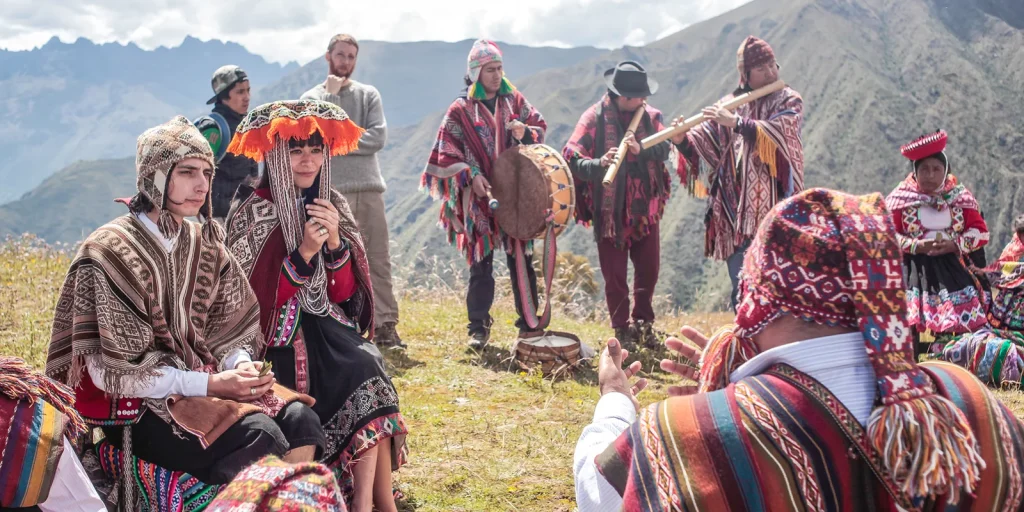
The maestro turns to the horizon and names the Apus — the mountain lords — in order: the great snow peaks first, then the regional mountains, then the hills of that specific valley, and last the one you are standing on. Each name is carried on a breath blown across three coca leaves.
This is not scene-setting. In Andean practice the Apus are the authorities whose territory you are in, and a ceremony is conducted with their permission. We explain how the whole system works in our guide to the Apus and Andean mountain spirits.
For a wedding specifically, the naming does something else useful. It locates your marriage somewhere. Not in a venue — in a landscape with names. Couples who marry at Chinchero are married under Apu Pachatusan and the peaks of the Urubamba range, and if they come back in twenty years the witnesses are still standing there.
2. The k’intu
Three perfect coca leaves, stacked, stems towards the giver, held between thumb and forefinger.
The k’intu is the smallest complete offering in Andean practice, and it is the gesture that recurs more than any other. In a wedding, the couple each prepare k’intus, blow their intention across them, and exchange them — and then both are given to the offering that will be made later.
Three things make this more than a pretty moment.
The leaves are chosen, not grabbed. You pick three unbroken ones. The act of selecting a whole leaf is part of the meaning, and people slow down noticeably when they understand that.
Coca is the medium of serious speech in the Andes. It is what you share before a difficult conversation, what you offer before asking a favour, what the paqo reads when someone wants an answer. Our article on what the coca leaves mean covers that wider role. Exchanging k’intus is closer to a handshake between parties than to a romantic flourish.
The breath is the delivery mechanism. The phukuy — blowing across the leaves while naming what you are asking for — is how the intention travels. Which means your vow, in this tradition, is literally exhaled.
3. The chumpi binding — and an honest word about it
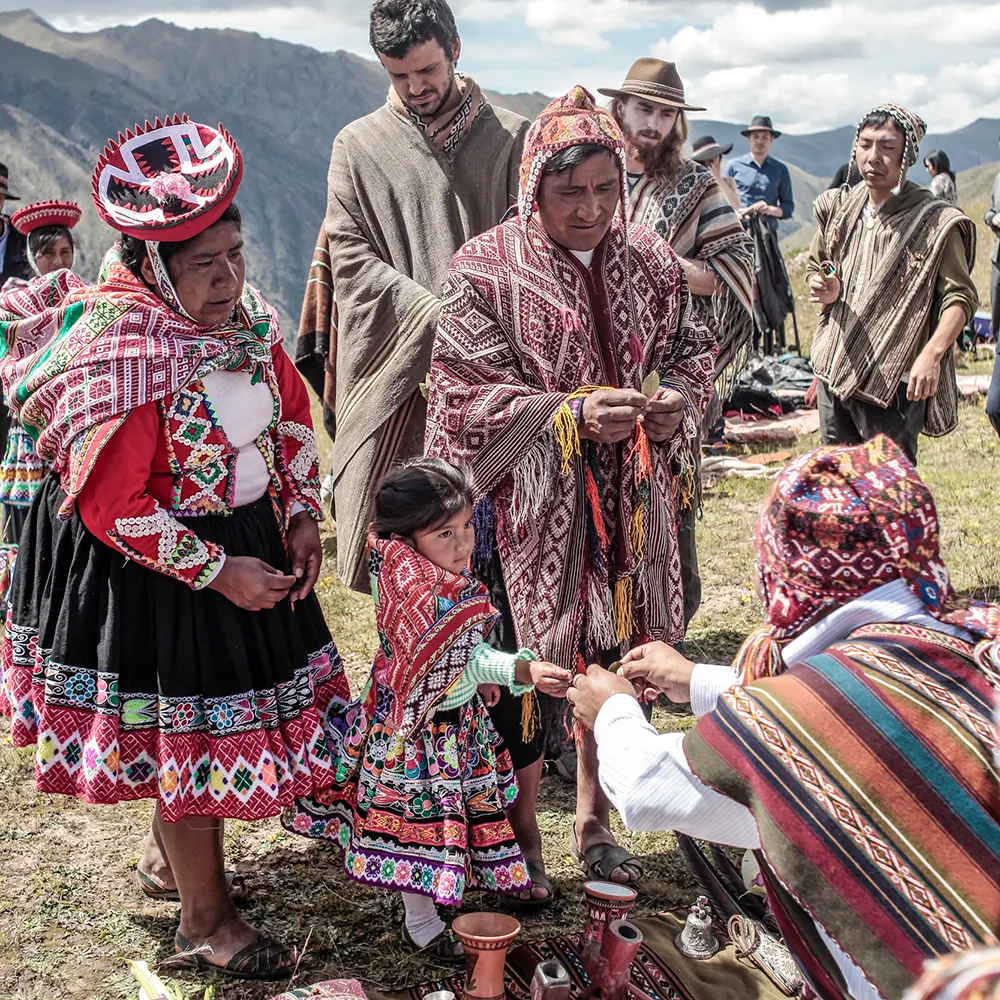
The couple’s hands are bound together with a chumpi, a handwoven Andean belt, usually by the maestro and often with the padrinos holding the ends.
It is the most photographed moment of the ceremony and the one couples remember. It also needs a straight explanation, because the internet will not give you one.
The object is deeply traditional. The gesture, as a wedding rite, is contemporary.
A chumpi is a working garment. In the textile communities of the Cusco highlands it fastens a woman’s skirts, supports a man’s lower back under a heavy load, and — this is the detail that matters — it is what a newborn is swaddled in. It is woven by hand, often over weeks, in patterns that identify the weaver’s community. Our piece on Chinchero, the land of the rainbow and sacred knowledge covers the weaving tradition these belts come from.
What the textile literature does not record is a pre-Hispanic rite of binding a couple’s hands with one. The hand-binding you will see in Cusco today is best understood as a modern ceremonial reading of a traditional object.
And it is a good one. Think about what the chumpi actually does in Andean life: it holds things together, it carries weight, it wraps what is newest and most vulnerable. A couple’s hands tied with the belt that does all three is a genuinely apt piece of ritual thinking, made by people inside the culture rather than borrowed from outside it.
We tell you it is recent because you deserve to know which parts are which. We still think it is the best moment in the ceremony.
4. The nuptial despacho
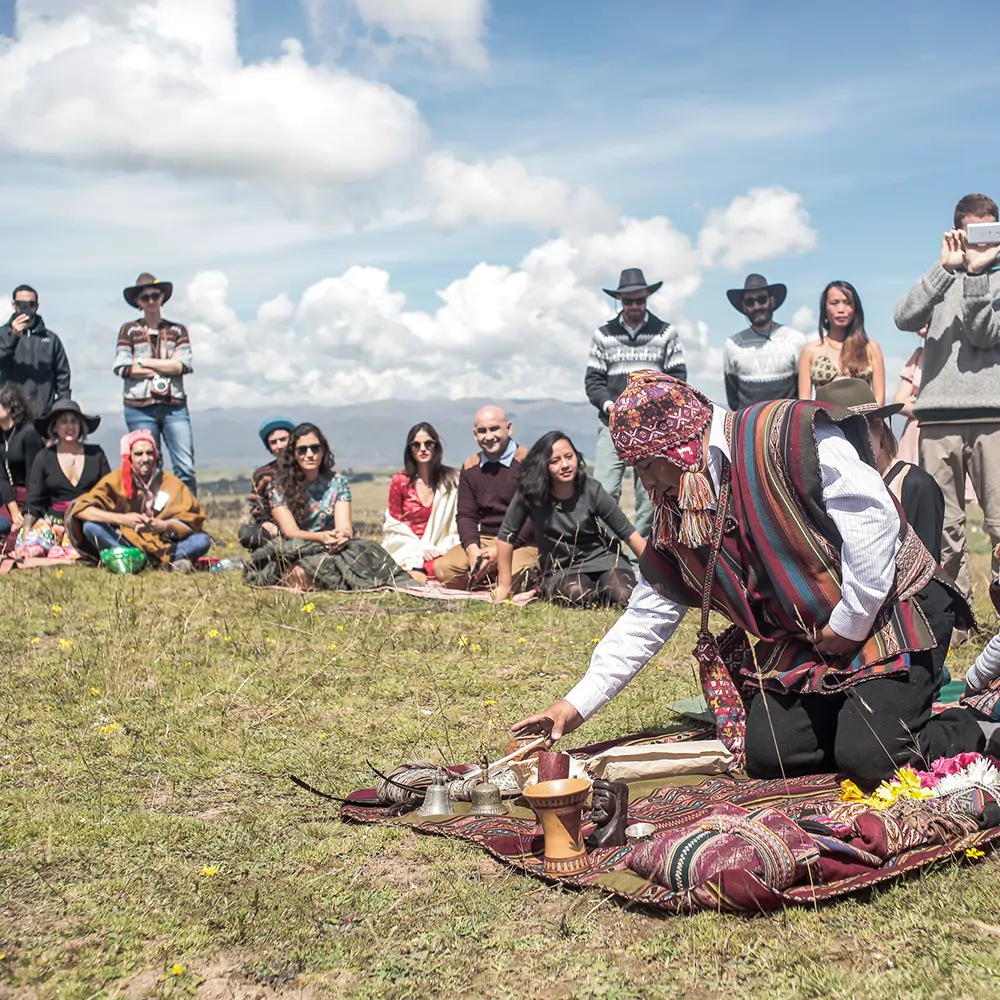
The heart of it, and the longest part — usually an hour or more of close, quiet work.
A despacho is an offering built by hand on a sheet of paper, element by element, each one carrying a meaning, the whole thing assembled in a specific order and then given to fire or buried in the earth. Every component is catalogued in our guide to despacho ceremony ingredients, and the ceremony as a standalone practice is our offering to Pachamama.
In a wedding despacho, certain elements carry particular weight:
- Paired items. Two of things, placed together — seeds, shells, figures. The pairing is the point.
- Mullu, the Spondylus shell, traded up from the warm Pacific for thousands of years and associated with water, fertility and abundance.
- Maize and quinoa, for a household that eats.
- Coloured wool, for the thread of a shared life.
- Sweets and sugar figures, for the sweetness you are asking for, offered rather than assumed.
- Llama fat, the richest thing a herding household had to give.
- The k’intus exchanged earlier, folded in.
You build it yourselves, with the maestro guiding. This is the thing couples do not expect. You will spend an hour placing small objects with care while someone explains what each one is for, and naming out loud what you are grateful for and what you are asking to be released from.
We have watched composed adults come undone over a coca leaf at this stage. That is the ceremony doing its work, and it is the reason the despacho sits where it does rather than at the end.
5. Giving the offering: fire, earth, or water
The despacho is folded into a bundle and delivered — burned in a prepared fire, buried in the ground, or given to running water, depending on the intention and the maestro’s reading.
For a marriage, fire and earth are both used. Nobody looks inside afterwards. The offering is given, not displayed, and the not-looking is part of it.
6. The challa
Chicha or trago, flicked in a few drops towards the ground and towards the peaks before anyone drinks.
The challa or t’inka is the single most common ritual act in the southern Andes — you will see it at construction sites, before journeys, at the start of any serious drinking session. In a wedding it is the first thing the couple does as a couple, and it says something precise: the first share of what you have goes to the earth and the mountains, not to you.
7. The padrinos — not witnesses, something much heavier
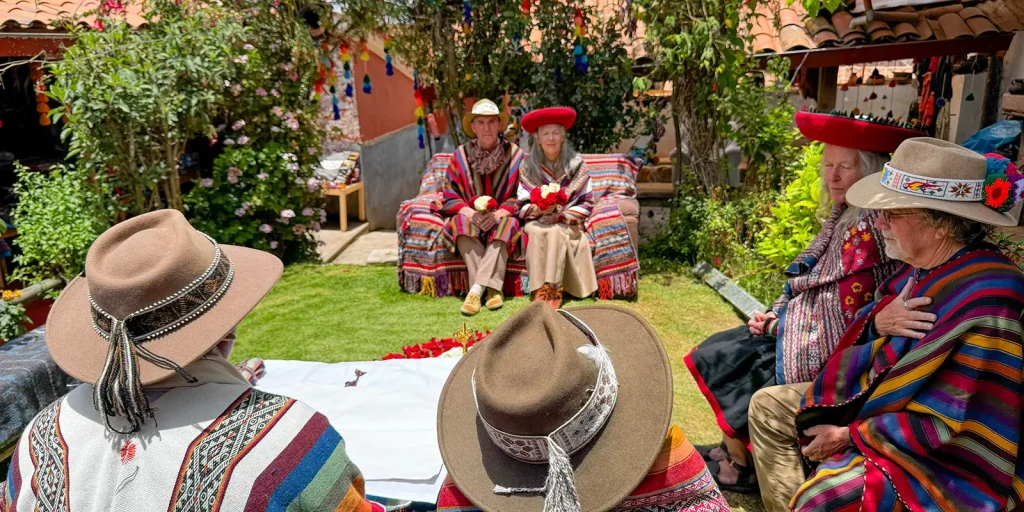
Two older couples, usually. In most Andean weddings they are the most consequential people present after the couple themselves, and Western wedding vocabulary has no equivalent.
The ceremony creates a permanent kinship bond between adults. This is compadrazgo, and the relationship it forms is not primarily between the padrino and the person being married — it is between the two sets of adults, who from that day address each other as compadre and comadre.
Writing in Anthropology News in 2024, the anthropologist Roland Armando Alum describes compadrazgo as drawing participants “into a quasi-sacred relationship that at times supersedes even consanguineal and affinal relations” — that is, one that can outrank blood and marriage ties. Co-godparents use the formal usted with each other rather than the familiar tú, which tells you how the register shifts. The obligations are real: material support, responsibility if something happens to the parents, and customarily the cost of the celebration.
Alum’s point is that the institution has endured precisely because it is plastic — it has survived development, migration, secularisation and Protestantism by adapting rather than by holding still.
What this means for a visiting couple. You probably do not have Andean compadres, and inventing them would be hollow. What you can do is choose your padrinos deliberately rather than by seniority — the two couples whose marriages you would actually want to resemble — and understand that in the local frame you are asking them for something ongoing, not asking them to stand still for a photograph.
8. The closing
The maestro closes the space in the reverse order it was opened: local hill first, then the regional mountains, then the great peaks, with thanks rather than requests.
And then, usually, food. In a community wedding the celebration runs for days; in a visiting couple’s ceremony it is a meal with the maestros and whoever came. Both are correct, and the meal is not an afterthought — commensality is how the Andes ratify things.
Ayni: The Actual Vow
Here is the conceptual centre, and the reason an Andean ceremony lands differently from a Western one.
The Western vow is a declaration of feeling that endures: I will love you, for better or worse, until death. It is a statement about the interior life of two people.
The Andean frame is ayni — reciprocity. Mutual obligation, the same principle that decides who helps whom at harvest, who lends oxen to whom, who turns up when a roof needs raising. Ayni is not sentiment. It is a ledger kept between parties over a lifetime, and it is the organising logic of Andean social life.
Applied to marriage, it says something unromantic and rather bracing: this is a working partnership, and both sides are expected to deliver. A household in the high Andes was an economic unit — herds, fields, weaving, children, obligations to the community and to the mountains. Marriage was how that unit was constituted.
There is a related concept worth knowing, yanantin, the idea of complementary pairing: two unlike things that form a working whole, as the left and right hand do. Scholarly treatments of it vary and some popular writing has stretched it a long way, so we present it as a frame rather than a doctrine. But the shape of it is visible in the ceremony — the paired items in the despacho, the two of you building one offering, the two hands bound with one belt.
What couples tend to say afterwards is that the obligation framing surprised them, and then felt more solid than the feeling framing. Promising to show up is a harder and more useful promise than promising to feel.
Our overview of Andean rituals and the page on ancient Peruvian rituals and practices set ayni in its wider context.
Documented, Debated, Interpreted
Sorting the claims is the most useful thing we can do here, because the subject is thick with confident assertions that have no source behind them.
| Claim | Standing |
| Pre-ceremonial cohabitation (sirvinakuy) was widespread and the Church fought it for two centuries | Documented — colonial records, viceregal instruction, ecclesiastical court material |
| Coca k’intus and the phukuy are central to Andean ritual speech | Documented across the Quechua Andes |
| The despacho as a built, element-by-element offering given to fire or earth | Documented in community ethnography |
| Compadrazgo creates binding ritual kinship between adults | Documented and still active across Latin America |
| Ayni as the organising principle of Andean social obligation | Documented |
| Kasarakuy as a Spanish-Quechua hybrid term | Documented linguistically |
| The named stages of Andean courtship as a fixed sequence | Debated — terms and sequences vary by region and the record is uneven |
| Binding the couple’s hands with a chumpi | Modern interpretation — the textile is traditional, the wedding rite is contemporary |
| Yanantin as a formal doctrine of sacred union | Modern interpretation in most popular usage; the underlying concept is real, the elaboration largely Western |
| “Inca royal wedding” ceremonies reconstructed in detail | Modern interpretation. The chronicles are secondhand, written by Spaniards decades after the conquest, and do not support a precise liturgy |
If a provider offers you an authentic Inca royal wedding ceremony, you have found row ten.
What an Andean Wedding Is Not
Four clarifications that save disappointment.
It is not legally binding. An Andean ceremony is symbolic. Civil marriage in Peru is a separate process through the municipality and RENIEC, with its own documents and timelines, and the two are not interchangeable. Most couples we work with are either already legally married, marrying legally at home, or treating the ceremony as the only marriage they want.
It is not a Catholic sacrament, and it is not in competition with one. Some couples hold both.
It is not quick. The full sequence runs two to three hours, and the despacho is the bulk of it. Providers offering a forty-minute Andean wedding are offering the photographs.
It is not a performance. Our maestros are from Chinchero and conduct this as practice, not as show. That means it runs at its own pace, parts of it are in Quechua, and the maestro will not stop for a drone shot. Couples who want a wedding video should bring someone who understands they are documenting a ceremony rather than directing one.
How to Take Part Without Getting It Wrong
- Come with a question, not a script. You will be asked what you are grateful for and what you are asking to release. Thinking about that beforehand changes the hour.
- Don’t write Western vows into it. You can read something if you want, but the vow in this ceremony is the k’intu and the offering, not a speech. Couples who try to run both find the two compete.
- Wear what you’d wear to something serious. There is no requirement to dress in Andean clothing, and we would gently steer you away from borrowed traditional dress for photographs. Many couples wear their own wedding clothes with a handwoven lliclla or poncho given as part of the ceremony — which is different from arriving in costume.
- Expect Quechua, and let it be. The maestro works in Quechua with translation into English or Spanish. The untranslated parts are not being withheld from you; some of it is addressed to the mountains rather than to the room.
- Bring your people, or don’t. The ceremony works with two and it works with thirty. What it does not do well is a crowd that treats it as a backdrop.
- Ask who you’ll be sitting with. This is the single best question to put to any provider. Ours are named on our team page, with where they are from, which is the only meaningful credential in this field — who vouches for someone in their own community.
Where This Fits in a Longer Journey
The ceremony works as a standalone, and it also works as a closing.
Couples who spend a week in the Sacred Valley doing ceremony and then marry at the end of it describe the wedding as landing very differently — everything the week surfaced is still in the room. Our guide to a spiritual retreat for couples in Peru covers how to structure that, and the Andean wedding service page has formats and inclusions.
If you want to understand the landscape you will be marrying in before you arrive, the pages on Sacred Valley spiritual sites and ancient traditions are the right background. A coca leaf reading a day or two beforehand is something a good number of couples do, and it has a way of clarifying what the ceremony is for.
Frequently Asked Questions
What are the main Andean wedding traditions?
The naming of the Apus, the exchange of coca k’intus, the binding of hands with a chumpi, the building and offering of a nuptial despacho, the challa libation, and the role of the padrinos. The organising idea behind all of them is ayni — reciprocal obligation.
What does kasarakuy mean?
It is the Quechua verb for marrying, formed from the Spanish casar plus the Quechua ending -kuy. The hybrid construction suggests the single binding ceremony arrived with the Church, grafted onto much older practice.
What is sirvinakuy?
A period of cohabitation before formal marriage, lasting from a few months to two or three years, understood as a way to test compatibility and strengthen the eventual union. The colonial Church opposed it for two centuries.
Is the chumpi hand-binding an ancient Inca ritual?
No. The chumpi — a handwoven belt — is a genuinely traditional object, but the hand-binding as a wedding rite is a contemporary ceremonial reading of it. We would rather say so than claim otherwise.
Is an Andean wedding legally recognised?
No. It is symbolic. Civil marriage in Peru is a separate municipal and RENIEC process. Most couples are already legally married or marry legally at home.
Can we do it as a vow renewal?
Yes, and it suits the tradition unusually well, since the Andean frame treats the ceremony as marking a relationship already in motion rather than starting one.
Who should our padrinos be?
Choose deliberately rather than by seniority. In the Andean frame you are asking them for an ongoing relationship, not a photograph — traditionally the bond created is between the two sets of adults, who afterwards address each other as compadre and comadre.
How long does the ceremony take?
Two to three hours for the full sequence, with the despacho taking the largest share. Anything much shorter has cut the despacho.
What should we wear?
Whatever you would wear to something serious. Many couples wear their own wedding clothes with a handwoven lliclla or poncho given during the ceremony. We would steer you away from full traditional dress as costume.
Do we need to speak Spanish or Quechua?
No. The maestro works in Quechua with translation into English or Spanish. Some passages are addressed to the mountains and stay untranslated.
Can same-sex couples hold an Andean ceremony?
Yes, with us. The ceremony is symbolic rather than legal, and the maestros we work with conduct it.
Is it disrespectful for foreigners to do this?
Not when it is conducted by practitioners from the community, paid properly, at their pace, on terms they set. It becomes a problem when it is staged by outsiders, compressed for convenience, or dressed up as something it is not.
What Stays With You
The photographs people send us years later are usually the binding. The thing they write about is almost always the despacho — the hour spent placing small objects while somebody explained what each one was asking for.
That hour is the tradition at its most characteristic. Not a declaration, not an audience, not a moment. Two people building one object out of coca, shells, seeds and wool, naming out loud what they owe each other, and then giving the whole thing away to a fire without looking back at it.
Tell us your dates and we’ll talk through what the ceremony would look like where you want to hold it.
This article draws on the published historical and ethnographic record of the southern Andes — including scholarship on indigenous marital life in colonial Peru published in the Hispanic American Historical Review and on compadrazgo in Anthropology News — and on the practice of the maestros we work with in Chinchero. Where the record is uneven or a practice is contemporary rather than historical, we have said so rather than choosing the more flattering version. Andean ceremonies conducted at archaeological sites are subject to regulation by Peru’s Ministerio de Cultura. An Andean wedding ceremony is symbolic and carries no civil or legal effect.