Which Andean Ceremony Should I Choose? An Honest Guide from Cusco
 By PumAdventures
At least once a week someone writes to us with a version of the same message: I’m coming to Cusco, I’d love to do a ceremony, but I don’t know which one. Sometimes it comes with a long story. Sometimes it is one line and a question mark.
It is a good question, and the honest answer is that it depends less on the ceremony than on you: what you are carrying, what you hope to understand, how your body is doing, how much time you have. Choosing which Andean ceremony to join is a bit like choosing a conversation. A short, clear one with a wise elder is sometimes worth more than a long night that leaves you exhausted.
This guide is how we would answer that email if we had an hour. It covers the ceremonies we offer in Cusco and the Sacred Valley, what each one actually involves, who it suits and who it does not, and how they fit together. It also tells you when the right answer is to wait.
Table of Contents
The Short Answer
If you only read one section, read this table. Find the line that sounds most like you.
| If you are looking for… | Start with | Then consider |
| Guidance on a decision or a question | Coca leaf reading | An offering to Pachamama |
| Gratitude, a new beginning, closing a chapter | Offering to Pachamama (despacho) | A coca reading beforehand |
| Feeling heavy, stuck or drained | Coca reading and Andean cleansing | A despacho |
| A first, careful step into plant medicine | San Pedro (wachuma) | Integration time before anything else |
| Deep inner work, with experience and medical clearance | Ayahuasca | A multi-day retreat |
| Marking a relationship | Andean wedding | A coca reading for both of you first |
| Understanding the culture, not a personal process | Coca reading and despacho | A walk to a sacred site with a guide |
Most people, especially first-timers, are best served by the top half of that table. The plant medicines are not “the advanced level” of Andean ceremony. They are different tools, with different risks, and many experienced practitioners never use them.
Five Questions to Ask Yourself First
Before looking at the ceremonies themselves, it helps to be honest about five things.
1. What am I actually hoping for?
“Healing” and “awakening” are words people use when they have not yet found their own. Try to be specific. I need to decide whether to leave my job. I want to say goodbye to my father properly. I want to understand why I keep repeating the same pattern. I want to give thanks for a good year. Each of those points to a different ceremony.
If you cannot name it, that is fine too. A coca leaf reading is often the best way to find out.
2. How is my health, and what medication do I take?
This question rules ceremonies in or out before preference does. Andean ceremonies without plant medicine are suitable for almost everyone. Wachuma and ayahuasca are not. Antidepressants, some other psychiatric drugs, heart conditions, high blood pressure, pregnancy and a personal or family history of psychosis or bipolar disorder all matter. We cover this in detail further down.
3. How much intensity do I want?
A coca reading is a conversation. A despacho is a slow, beautiful ritual you take part in. Wachuma is a full day in an altered state. Ayahuasca is a night that can be physically and emotionally overwhelming. None of these is better. But it is worth asking yourself how much you want to be shaken, and how much time you have to recover afterwards.
4. How much time do I have?
If you are in Cusco for three days, with Machu Picchu in the middle, a plant medicine ceremony may not fit. It needs preparation beforehand and rest afterwards. A coca reading takes an hour; a despacho, two or three.
5. Alone, as a couple or as a group?
Some ceremonies are naturally personal (a coca reading), some work beautifully shared (a despacho, a wedding), and plant medicine can be done privately or in a small group. Our guide to private vs group ceremonies goes into the trade-offs.
The Ceremonies, One by One
Coca leaf reading
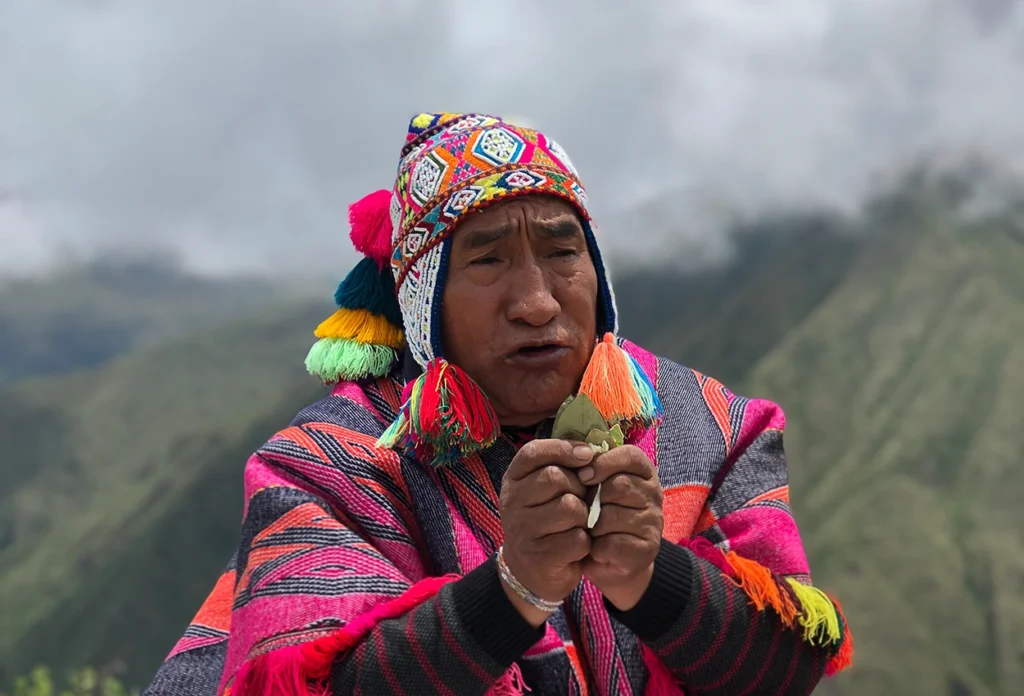
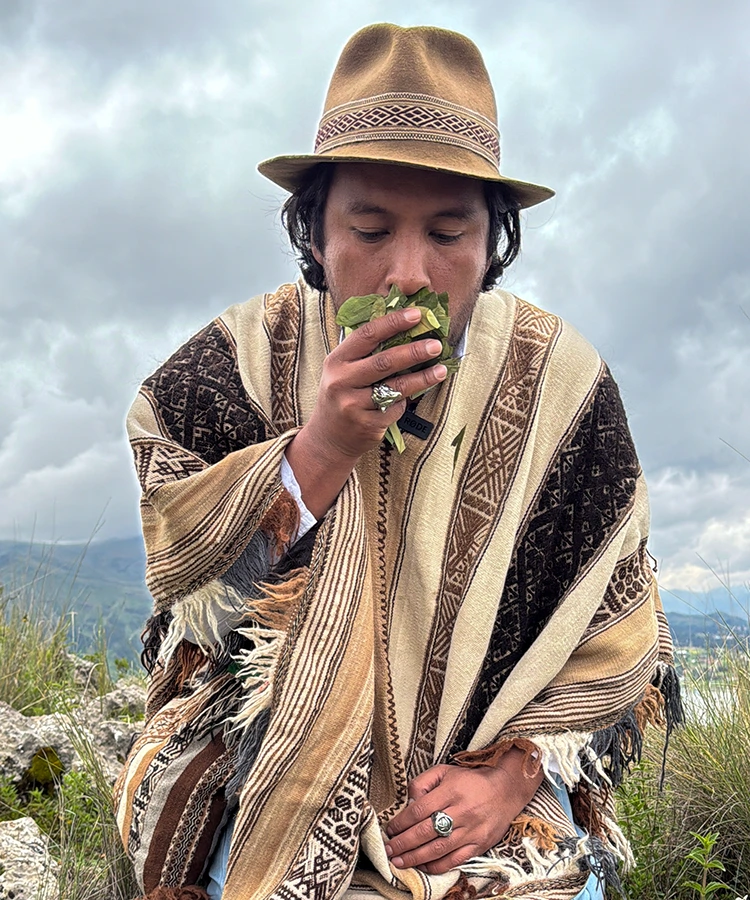
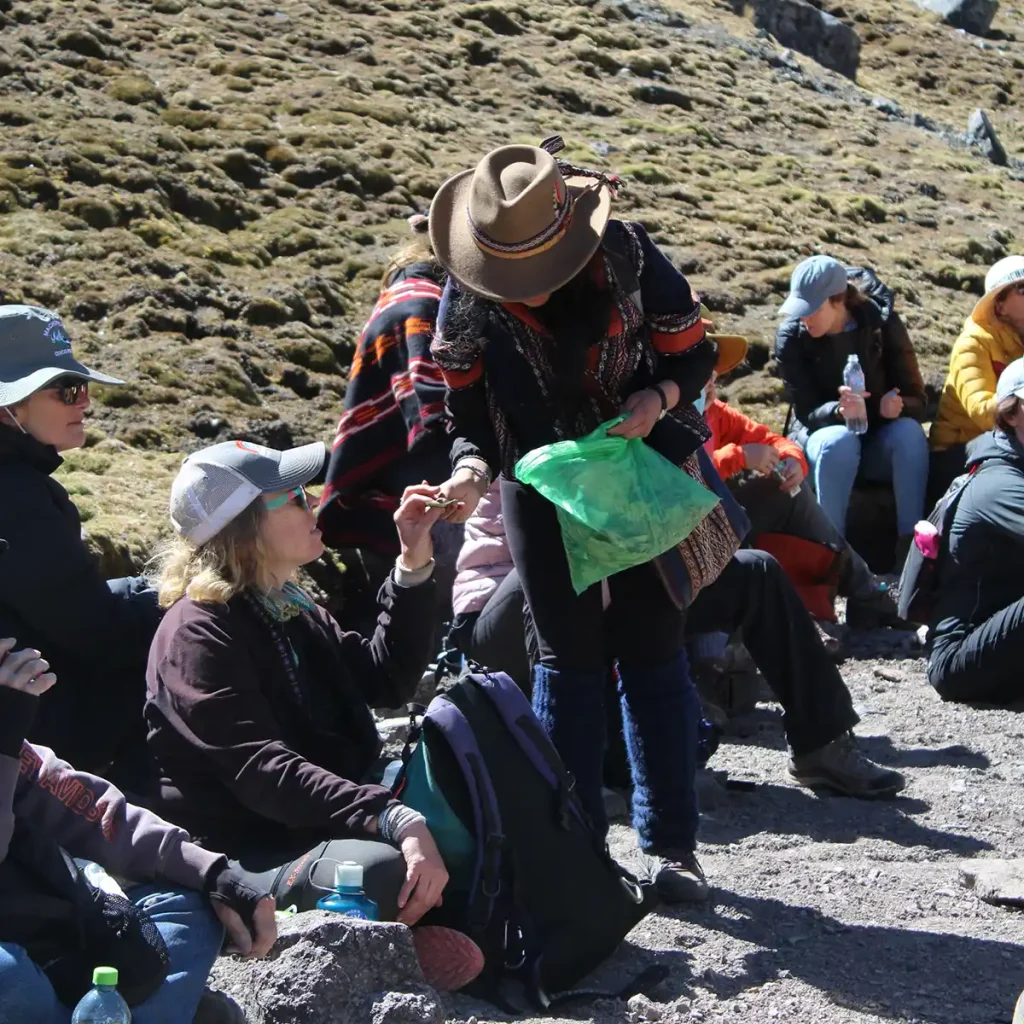
What it is. A paqo, an Andean ritual specialist, holds coca leaves, blows a prayer over them and lets them fall onto a small woven cloth. The way the leaves land (face up or down, pointing which way, close to which others) is read in relation to your question. Then the paqo talks with you about what they see. In Quechua it is called k’uka qhaway, “looking at the coca”.
What it feels like. Closer to a conversation with a perceptive elder than to fortune-telling. Most people are surprised by how specific and practical it becomes.
Who it suits. Almost everyone. First-timers, sceptics, people with a decision to make, couples before a wedding, and anyone at the start of a longer retreat who wants to clarify their intention.
Who it does not suit. People expecting predictions of the future with dates and names. That is not how the reading works.
Time and cost. About one hour. From US$70. No diet or medical screening needed.

Read what a coca leaf reading means and questions to ask in a coca leaf reading.
Offering to Pachamama (despacho)
What it is. The central ceremony of Andean life. The paqo builds an offering bundle on a sheet of white paper, layer by layer: coca leaves arranged in threes, seeds, grains, sweets, shells, llama fat, coloured wool, flowers. You take part, adding k’intus of coca with your own intentions. The bundle is then wrapped and given to fire or to the earth. It is the Andean principle of ayni, reciprocity, made visible: the earth feeds you, so you feed her.
What it feels like. Slow, careful and quietly moving. People often say they did not expect to feel so much while arranging seeds on a piece of paper.
Who it suits. Anyone marking a beginning or an ending: a new job, a move, recovery after illness, a birthday, the end of a relationship. Families and groups. People who want to understand Andean culture from the inside. It is also an excellent way to open or close a longer retreat.
Who it does not suit. People looking for a dramatic personal experience. A despacho is about relationship and gratitude more than inner fireworks.
Time and cost. Two to three hours. From US$350, which covers the paqo, all offering materials and the setting. No diet or screening needed. August, the month of Pachamama, is a particularly meaningful time; see Pachamama Raymi.
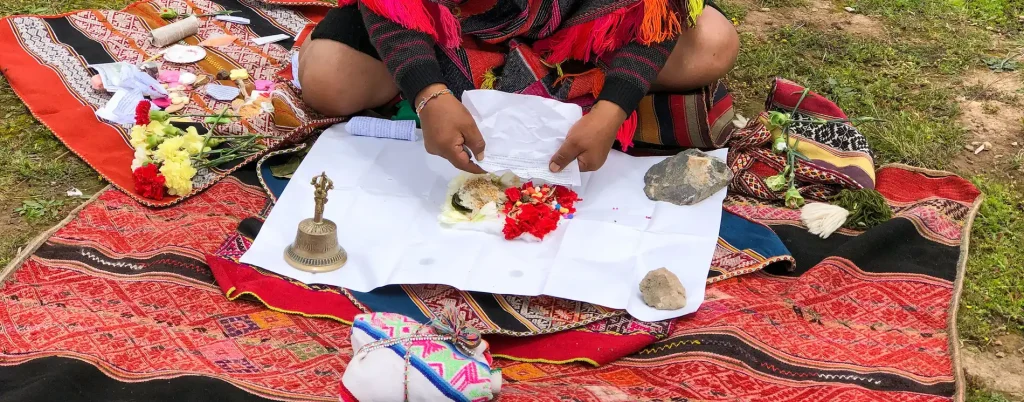
Our guide to despacho ceremony ingredients explains what each element means.
Andean cleansing (limpia)
What it is. A traditional cleansing in which the paqo passes flowers, stones, florida water or other elements over your body, with breath and prayer, to lift what feels heavy. It is often followed by a florecimiento, a flower rinse. In our ceremonies it is usually combined with a coca reading or a despacho rather than booked alone.
Who it suits. People who feel drained, stuck or weighed down, and those coming out of a difficult period.
An important note. A limpia is a spiritual and cultural practice. It is not a medical treatment and does not replace one.
San Pedro (wachuma)
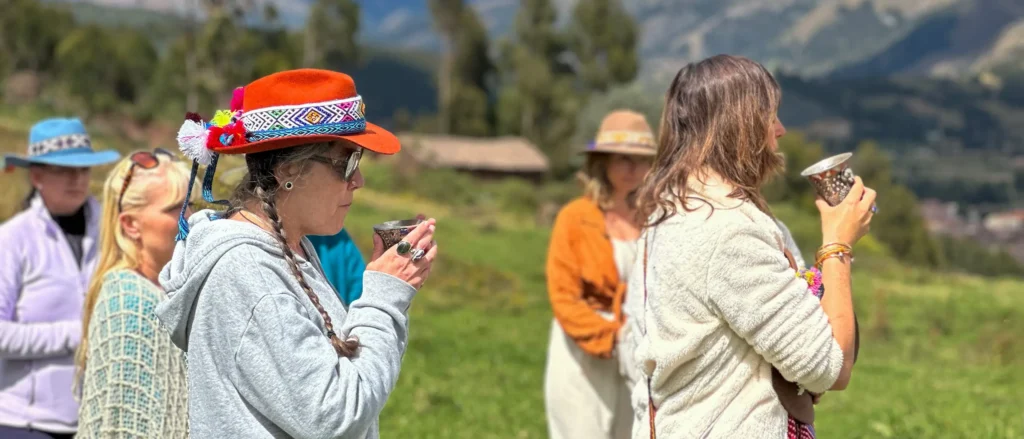
What it is. A daytime ceremony with wachuma, a columnar cactus of the Andes (Echinopsis pachanoi) that contains mescaline. A carved figure holding the cactus at Chavín de Huántar, in the northern highlands, is roughly three thousand years old. Our ceremonies open with a coca reading and a small offering, continue outdoors in the landscape and close with a sharing circle.
What it feels like. It varies a lot. Many people describe heightened senses, emotional openness, a strong connection with nature and with others, and clarity about relationships or choices. Some feel mostly physical effects; nausea is common and some people vomit. The effects last most of the day, roughly 8 to 12 hours.
Who it suits. People who are drawn to plant medicine, have passed medical screening and want a first experience in daylight and open air. Many people find it a gentler introduction than ayahuasca, though it is still a powerful experience.
Who it does not suit. Anyone with heart disease, high blood pressure or a history of psychosis or bipolar disorder, people taking certain medications, and anyone pregnant. Also anyone who needs to be somewhere important the same evening.
Time and cost. A full day. From US$250, including transport, the ceremony and an integration circle the next morning. Requires a health questionnaire and a preparation diet. See what is wachuma, is wachuma safe? and the real cost of a San Pedro ceremony.

Ayahuasca
What it is. An Amazonian brew of the Banisteriopsis caapi vine, usually with chacruna leaves, taken at night in a closed ceremonial space while the facilitator sings icaros, healing songs from the Amazonian tradition. Ayahuasca is not Andean. It is served in Cusco because people want to combine it with a journey in the Andes, and we say so openly.
What it feels like. Usually intense. Visions, strong emotions, memories, physical discomfort and purging (vomiting, sometimes diarrhoea) are common. The strongest effects last several hours, and the ceremony often runs late into the night. Some people find it profoundly meaningful; some find it very hard; many find it both.
Who it suits. People who have thought about it carefully, have passed medical screening, are not taking incompatible medication and have time to rest and integrate afterwards. Ideally, people who have already met Andean ceremony in a gentler form.
Who it does not suit. Anyone taking antidepressants (SSRIs, SNRIs, MAOIs and several others), stimulants or other serotonergic drugs. The combination can cause serotonin syndrome, which can be life-threatening. Also people with heart conditions, a personal or family history of psychosis or bipolar disorder, or who are pregnant, and anyone in acute crisis.
Time and cost. One night, or two ceremonies over two days. From US$350. Requires a health questionnaire and a preparation diet of one to two weeks. Read who should not drink ayahuasca and ayahuasca and antidepressants before booking.
Andean wedding or vow renewal
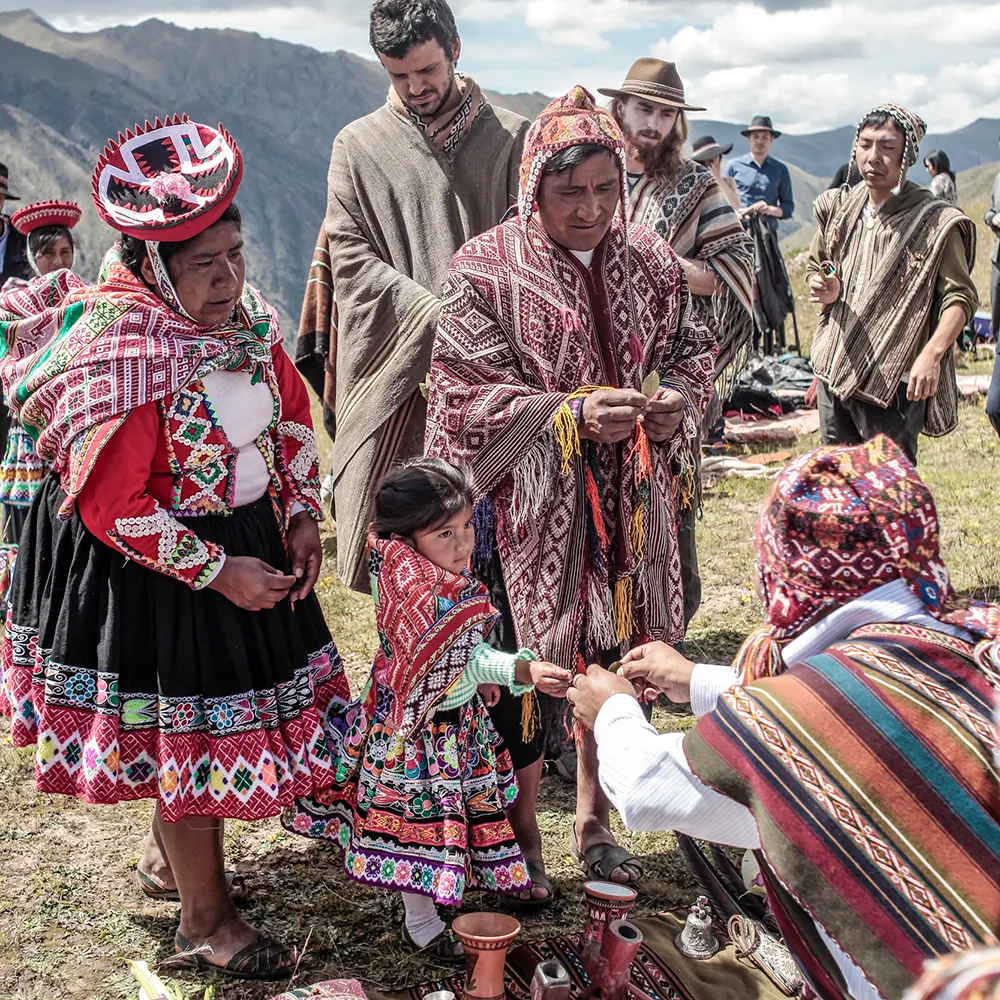
What it is. A symbolic marriage in the Andean tradition, led by maestros from Chinchero. The Apus are named, the couple exchange k’intus of coca, their hands are bound with a woven belt (chumpi) and a nuptial despacho is built and offered. It is not legally binding; it marks a relationship in the way the Andean world has always understood marriage, as a commitment to each other, a community and a landscape.
Who it suits. Couples marrying, renewing vows or celebrating a relationship already well under way.
Time and cost. About two to three hours for the full sequence, most of it the despacho. From US$1,500. See Andean wedding traditions and what an Andean wedding in Cusco costs.
All the Andean Ceremonies Side by Side
| Coca reading | Despacho | Cleansing | San Pedro | Ayahuasca | Andean wedding | |
| Tradition | Andean | Andean | Andean | Andean | Amazonian | Andean |
| Intensity | Gentle | Gentle | Gentle | Strong | Very strong | Gentle, emotional |
| Length | ~1 hour | 2–3 hours | 30–60 min | Full day | One night | 2–3 hours |
| Altered state | No | No | No | Yes | Yes | No |
| Medical screening | No | No | No | Yes | Yes | No |
| Preparation diet | No | No | No | Yes | Yes (1–2 weeks) | No |
| Recovery time | None | None | None | Rest of day + next morning | Next day at least | None |
| From (US$) | 70 | 350 | Usually combined | 250 | 350 | 1,500 |
A Simple Way to Decide
If the table still leaves you unsure, walk through these steps in order.
- Do you take antidepressants or other psychiatric medication, or have a heart condition, a history of psychosis or bipolar disorder, or are you pregnant? If yes, choose from the Andean ceremonies without plant medicine. Do not stop any medication to take part without your doctor’s supervision.
- Do you have fewer than four days in Cusco? Choose a coca reading, a despacho, or both. Plant medicine needs time on both sides.
- Is your intention mainly about gratitude, a beginning or an ending? A despacho.
- Is it mainly about a question or a decision? A coca reading.
- Are you a couple marking your relationship? An Andean wedding, ideally with a coca reading a day or two before.
- Do you want to explore plant medicine, have passed screening and have time? Start with San Pedro. Consider ayahuasca later, or on a longer retreat, once you know how you respond.
You can also simply write to us. We would rather spend twenty minutes helping you choose than see you book the wrong thing.
Ceremonies That Work Well Together
Many people combine two or three ceremonies over a few days. Some sequences we have seen work well over the years:
- Coca reading, then despacho. The reading clarifies your intention; the offering puts it into the earth. One or two days apart. Good for almost anyone.
- Coca reading, despacho, then San Pedro. The classic structure of a short Andean retreat. The first two ceremonies prepare you for the third, and you meet the paqos before the more demanding day. Allow a rest day afterwards.
- Coca reading for the couple, then Andean wedding. Couples often say the reading changed what they wanted to say at the ceremony.
- Despacho at the start and end of a longer retreat. Opening and closing with an offering gives a retreat a shape. Our Sacred Valley spiritual retreat programmes are built this way.
- What we generally advise against: two plant medicine ceremonies on consecutive days for first-timers, plant medicine the day before a long journey or the Inca Trail, and ayahuasca on your first or second day at altitude.
Choosing by Intention
These are suggestions, not prescriptions. The paqos will often suggest something different once they have met you.
- After a loss. Grief is not something to fix in one ceremony. A despacho can be a beautiful way to honour someone who has died, and a coca reading can give space to talk about them. If the loss is recent and raw, we usually suggest waiting before any plant medicine, and continuing support at home.
- At a crossroads. A coca reading, then time to walk and think. If the decision is very large, a despacho to mark the choice once you have made it.
- Feeling heavy or burnt out. A coca reading with a cleansing, then rest. Many people in this state want the strongest medicine available; often what helps most is sleep, sun and a slower week.
- Gratitude or celebration. A despacho. It is, in the end, a thank-you letter to the earth.
- Curiosity about the culture. A coca reading and a despacho, ideally with time to ask the paqo questions. Our guide to Andean cosmovision is useful background, and our Andean spiritual glossary explains the words you will hear.
- Deep inner work. San Pedro first, perhaps ayahuasca later, inside a retreat with preparation and integration, after medical screening. If this is your main intention, a multi-day retreat is usually better than a single ceremony squeezed into a tour.
When the Right Answer Is “Not Now”
Sometimes the most useful thing we can tell someone is to wait. We will suggest that if:
- you are in an acute mental health crisis or have recently been hospitalised
- you have stopped psychiatric medication recently, or are thinking of doing so to take part
- you are hoping a ceremony will replace treatment you need
- you are exhausted, ill or struggling with the altitude
- someone else is pressuring you to take part
None of this rules out coming to Cusco. A coca reading or a despacho is usually still possible, and the plant medicine can wait for another trip, when the ground is steadier.
Which Andean Ceremony Is Right for Beginners?
For a first experience of Andean ceremony, we almost always recommend a coca leaf reading followed by a despacho. Together they take less than half a day, need no preparation, carry essentially no physical risk and give you a real sense of how Andean ceremony works: the greeting of the mountains, the role of coca, the idea of reciprocity.
If you then want to explore plant medicine, San Pedro is the usual first step, after medical screening. Ayahuasca is best kept for when you have more experience and more time.
How to Tell a Good Ceremony from a Bad One
Whichever ceremony you choose, these signs help you choose a good provider:
- They tell you who leads the ceremony and which community they come from.
- They ask about your health and medication before taking payment for plant medicine.
- They explain what will happen, step by step, without promising healing or visions.
- Groups are small, especially for plant medicine.
- They are willing to say no when a ceremony is not right for you.
- Prices are clear, and include what they say they include.
Read how to choose a safe ayahuasca retreat for a longer checklist, and see all our ceremonies in Cusco.
Which Andean Ceremony: Frequently Asked Questions
Which Andean ceremony should I choose for my first time?
A coca leaf reading followed by an offering to Pachamama. They need no preparation, carry no real physical risk and introduce the core ideas of Andean ceremony. If you later want plant medicine, San Pedro is the usual first step, after medical screening.
What is the difference between a coca leaf reading and a despacho?
A coca reading is a personal consultation: the paqo reads leaves in relation to your question. A despacho is an offering ritual: you and the paqo build and give a bundle of gifts to the earth and the mountains. The first is about guidance, the second about reciprocity and gratitude.
Is San Pedro or ayahuasca better for a first plant medicine ceremony?
Many people start with San Pedro, which is held in daylight and outdoors. Both carry medical risks and require screening, so the right choice depends on your health as well as your preference.
Can I do an Andean ceremony if I take antidepressants?
Yes, the ones without plant medicine: coca reading, despacho, cleansing and Andean wedding. Ayahuasca is not safe with most antidepressants, and wachuma requires medical advice. Never stop medication without your doctor’s supervision.
Can I do more than one ceremony during my trip?
Yes. Coca reading and despacho combine easily, even on the same day. Leave at least one rest day after any plant medicine ceremony before the next one or before travelling.
Which Andean ceremony is best for couples?
An Andean wedding or vow renewal if you want to mark the relationship. A shared despacho if you want something simpler. Many couples also book a coca reading together.
How far in advance should I book?
Coca readings and despachos can often be arranged a few days ahead. Plant medicine ceremonies need time for screening and a one-to-two-week preparation diet, so book at least two to three weeks ahead. Weddings need more notice.
Do I need to speak Spanish or Quechua?
No. Prayers are often in Quechua, and your guide translates and explains in English.
Can children take part?
Children are welcome at coca readings, despachos and weddings with their families. Plant medicine ceremonies are for adults only.
Still Not Sure?
Write to us with a few lines about yourself, your dates and what you are hoping for. We will suggest a ceremony, or a combination, and tell you honestly if we think something else would serve you better. If you would like to make the decision in person, you can also book a coca leaf reading first and ask the paqo.
See all ceremonies · Private ceremonies · Contact us