Andean Spiritual Terms: A Glossary from Cusco
 By PumAdventures
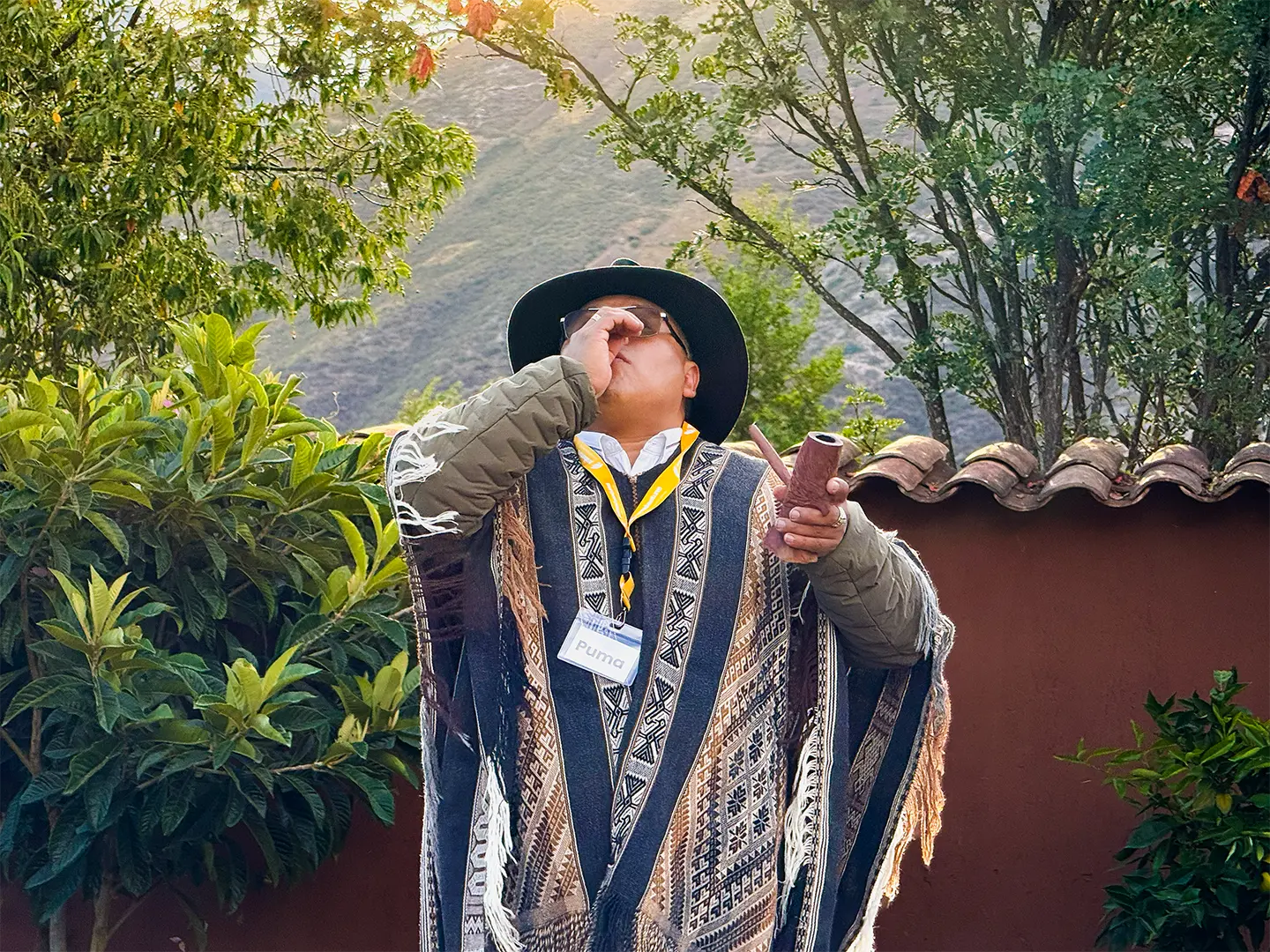
The first time most visitors hear a paqo pray, they catch maybe one word in twenty. Pachamama, usually. Perhaps Apu. The rest goes by in a quick, breathy Quechua, three coca leaves held to the lips, and it is gone before you can ask.
This glossary is for the moment afterwards, when you want to know what you just took part in. It collects the Andean spiritual terms you are most likely to hear in Cusco and the Sacred Valley: in a coca leaf reading, at a despacho, on a mountain pass, during a wedding in Chinchero, or in conversation with the people who lead these ceremonies.
We have grouped 84 words into seven families, because the vocabulary makes more sense as a system than as an alphabet. Ayni explains the despacho. The despacho explains why the Apus are named first. The Apus explain why a trek over a 4,600-metre pass begins with a stone added to a cairn.
Two promises about how this is written. First, we say where a word comes from and how it is actually used here, not how it has been repackaged in workshops abroad. Second, where a term is a modern interpretation rather than long-documented practice, we tell you.
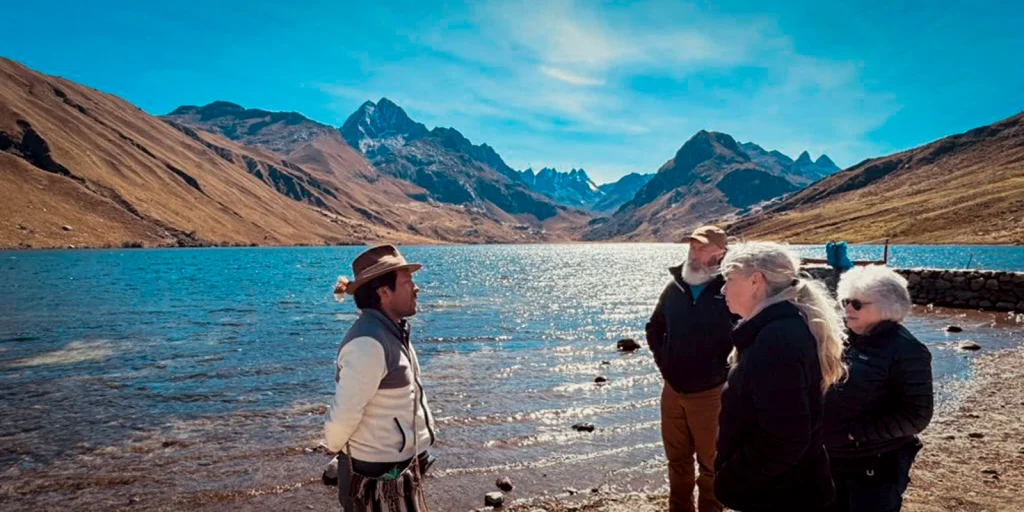
Table of Contents
How to Read This Glossary (and Why the Spelling Keeps Changing)
You will see the same word written three ways on three signs in Cusco. That is not carelessness.
Quechua was written down first by Spanish priests, who spelled it with the letters they had. In 1985 Peru adopted an official alphabet with three vowels (a, i, u), which is closer to how the language sounds. Cusco’s own Academia Mayor de la Lengua Quechua has long preferred five vowels, and the disagreement is still visible on street signs. So you will see Inca and Inka, huaca and wak’a, Ccoricancha and Qorikancha. Many families, guides and hotels keep the older spellings.
Our rule: the heading gives the spelling you are most likely to meet in Cusco, and the variants follow in brackets. The apostrophe marks a glottal sound (a small catch in the throat), and it changes meaning. Paqo and p’aqo are not the same word in every valley.
A few other conventions:
- Quechua (Q) and Aymara (A) are marked where it matters. Aymara is spoken mainly around Lake Titicaca and in Bolivia.
- Modern usage marks terms whose current meaning comes largely from the past fifty years of teaching, much of it aimed at foreign students. The concepts are not fake. They are newer than they are usually presented.
- Meanings vary from valley to valley. When we write “in Cusco”, we mean what our own maestros in Chinchero use. A family in Puno or Ayacucho may disagree, and they would not be wrong.
The 15 Andean Spiritual Terms You Will Hear First
If you only learn a handful before a ceremony, learn these.
| Term | Short meaning | Where you will hear it |
| Pachamama | Earth Mother, the living earth | Every ceremony |
| Apu | Mountain lord, a protective mountain spirit | Opening prayers, treks |
| Ayni | Reciprocity, giving back what you receive | Despacho, weddings |
| Paqo | Andean ritual specialist | Coca reading, despacho |
| Despacho | Offering bundle for the earth and mountains | Pachamama ceremonies |
| K’intu | Three coca leaves held as a prayer | Every ceremony |
| Phukuy | Blowing a prayer over the leaves | Every ceremony |
| Coca (k’uka) | Sacred leaf, food and medicine | Everywhere |
| Ch’alla | Sprinkling drink as an offering | Toasts, weddings |
| Mesa | A paqo’s ritual bundle of stones | Healing, despacho |
| Khuya | Sacred stone carried in a mesa | Healing |
| Huaca (wak’a) | Any sacred place or object | Sacred site visits |
| Hanan / Kay / Ukhu Pacha | The upper, middle and inner worlds | Teachings |
| Wachuma | San Pedro cactus, Andean plant medicine | San Pedro ceremonies |
| Munay | Love joined to will | Teachings |
Core Principles: The Ideas Underneath Everything
These are less “spiritual terms” than rules for living. They govern farming, marriage and politics as much as ritual, which is exactly why they matter in ceremony.
Ayni
Reciprocity. You help your neighbour harvest; next season they help you. In daily life ayni is a concrete exchange of labour between households, tracked carefully and repaid in kind. In ritual it extends to the land: Pachamama feeds you, so you feed her. A despacho is ayni made visible.
If you take one word home, take this one. Almost every gesture in an Andean ceremony is an answer to the question what do I owe, and to whom?
Mink’a (minka)
Collective work for a shared benefit: clearing an irrigation channel, roofing a house, rebuilding a bridge. Where ayni is one-to-one, mink’a is everyone-for-the-commons, usually with food and chicha provided by the host. The most famous example near Cusco is the annual renewal of the Q’eswachaka bridge, rebuilt every year by four communities over the Apurímac gorge.
Ayllu
The extended kin community that holds land, shares work and keeps ritual obligations together. An ayllu includes the living, the ancestors and, in many communities, the local mountains and springs. When a paqo prays “for the ayllu”, it is not a figure of speech.
Munay
Love, but not the sentimental kind. Munay carries the sense of wanting and will: love that acts. In modern Andean teaching it is the first of three principles, alongside yachay and llank’ay. The Quechua word is old; the three-part teaching is modern usage, shaped largely in Cusco from the 1970s onward.
Yachay
Knowledge, learning, wisdom. A yachaq is someone who knows. In the triad, yachay is the clear mind that should guide munay.
Llank’ay
Work, labour, effort. The third principle. A paqo will tell you that love and knowledge with no work behind them are just talk, and that a field does not plant itself.
Yanantin
Complementary pairing: two different things that make one whole. Right and left hand, sun and moon, man and woman, the two halves of a set of panpipes (sikus are played in pairs, each player holding half the notes). The concept is genuinely Andean. Its treatment as a formal doctrine of “sacred union” is mostly modern usage.
Tinkuy
The meeting point where two forces come together: two rivers joining, two communities at a boundary. Tinkuy can be harmonious or violent. In parts of northern Potosí (Bolivia), tinku is a ritual fight between communities. In ceremony, it is any moment where opposites meet and produce something new.
Kawsay
Life, the life-force. Kawsay pacha, “the world of living energy”, is a phrase you will hear in modern Andean teaching (modern usage). The older and simpler sense is that mountains, water, maize and stones are alive, and are treated accordingly.
Sami
Refined, light energy: the kind you feel in clean mountain air, a good harvest or a kind word. Paqos trained in the modern teaching speak of drawing sami in.
Hucha
Heavy energy. In colonial Quechua hucha meant fault or sin, and the word still carries that weight. In modern Andean teaching (modern usage) hucha is not evil, only dense and misplaced, and Pachamama can “digest” it. Expect to hear sami and hucha in cleansing work.
Sumaq kawsay (sumak kawsay)
“Good living” or “living well”, in balance with community and land. The idea entered constitutional law in Ecuador in 2008 as sumak kawsay, and in Bolivia in 2009 as the Aymara suma qamaña. In Cusco it is less a slogan than a description of what a good harvest year feels like.
The Cosmos: Worlds, Sky and Time
Andean cosmology is spatial. Time and space share a word, and the sky is read for rivers and animals as much as stars.
Pacha
World, earth, time and space all at once. Pacha can mean “the ground”, “this era” or “the moment”. That one word holds all of them is the most useful thing to know about Andean thinking.
Hanan Pacha
The upper world: sun, moon, stars, lightning and the condor that flies between. In Christian-era usage it was used to translate “heaven”, which changed it. The older sense is not a reward for the good dead but simply the realm above.
Kay Pacha
“This world”: the visible world of people, animals, fields and mountains. Associated with the puma. Most ceremony takes place here, addressed upward and downward.
Ukhu Pacha
The inner world, under and within the earth: seeds, springs, ancestors, the dead. Associated with the serpent. Spanish priests translated it as “hell”, and you will still meet guides who repeat that. It is wrong. Ukhu Pacha is where life germinates.
Pachakuti
The overturning of the world: a cosmic turning that ends one age and starts another. It was also the name taken by the ruler Pachacuteq, who reshaped Cusco in the fifteenth century. Prophecies of a coming pachakuti circulate widely today, most of them modern usage.
Chakana
The stepped cross, the “Andean cross” sold in every market in Cusco. Chakana means bridge or ladder. In the sky it names the Southern Cross. The stepped square-cross motif is ancient and appears at Tiwanaku and elsewhere. The detailed modern symbolism (three steps for three worlds, four arms for four directions, a hole for Cusco) is largely modern usage, although many paqos now teach it sincerely.
Mayu
River. In the sky, Mayu is the Milky Way, the celestial river that mirrors the Vilcanota below. Andean astronomy follows how water circulates between the two.
Yana phuyu
“Dark clouds”: constellations read in the dark patches of the Milky Way rather than in its stars. Among them are the llama (Yacana), with two bright stars for eyes, the toad, the serpent and the fox. Farmers near Cusco still watch the llama’s eyes to time planting.
Inti
The sun. Worshipped as a lineage ancestor of the Inca rulers, with the Qorikancha in Cusco as his principal temple. Honoured in Inti Raymi.
Mama Killa
Mother Moon, wife of Inti, associated with women, weaving and the ritual calendar, which was lunar as well as solar.
Illapa
Thunder, lightning and rain, held in the upper world. In the highlands a person who survives a lightning strike is often understood to have been chosen, and may go on to train as an altomisayoq.
Wiraqocha (Viracocha)
The creator figure who rose from Lake Titicaca, shaped the world and walked away over the sea. Spanish chroniclers recorded him; his precise place in pre-Inca religion is still debated.
Sacred Beings and Sacred Places
Here the line between landscape and person disappears. A mountain has a name, a temper and preferences.
Pachamama
The Earth Mother: the living earth that feeds, holds and receives. Not a goddess in the Greek sense, and not distant. She is under your feet. She is thought to be especially “open” and hungry in August, when the soil is turned for sowing, which is why August is the great month of offerings. See our guide to Pachamama Raymi.
Apu
Lord, applied to the great mountains that protect a territory. Around Cusco the most powerful is Ausangate, followed by Salkantay, with dozens of local Apus below them. Every ceremony begins by naming them. Our guide to the Apus and Andean mountain spirits explains the hierarchy.
Awki
In some Cusco communities, including Q’ero, awki refers to mountain spirits or ancestral lords, at times interchangeable with Apu and at times ranked below it. Usage varies by village.
Wamani
The word for mountain spirits in Ayacucho, Huancavelica and the central Andes. If a guide from Ayacucho says wamani where a Cusqueño says Apu, they mean much the same thing.
Achachila (A)
“Grandfather” in Aymara: the ancestral mountain spirits of the Titicaca region and Bolivia. You will hear it if your journey continues to Puno.
Mama Qocha
Mother Sea, extended to lakes and lagoons. Water from Mama Qocha is thought to rise through the earth into springs and fall back as rain. Lagunas such as Huaypo and Piuray near Chinchero are offered to in this spirit.
Huaca (wak’a)
Anything sacred: a rock outcrop, a spring, a cave, a mummy, a carved stone, a whole mountain. The Spanish destroyed thousands of huacas in campaigns to “extirpate idolatry”, which is why so many sacred rocks near Cusco have crosses carved into them. Our list of power places in Cusco includes several.
Paqarina
A place of origin, the spot from which a people emerged. The Incas named two: Lake Titicaca and the cave of Tambo T’oqo at Pacaritambo. Many communities still point to their own lake or spring.
Ceque (siq’i)
Sightlines radiating from the Qorikancha across the Cusco valley, each strung with huacas. The Jesuit Bernabé Cobo, writing in the seventeenth century, listed around 328 shrines on 41 lines. Walking a ceque today is one of the most quietly remarkable things you can do in Cusco.
Apacheta
A cairn of stones at a high pass. Travellers add a stone, often with a k’intu of coca, to leave their tiredness behind and ask the Apu for safe passage. You will pass several on the Salkantay and Ausangate routes. Adding a stone is welcome; taking one is not.
Ñust’a
Princess. In ceremony, a feminine spirit of a spring, lagoon or smaller mountain. Some paqos pair each Apu with a ñust’a. Treat the pairing as regional and partly modern usage.
Machula (machula aulanchis)
“The old grandfathers”: the ancient, pre-Christian ancestors, associated with chullpas and ruins. They are respected and a little feared. In some communities a sudden chill at a ruin is blamed on them, and a paqo may make a small offering before you enter.
The People Who Hold the Tradition
The word “shaman” appears on every flyer in Cusco. It is rarely what anyone here calls themselves.
Paqo (paq’o)
The general Quechua term for a ritual specialist: someone who makes offerings, reads coca, diagnoses misfortune and heals. Paqos are usually farmers and herders too. Being a paqo is a calling and a responsibility, not a job title. Our page on the role of the Andean shaman in wachuma ceremonies looks at one part of that work.
Pampamisayoq
“One of the mesa of the plain.” The paqo who works mainly with Pachamama: preparing despachos, reading coca, conducting marriages and blessings. Most paqos you will meet in the Sacred Valley work at this level.
Altomisayoq
“One of the high mesa.” A paqo understood to speak directly with the Apus, often after being called by lightning. Altomisayoqs are rarer, and few work with visitors. Be cautious with anyone who advertises the title.
Kuraq akulleq
“Elder coca chewer”: the most senior ritual authority in some communities’ hierarchy, a role held by very few people. You are unlikely to meet one in a tourist context, and that is as it should be.
Hampiq (hampeq)
Healer, from hampi, medicine. A hampiq works with plants, massage, setting bones and cleansing. Many are not paqos at all, and some paqos are not healers.
Yachaq
“One who knows.” A respectful general term for a wise person, healer or ritual specialist. Used more widely in some regions than paqo.
Layqa
A sorcerer who works with harmful intent, or is suspected of it. Misfortune in a community may be traced to a layqa, and a paqo may be asked to undo the damage. Nobody introduces themselves as one.
Curandero / curandera
Spanish for “healer”. In northern Peru it names the wachuma tradition of the coast and mountains; in the Amazon, the ayahuasca healers of mestizo and Shipibo practice. In Cusco you will hear it used loosely for almost any healer.
Maestro / maestra
“Teacher.” What Peruvians most often call the person leading a ceremony, in both Andean and Amazonian contexts. Our own officiants are called maestros, which is what they call one another.
Q’ero
A Quechua-speaking people of the Paucartambo province, east of Cusco, living in high, remote villages under Ausangate. After an expedition led by the anthropologist Oscar Núñez del Prado in 1955 the Q’ero became famous as keepers of Inca-era tradition. Their weaving and ritual are genuinely distinctive. The name is now also used heavily in marketing, so ask a provider directly which community their paqos come from.
Karpay
An initiation or transmission of power: from a teacher to a student, or from an Apu to a person. Hatun karpay, “great initiation”, is a modern teaching sequence (modern usage). In communities, karpay is usually private and earned over years.
Ritual Objects and Offering Materials
Most of these can be bought at the San Pedro market or the stalls behind it, which tells you something: the materials are ordinary. What makes them sacred is the intention and the way they are given.
Despacho
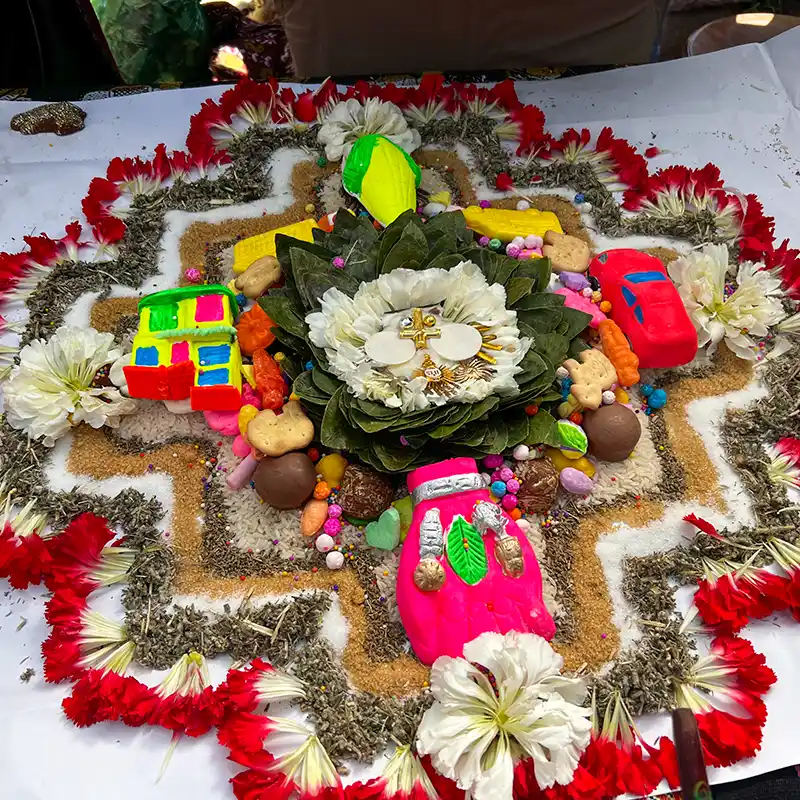
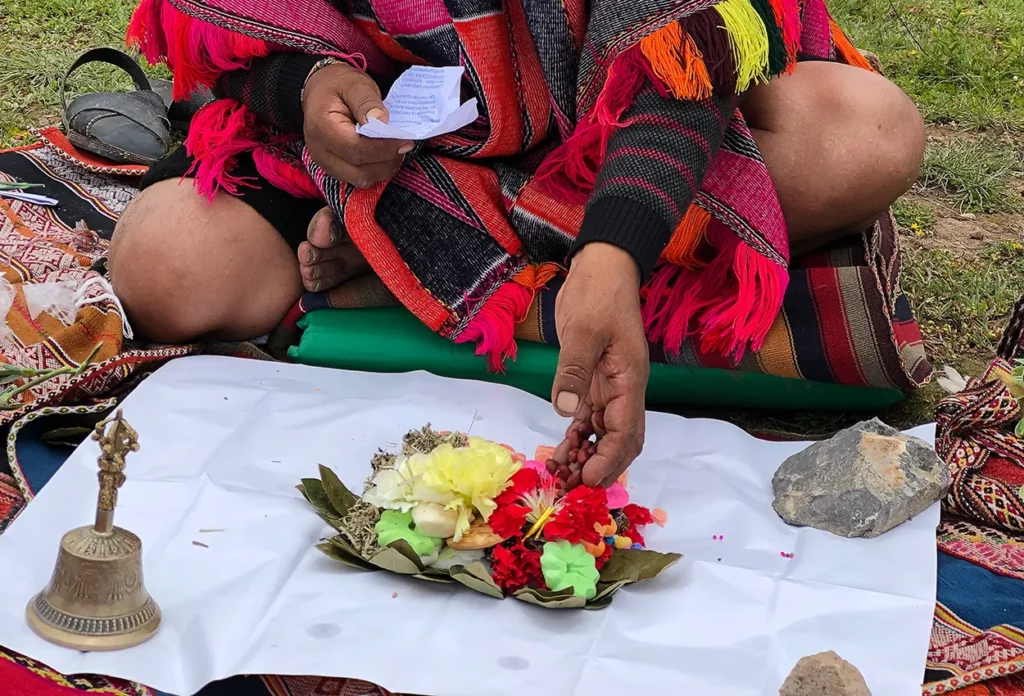
The offering bundle at the centre of Pachamama ceremony. On a sheet of white paper the paqo builds a small world, layer by layer: coca k’intus, seeds, sweets, shells, llama fat, coloured wool, flowers, sometimes a llama foetus. It is wrapped, tied and given to fire or buried. Our guide to despacho ceremony ingredients goes through each element.
Haywarisqa (pago a la tierra)
“That which is handed over”: another name for the offering, used widely in Cusco. Spanish-speaking families often call it a pago, a payment, which is the ayni idea stated plainly.
Mesa
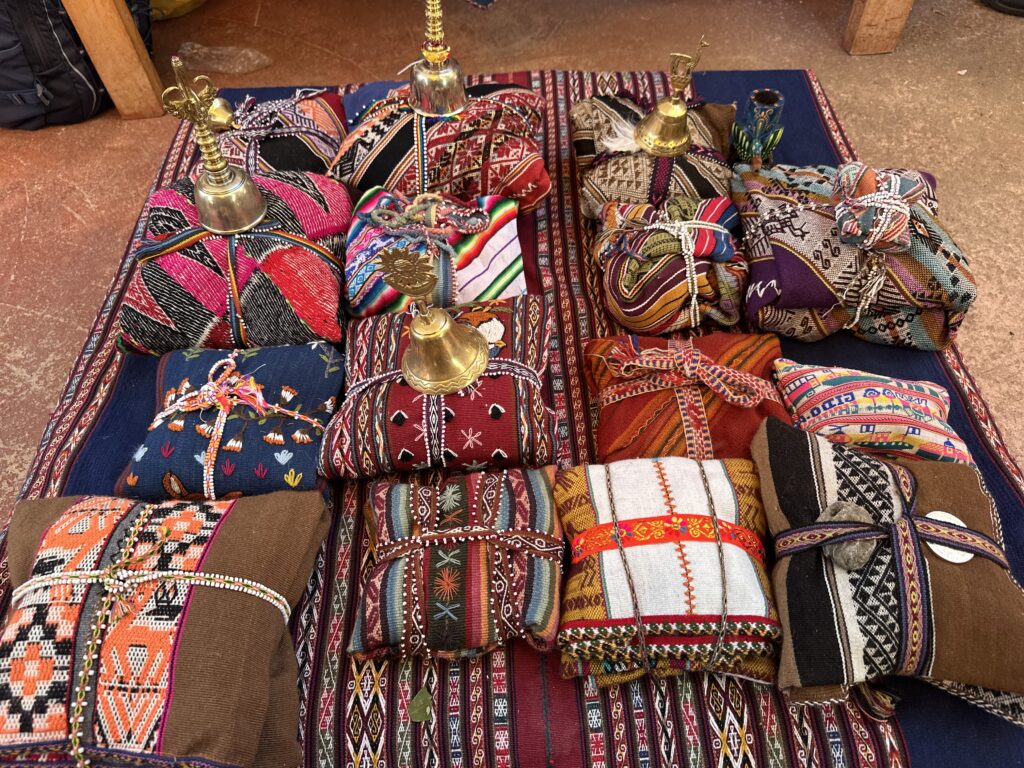
A paqo’s ritual bundle: an unkuña cloth wrapped around a set of khuyas and other objects gathered over a lifetime. The mesa is a working tool and also a kind of identity. In northern Peru mesa means something different, a wachuma healer’s altar laid out with staffs and objects. Our page What Is a Mesa? covers both.
Khuya
A sacred stone in a paqo’s mesa, received from a teacher, found on a mountain or given by a river. Khuyas are used to diagnose, cleanse and carry the protection of an Apu. Polished, shaped stones sold as “chumpi stones” are modern usage.
Coca (k’uka)
The sacred leaf of the Andes, chewed for altitude and hunger, offered in every ceremony and read as an oracle. Coca leaf is not cocaine, any more than grapes are brandy. Chewing it is legal in Peru. Taking leaves home is not legal in most countries.
K’intu
Three perfect coca leaves, stacked and held between thumb and forefinger, offered with a breath. The smallest complete offering in Andean practice. You choose unbroken leaves deliberately; the choosing is part of the prayer.
Ch’uspa
The small woven bag in which coca is carried. Offering someone coca from your ch’uspa is a greeting, an opening and a sign of trust.
Unkuña
A small square woven cloth, used to carry coca, wrap a mesa or lay out a coca reading. Weavers in Chinchero still make them with traditional designs.
Q’aytu
Spun wool thread, often in bright colours, used in despachos and healing. Coloured threads may stand for particular intentions or for the rainbow.
Untu
Llama or alpaca fat, a valued offering ingredient. To the land it is food: rich, warm and given generously.
Misterios
Small figures of sugar or tin (a house, a car, a couple, a heart) placed in despachos to stand for what is being asked for. More common around Puno and La Paz, increasingly seen in Cusco.
Chicha
Maize beer, brewed in homes across the highlands. A red flag or a bunch of flowers on a pole outside a door means chicha is for sale. Before you drink, a few drops go to the earth.
Huayruro
A bright red and black seed from the Amazonian lowlands, worn as a bracelet or carried in a pocket for protection and luck. You will see it on babies’ wrists in Cusco markets.
Agua florida
Florida water: a perfumed cologne used in both Andean and Amazonian ceremony. It is blown or sprinkled to cleanse, and sometimes rubbed into the hands and crown.
Chumpi
A handwoven belt. In weddings the chumpi binds the couple’s hands, a ceremonial reading we describe honestly as contemporary in our article on Andean wedding traditions. The textile itself is entirely traditional.
Ceremonies, Gestures and Festivals
Not every ritual is long. Some last the length of a breath.
Phukuy
Blowing: the breath carried across a k’intu, into a despacho or over a person. Breath carries intention. A paqo’s prayer is made of phukuy as much as of words.
Ch’alla
Sprinkling a drink (chicha, wine, cane alcohol) on the earth, a house, a vehicle or a new venture, as an offering. At a wedding the ch’alla closes the ceremony.
T’inka
A similar offering of drink, flicked with the fingers towards the Apus and Pachamama before drinking. Usage overlaps with ch’alla and differs by region.
Coca leaf reading (k’uka qhaway)
Divination by coca leaves, literally “looking at the coca”. The paqo drops leaves onto an unkuña and reads their position, face and orientation. It is diagnosis and advice, not fortune-telling. More in coca leaf reading meaning, or book a coca leaf reading in Cusco.

Limpia
Cleansing. The paqo passes something over the body to draw out hucha or illness: flowers, a candle, an egg, a stone, a guinea pig (soba de cuy), sometimes llama fat. It belongs to traditional healing. It is not a substitute for medical treatment.
Florecimiento
“Flowering”: a bath or rinse with flowers, florida water and herbs, given after a limpia or before a new start. Common in both Andean and Amazonian practice.
Kasarakuy
The Quechua word for marrying, built from the Spanish casar plus a Quechua ending. The hybrid form tells its own story: the single binding wedding ceremony arrived with the Church. See our Andean wedding ceremony.
Sirvinakuy
A period of living together before formal marriage, from a few months to a few years. The colonial Church fought it for two centuries. Many highland families still treat it as normal.
Taki
Song, with music and dance as one act. In the 1560s a resistance movement around Huamanga called the Taki Onqoy, the “dancing sickness”, urged people to return to the huacas. In ceremony today, taki is the sung prayer that accompanies an offering.
Pututu
A conch-shell trumpet blown to open ceremony, call the Apus and gather people. Shells from the coast reached the highlands through long trade routes, which is part of their value.
Pachamama Raymi
The festival of the Earth Mother, centred on 1 August and lasting through the month. Families feed the earth, cleanse their homes and drink a protective infusion. Our offering to Pachamama runs year-round, but August is when the whole region joins in.
Inti Raymi
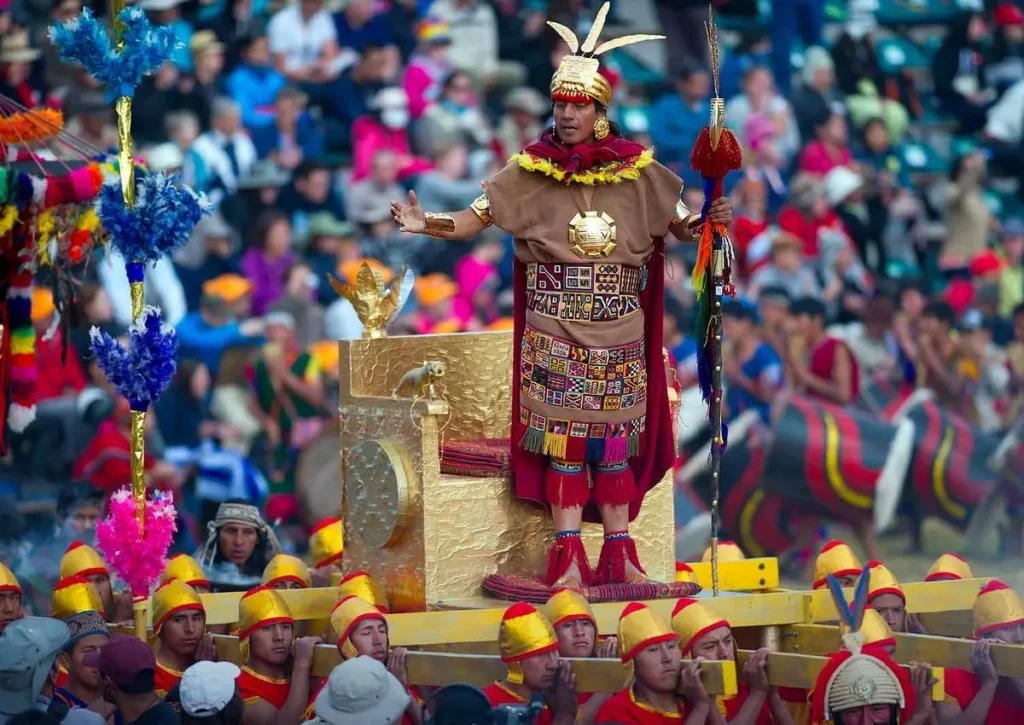
The Festival of the Sun at the June solstice, staged on 24 June at Sacsayhuamán. The modern staging dates from 1944 and draws on colonial-era descriptions. It is spectacular, and it is theatre built on history. Our page on Inti Raymi has the details.
Qoyllur Rit’i
“Snow star.” A pilgrimage of tens of thousands to the Sinakara valley under Ausangate, held in late May or June in the week before Corpus Christi. It joins Catholic devotion with older mountain worship, and was added to UNESCO’s Representative List in 2011. Our article on the Snow Star pilgrimage describes the event.
Ukuku
The bear-dancers of Qoyllur Rit’i, masked figures in shaggy dark costumes who keep order, joke and climb towards the glacier. Their ascent is the most famous image of the pilgrimage.
Plant Medicine Vocabulary: Andean and Amazonian
Cusco sits between two traditions. Wachuma is Andean; ayahuasca comes from the Amazon. Their vocabularies get mixed in tourist marketing, and keeping them apart is a good test of whether a provider knows what they are doing.
A note on safety. Both plant medicines below have real physical and psychological risks and serious interactions with some medications, including many antidepressants. Talk to your doctor before booking, be honest in any medical screening, and read our guides to who should not drink ayahuasca and ayahuasca risks. Participation is always your informed decision.
Wachuma (huachuma, San Pedro)
A columnar cactus of the Andes (Echinopsis pachanoi), containing mescaline. A carved figure holding the cactus at Chavín de Huántar suggests a ceremonial history of roughly three thousand years. In ceremony it is taken during the day, often walking in the landscape. Read what is wachuma, its legal status in Peru, and our San Pedro ceremony in Cusco.

Ayahuasca
Quechua for “vine of the souls” or “vine of the dead”: an Amazonian brew of the Banisteriopsis caapi vine, usually with chacruna leaves. The vine contains MAO inhibitors that make the DMT in chacruna active, and the same mechanism is behind its dangerous interactions with antidepressants and other serotonergic drugs. Peru declared its traditional use part of the national cultural heritage in 2008 (see the Ministry of Culture). Start with what is ayahuasca.

Chacruna
Psychotria viridis, the leaf that supplies DMT in most ayahuasca brews. Some traditions use other plants instead.
Icaro
A healing song sung or whistled by an Amazonian curandero during an ayahuasca ceremony. Icaros are learned from teachers and, in the tradition’s own terms, from the plants. They are not Andean, and a wachuma ceremony in Cusco uses different songs.
Dieta
Two senses. Before any ceremony, the dieta is a period of avoiding salt, pork, alcohol, sex and certain medications. In the Amazon, a dieta also means a long, isolated apprenticeship with one master plant. Our ayahuasca diet guide covers the first.
Mareación
From the Spanish marear, to make dizzy: the curanderos’ word for the altered state itself, its waves and its visions.
Purga
The purge: vomiting, sometimes diarrhoea, tears or yawning. In the tradition it is cleansing, not a side effect to be ashamed of. Every participant gets a bucket.
Integration
Not a Quechua word, but you will hear it constantly. Integration is the work after a ceremony of making sense of it and changing something real in daily life. Read life after ayahuasca and wachuma integration.
Words That Get Misused (and What to Say Instead)
Part of respecting a tradition is not putting words in its mouth. A few that come up constantly in Cusco:
- “Shaman.” The word comes from Siberia, via Russian, and reached the Andes through anthropology and tourism. It is a convenient English shorthand, and we use it on this site because travellers search for it. In conversation, paqo, maestro or curandero will be understood and appreciated.
- “Inca shamanism.” The Inca state had a priesthood serving the Sun, and it was dismantled after the conquest. What survives in communities is older and more local than the Inca, and has been changed by five centuries of Catholicism. Calling it Inca is flattering and mostly inaccurate.
- “Munay-Ki.” A set of nine rites popularised in the 2000s by a US-based school. It borrows Andean words and ideas, but it is not a ceremony practised in Andean communities. If someone offers it to you in Cusco, they are offering a modern product, which may or may not interest you. It should be labelled as one.
- “Pachamama ceremony” as a catch-all. Ask what it actually is. A despacho, a limpia and a coca reading are three different things, and a provider who cannot tell you which one you are booking probably does not know.
- “Ayahuasca is Andean.” It is not. It comes from the Amazon, and its use in Cusco is relatively recent. That does not make a Cusco ceremony illegitimate, but the honest version is “an Amazonian medicine, served in the Andes”.
Andean Spiritual Terms: Frequently Asked Questions
What are the most important Andean spiritual terms to know before a ceremony?
Pachamama, Apu, ayni, paqo, despacho, k’intu and phukuy. With those seven you will follow the structure of almost any Andean ceremony in Cusco.
What does ayni mean in simple words?
Ayni means reciprocity: what you receive, you give back. It began as a labour exchange between families and extends in ritual to the earth and the mountains, which feed people and are fed in return.
What is the difference between a paqo and a shaman?
Paqo is the Quechua word for an Andean ritual specialist who makes offerings, reads coca and heals. Shaman is a Siberian word used in English as a general label. Most paqos do not call themselves shamans.
What is the difference between a pampamisayoq and an altomisayoq?
A pampamisayoq works mainly with Pachamama through offerings and coca reading. An altomisayoq is understood to communicate directly with the Apus and is much rarer. Both titles and their meanings vary between communities.
Is the chakana an ancient Inca symbol?
The stepped cross motif is ancient and pre-dates the Incas. Much of the detailed symbolism attached to it today is a modern interpretation.
Are Hanan Pacha and Ukhu Pacha heaven and hell?
No. Hanan Pacha is the upper world and Ukhu Pacha the inner world of seeds, water and ancestors. The heaven-and-hell translation came from colonial priests and distorts both.
Is coca the same as cocaine?
No. Coca leaf is a mild stimulant chewed or brewed as tea across the Andes, and it is legal in Peru. Cocaine is a chemical extract. Do not take leaves out of Peru, because most countries prohibit them.
Are wachuma and ayahuasca both Andean?
Wachuma (San Pedro) is Andean. Ayahuasca is Amazonian and is served in Cusco but not native to it. Both carry medical risks, so talk to a doctor first.
How do you pronounce Quechua words like k’intu or ch’alla?
The apostrophe marks a short catch in the throat after the consonant. Say k’intu roughly as “k-INN-too” with a clipped first sound, and ch’alla as “CH-AH-ya”.
Can visitors take part in Andean ceremonies respectfully?
Yes. Most paqos welcome sincere participants. Ask before photographing, follow the officiant’s lead, bring coca to share if you can, and choose providers who name the community their maestros come from.
From Words to Practice
A glossary will get you through the first prayer. The rest is learned the way it has always been learned here: by sitting down, choosing three good leaves and listening.
If you want to see these words in use, our ceremonies in Cusco are led by maestros from Chinchero, where our family has worked since 2013. The Chinchero guide is a good place to understand where they come from. Ask us anything before you book. If we do not know the answer, we will say so.
A despacho offering laid out on white paper in the Sacred Valley, with the Andean spiritual terms for each element Alt text: A despacho offering on white paper in the Sacred Valley, showing the coca, seeds and wool described among these Andean spiritual terms